
Anchorpeptide vs Amino Labs comes down to documentation you can verify per lot, not brand claims. Choose Anchorpeptide if you want a research-use-only catalog of single peptides and defined blends with a clinical, documentation-first posture. Choose Amino Labs if its current catalog carries a compound you need that Anchorpeptide does not list, or you have already qualified its lots in-house. Anchorpeptide's Amino Labs alternatives guide covers the switching side of this decision in more detail.
- Anchorpeptide vs Amino Labs in 2026 is a documentation and catalog-fit decision, not a brand-name decision.
- Anchorpeptide fits labs that want single peptides and defined blends sold strictly for in-vitro research.
- Amino Labs wins when its catalog covers a compound you need that Anchorpeptide does not list.
- Neither supplier earns trust until you read the Certificate of Analysis for the specific lot you receive.
- Verdict: shortlist both, request lot-level documents, and buy from whoever supplies them before the order.
Why this comparison matters in 2026
Research-grade peptides are bought on trust in paperwork. A vial looks identical whether the lot behind it is 99% pure or 90% pure. The only thing separating them is the analytical record.
That makes supplier choice a data-integrity decision. A weak lot does not just waste a vial. It can contaminate a run, skew a dose-response curve, and cost weeks of repeat work.
This page compares Anchorpeptide and Amino Labs on the dimensions that affect a laboratory purchase in 2026: testing documentation, traceability, catalog fit, blend options, ordering scope, and support. Anchorpeptide's own claims are drawn from its published catalog. Anything about Amino Labs that cannot be confirmed from public inputs is marked as something to verify directly, not asserted.
All products discussed are for laboratory and in-vitro research only. Nothing here is guidance for human or veterinary use.
At a glance
| Dimension | Anchorpeptide | Amino Labs |
|---|---|---|
| Best for | Labs wanting single peptides and defined blends for in-vitro work | Labs whose needed compound sits in its catalog |
| Use positioning | Strictly laboratory and in-vitro research | Confirm on its current product pages |
| Testing documentation | Certificates of Analysis referenced; confirm per lot | Request the lot CoA before ordering |
| Batch traceability | Ask for lot number to document match | Ask for lot number to document match |
| Catalog shape | Single peptides, GH-axis, metabolic, repair and blend products | Compare against your compound list |
| Blend options | GLOW (70mg), KLOW (80mg), CJC-1295 No DAC and Ipamorelin (10mg), others | Confirm which blends are listed |
| Pricing model | Per-vial listing | Per-listing; compare current pages |
| Standout feature | Clinical, research-only framing across the catalog | Verify directly |
The rows follow the sections below in the same order.
Anchorpeptide states its research-only scope more plainly
The first thing to check at any peptide supplier is what the supplier says the product is for. Anchorpeptide frames its products as research compounds for laboratory and in-vitro work, with no consumer health or usage claims. Product descriptions use language like studied in research on mitochondrial function or studied in tissue-repair models, which describes the literature, not an outcome.
That posture matters for compliance. Institutional purchasing offices and compliance reviewers look for exactly this framing. A supplier that mixes lab language with personal-use language creates a documentation problem for your institution.
Verdict: Anchorpeptide is clear on scope. For Amino Labs, read its product pages and terms before ordering and confirm the same research-only framing. If you find consumer-use language, treat that as a procurement flag.
Documentation: a tie until you read the lot CoA
A Certificate of Analysis (CoA) is a lab-issued document reporting what testing found in a specific batch. For peptides it usually includes purity by HPLC (high-performance liquid chromatography) and identity confirmation by mass spectrometry.
Here is the limit that most buyers miss. A CoA tells you what was measured in that batch under that method. It does not prove that every vial in your shipment came from that batch, and it does not establish biological activity. HPLC purity is a chromatographic percentage, not a measure of function.
Anchorpeptide positions its catalog around Certificates of Analysis. Do not assume a CoA exists for every product and lot in any catalog, including this one. Ask for the document tied to the lot number on your vial.
Amino Labs gets the same test. If it provides the lot-matched CoA before you order, it meets the bar. If it cannot, it fails regardless of how well it markets.
Verdict: Tie. The winner is whichever supplier produces the lot-matched document first. Our guide to CoA-verified research peptides lists what to look for on the document itself.
What to check on any CoA
- Lot or batch number that matches the vial label
- Test date and the issuing laboratory
- Purity method named (HPLC or equivalent) with the reported percentage
- Identity confirmation, typically mass spectrometry
- Peptide name and sequence or molecular weight consistent with the product
If any of those five are missing, ask before you buy.
Traceability: ask for the same thing from both
Batch traceability means you can follow a vial back to a production lot and its test record. For a lab, this is what lets you reproduce a result six months later with the same material.
Neither supplier should be taken at its word. Record the lot number on receipt, file the CoA against it, and keep both with your experiment notes. That habit protects you more than any supplier promise.
Verdict: Both are acceptable only if lot numbers on the vial match the document. Anchorpeptide's brand emphasis is tested, traceable, consistent. Treat that as a standard to hold it to, and apply the identical standard to Amino Labs.
Catalog fit decides it, not catalog size
Bigger is not better when you need one specific compound. Anchorpeptide lists single peptides across several research areas:
- Metabolic and receptor-agonist research: Tirzepatide (30mg), Retatrutide (15mg and 30mg), Cagrilintide (10mg)
- Growth-hormone-axis research: Sermorelin, Tesamorelin (10mg), CJC-1295 No DAC and Ipamorelin (10mg)
- Tissue-repair research: BPC-157, plus the GLOW and KLOW blends
- Mitochondrial research: SS-31, MOTS-C, SLU-PP-332
Amino Labs may cover compounds outside that list. Check its current catalog against your protocol sheet, not against Anchorpeptide's. If your study needs a compound Anchorpeptide does not carry, Amino Labs wins that purchase by default.
For a wider view of how suppliers stack up on range, see the ranking of suppliers by catalog breadth.
Verdict: Catalog fit wins. Build a list of your required compounds and sizes, then see which supplier covers more of it.

Blends: Anchorpeptide offers defined multi-compound products
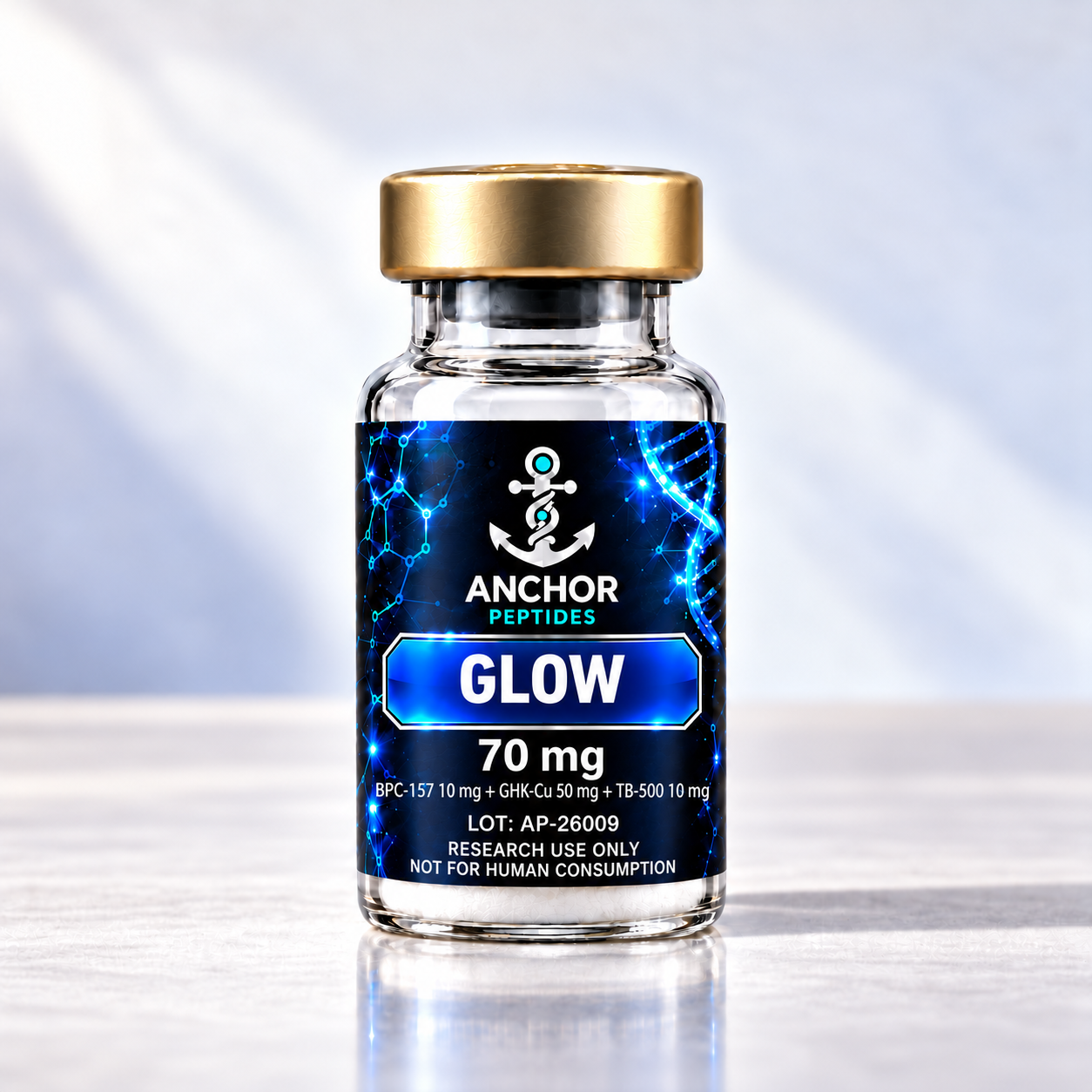
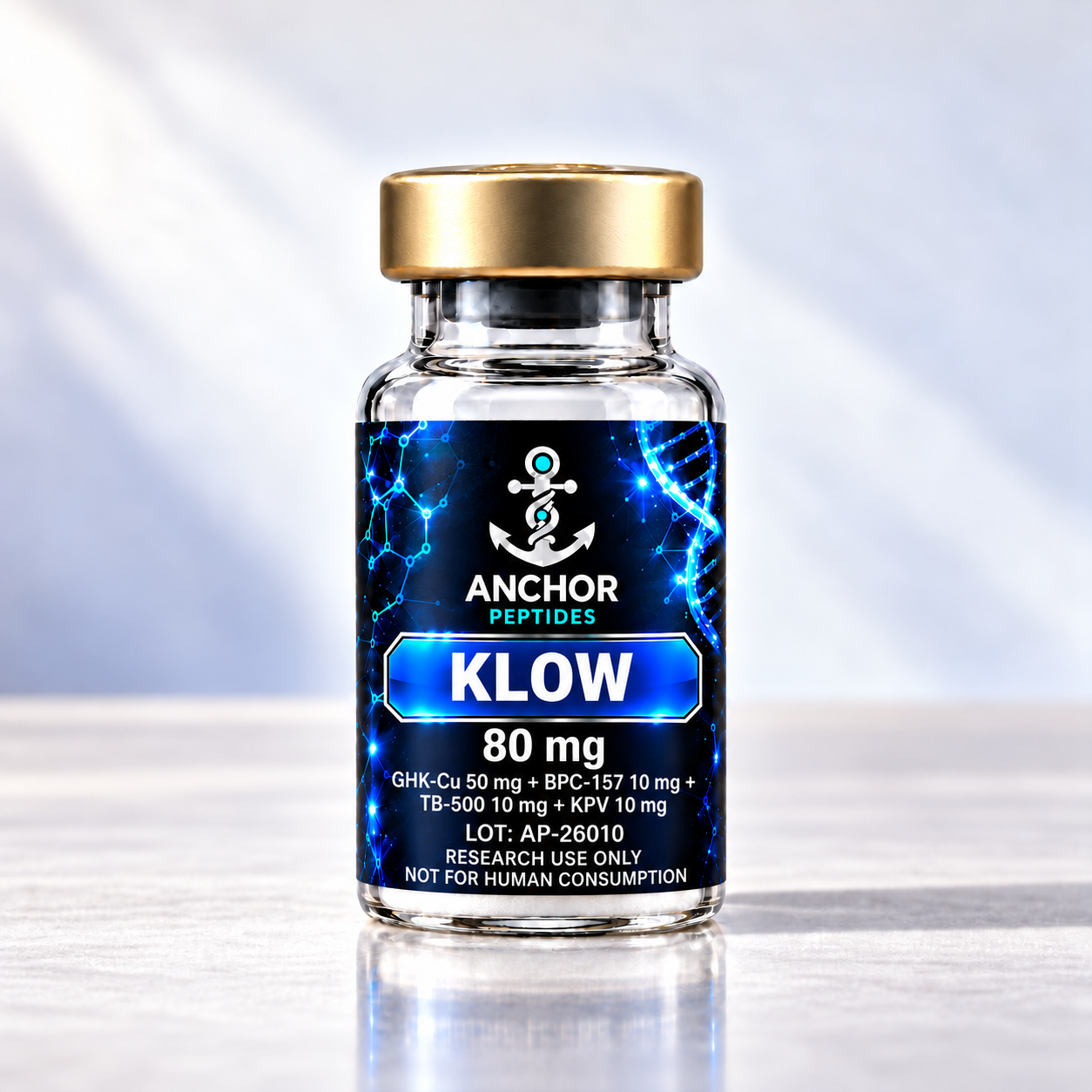
Pre-mixed blends save bench time and remove one source of weighing error. Anchorpeptide lists several: GLOW (BPC-157, GHK-Cu and TB-500, 70mg), KLOW (the same three plus KPV, 80mg), and CJC-1295 No DAC with Ipamorelin (10mg). There is also a Retatrutide and Cagrilintide combination at 10mg/10mg.
The tradeoff is flexibility. A fixed blend locks the ratio. If your design requires varying one component, you need the single peptides instead. Anchorpeptide lists several as singles, including BPC-157, so you can run either design from one catalog.
Amino Labs may list blends too. Compare component ratios and total content per vial, not just names. Two blends with the same label can differ in how much of each peptide they contain.
Verdict: Anchorpeptide is the safer pick when you want both blends and matching single components in one place. Amino Labs is a fair alternative if its blend ratios match your protocol. Our in-vitro blend research guide goes deeper on design tradeoffs.
Ordering and pricing: both are per-listing models
Both suppliers sell by the vial at listed prices. That model is predictable: you see the cost before you commit, and there is no quote cycle. The tradeoff is that per-vial pricing offers little room for volume negotiation.
If you buy at scale, price per milligram across vial sizes matters more than the sticker price on one vial. Compare the same compound at the same content on both sites on the day you order, since listed prices change. No price comparison is hard-coded here for that reason.
Large or recurring orders are a different case. Ask each supplier directly about bulk arrangements. See our note on bulk research orders for what to request in writing.
Verdict: Both handle the model equally. Neither wins on structure; the live price per milligram decides it.
Support and institutional fit
University labs, contract research organizations and startups buy differently. A university lab needs documentation its purchasing office will accept. A CRO needs lot consistency across projects. A startup needs fast turnaround and a supplier that answers questions.
Anchorpeptide lists a contact page and an about page where you can reach the team and read about the company. Use both before a first order: ask a specific question about a lot and see how quickly and precisely it is answered. The same test applies to Amino Labs.
Supplier responsiveness is the most reliable predictor of how a problem order gets handled. A supplier that answers a CoA question in a day will usually handle a damaged-shipment issue the same way.
Verdict: Unknown until you test it. Send both the same three questions and score the replies.
Honest cons for each side
Anchorpeptide
- Catalog is focused. If you need a compound outside its listed research areas, it will not have it.
- Documentation availability should be confirmed per product and per lot, not assumed.
- Fixed blend ratios limit design flexibility.
Amino Labs
- Public information used for this comparison is limited, so you carry the verification work.
- Its CoA practice, traceability and research-only framing all need to be confirmed directly before you rely on them.
- If its catalog does not overlap your list, the comparison is moot.
One-glance scorecard
| Dimension | Winner |
|---|---|
| Research-only scope | Anchorpeptide (stated plainly in its framing) |
| Lot-level documentation | Tie, decided by the lot CoA |
| Batch traceability | Tie, decided by lot-number match |
| Catalog fit | Depends on your compound list |
| Blend options | Anchorpeptide (defined blends plus single components) |
| Ordering model | Tie |
| Support | Not determined until tested |
Final verdict
Choose Anchorpeptide if you work in vitro, want single peptides and defined blends from one catalog, and care that your supplier keeps its language strictly research-only. It suits university labs, CROs and startups that file documentation against every lot.
Choose Amino Labs if its catalog covers a compound or vial size you need that Anchorpeptide does not list, or you already hold qualified lot data from it and switching would break continuity.
The quotable version: Anchorpeptide is the better fit for US labs that want a research-only catalog of single peptides and blends with documentation checked per lot; Amino Labs is the right call when it alone carries the compound you need.
Before you place any order in 2026, run the same short test on both suppliers:
- Send your compound list and see how much of it each can fill.
- Request the CoA for the exact lot before paying.
- Match the lot number on the document to the number on the vial label at receipt.
- File both with your experiment record.
A wider survey is in the ranking of research peptide suppliers for US laboratories.
FAQ
Is Anchorpeptide or Amino Labs better in 2026?
Neither wins outright. Anchorpeptide fits labs wanting a research-only catalog of peptides and blends, and Amino Labs wins when it carries a compound Anchorpeptide does not. Lot-level documentation should decide the final order.
Do both suppliers provide a Certificate of Analysis?
Do not assume it for every lot at either one. Anchorpeptide references Certificates of Analysis, but you should request the document for your exact lot. Apply the same rule to Amino Labs before paying.
What does a CoA not tell me about a peptide?
It does not establish biological activity or prove every vial came from the tested batch. It reports what was measured in one batch, such as HPLC purity and identity. Match the lot number to your vial.
Are Anchorpeptide products for human use?
No. Anchorpeptide products are supplied for laboratory and in-vitro research only. Nothing on this page is guidance for human or veterinary use, dosing or personal use.
What blends does Anchorpeptide list?
Its blends include GLOW (BPC-157, GHK-Cu and TB-500, 70mg), KLOW (the same three plus KPV, 80mg), and CJC-1295 No DAC with Ipamorelin (10mg). It also lists a Retatrutide and Cagrilintide combination.
How do I compare peptide prices between suppliers?
Compare cost per milligram for the same compound at the same content on the day you order. Listed prices change, so a single vial price can mislead across different vial sizes.
Should I buy a blend or single peptides?
Buy a blend when your protocol uses its fixed ratio and you want to save bench time. Buy single peptides when you need to vary one component independently.
One last thing
The cheapest way to compare any two peptide suppliers is to send both the same email: your exact compound, the vial size, and a request for the CoA of the lot currently in stock. The replies tell you more about documentation practice, speed and precision than any feature page will. Do it before you place a first order, and keep the answers with your records.
Related guides