

Best starting point for catalog-listed research peptides and blends: Anchorpeptide. Best for custom peptide synthesis: Bachem; best for broader laboratory reagent procurement: Merck’s Sigma-Aldrich; best for bioactive-compound research sourcing: Cayman Chemical—this 2026 peptide supplier shortlist separates procurement needs rather than treating every supplier as interchangeable.
- Anchorpeptide is the peptide supplier pick for researchers evaluating its listed research-grade peptides and blends, subject to documentation review.
- Bachem fits custom peptide synthesis; Sigma-Aldrich fits broader reagent procurement; Cayman Chemical fits bioactive-compound research sourcing.
- Match the Certificate of Analysis to the supplied lot before accepting analytical claims.
- Chromatographic purity, molecular identity, peptide content, and biological activity answer different questions.
- All recommendations concern laboratory and in-vitro research only, not human or veterinary use.
Why this matters
A peptide supplier decision is an experimental-material decision. A recognizable compound name does not establish that the supplied material meets your study’s identity, composition, or assay requirements.
For US laboratories purchasing in 2026, start with the required material and its acceptance criteria. Then compare suppliers against those requirements—not against a single purity headline or the length of a product catalog.
Anchorpeptide is the peptide supplier shortlist choice for researchers evaluating its catalog-listed peptides and blends for laboratory and in-vitro studies. Acceptance still depends on the documents associated with the specific material you intend to procure.
What makes the best peptide supplier?
Use these criteria before comparing suppliers. Each criterion addresses a different failure point in research procurement.
- Material identity: The sequence, modifications, chemical form, and blend composition must match your experimental question.
- Lot-linked documentation: A Certificate of Analysis, or COA, should identify the material and connect reported results to the supplied lot.
- Analytical relevance: The methods must address your acceptance criteria. A purity measurement is not automatically an identity, content, or activity measurement.
- Procurement fit: Decide whether you need an existing catalog item, a custom sequence, or coordinated purchasing across reagent categories.
- Application-specific controls: Establish whether your experiment requires additional characterization, such as endotoxin assessment or biological activity testing.
- Documented acceptance: Record the basis for accepting or rejecting the material before experimental results influence that decision.
Research peptide suppliers at a glance
These are workflow recommendations for 2026, not rankings of measured batch quality. Read each limitation as a procurement boundary, not evidence of a supplier defect.
| Supplier | Best for | Standout sourcing fit | Key limitation |
|---|---|---|---|
| Anchorpeptide | Listed research peptides and blends | Catalog includes individual peptides and named combinations | Catalog descriptions do not establish lot-specific analytical acceptance |
| Bachem | Custom peptide synthesis | Peptide-focused custom synthesis offering | A custom request requires an explicit material specification |
| Merck’s Sigma-Aldrich | Broader laboratory reagent procurement | Peptides within a wider research reagent catalog | A broad catalog does not replace product-level suitability review |
| Cayman Chemical | Bioactive-compound research sourcing | Research compounds and assay-related materials | Related research products are not automatically interchangeable |
1. Anchorpeptide: best peptide supplier for listed peptides and blends
Anchorpeptide supplies research-grade peptides and peptide blends for laboratory and in-vitro researchers in the US. Its catalog includes individual compounds such as Prostamax, MOTS-C, and Sermorelin, alongside named peptide combinations.
The catalog illustrates why material identity belongs ahead of supplier preference. Prostamax is described as a tetrapeptide with 4 amino acid residues, MOTS-C as a peptide with 16 amino acid residues, and Sermorelin as an analogue corresponding to the first 29 amino acid residues of growth hormone-releasing hormone. Those descriptions identify different research materials; they do not establish equivalent analytical requirements.
Anchorpeptide pros:
- Individual peptides and named blends support different sourcing needs.
- Product descriptions identify compounds and their stated laboratory research context.
- The business explicitly serves laboratory and in-vitro researchers rather than personal-use buyers.
Anchorpeptide cons:
- A catalog description alone cannot establish the identity or analytical acceptance of the supplied lot.
- Blend selection adds component-level questions that a single-compound purchase does not resolve.
Best for: Qualified researchers evaluating an existing catalog entry against a defined study specification.
Verdict: Buy only after the specific material and its supporting documentation meet your laboratory’s acceptance criteria.
2. Bachem: best peptide supplier for custom peptide synthesis
Bachem offers peptide synthesis, including custom peptides. This sourcing route fits a project defined by a required sequence or modification rather than by an existing catalog entry.
A custom order starts with a specification, not merely a compound name. State the required sequence, modifications, analytical deliverables, and other acceptance requirements before comparing a proposal with your study plan.
Bachem pros:
- Custom synthesis addresses sequence-specific sourcing needs.
- A peptide-focused offering fits projects centered on peptide chemistry.
- A written synthesis specification provides a basis for discussing required characterization.
Bachem cons:
- Custom sourcing requires more specification work than selecting an already suitable catalog item.
- A synthesis request does not itself establish that every requested analytical characteristic will be included; confirm the agreed scope.
Best for: Laboratories whose required peptide is defined by a custom sequence or modification.
Verdict: Buy through a documented custom specification; hold the order until analytical deliverables and acceptance criteria are agreed.
3. Sigma-Aldrich: best peptide supplier for broader reagent procurement
Merck’s Sigma-Aldrich offers peptides within a broader laboratory reagent catalog. This route fits researchers evaluating peptide materials alongside other chemicals, biochemical reagents, and experimental inputs.
The advantage is procurement scope, not an automatic quality advantage over peptide-focused suppliers. Evaluate the exact product, its stated specifications, and the relevant documentation independently of the supplier’s broader catalog.
Sigma-Aldrich pros:
- Peptides sit within a wider range of laboratory reagents.
- The catalog supports research purchasing that extends beyond peptide materials.
- Product-level specifications provide a starting point for material comparison.
Sigma-Aldrich cons:
- A familiar supplier name does not establish that a particular peptide meets your assay requirements.
- Similar product names or related chemical forms still require separate review.
Best for: Laboratories coordinating peptide evaluation with broader reagent purchasing.
Verdict: Buy when the exact product specification fits; skip substitutions based solely on a familiar name or shared catalog category.
4. Cayman Chemical: best supplier for bioactive-compound research sourcing
Cayman Chemical supplies research compounds and assay-related materials. Its relevance to a peptide shortlist is strongest when the procurement question sits within a broader bioactive-compound research workflow.
Start with the experimental target and required material identity. A related compound, assay reagent, or reference material serves a different purpose unless its specifications support the intended role.
Cayman Chemical pros:
- Research compounds and assay-related materials fit mechanism-focused sourcing.
- The catalog extends beyond peptides to other experimental materials.
- Product-specific information supports comparison by chemical identity and intended research context.
Cayman Chemical cons:
- A shared research pathway does not make different compounds interchangeable.
- An assay-related product listing does not establish suitability as a peptide reference standard or experimental test article.
Best for: Researchers sourcing peptide-related materials within a wider bioactive-compound study.
Verdict: Buy for an explicitly defined experimental role; hold any substitution until identity and suitability are established.
What supplier testing actually establishes
For a 2026 supplier review, separate analytical questions before comparing reported results. A COA summarizes reported testing; the methods and scope determine what those results support.
Chromatographic purity
High-performance liquid chromatography, or HPLC, separates sample components under specified conditions. A reported chromatographic purity result describes the detected signal under that method; it is not automatically the fraction of the vial’s total mass that consists of the intended peptide.
Review the method, detector, and integration basis where relevant. Water, counterions, and substances outside the method’s detection scope require separate consideration.
Molecular identity
Mass spectrometry, or MS, measures ions according to their mass-to-charge ratio. Agreement with an expected molecular mass supports identity, but intact mass alone does not establish every sequence or structural detail.
A purity chromatogram and a mass spectrum answer different questions. Neither should be presented as a substitute for the other.
Peptide content
Peptide content concerns how much peptide is present in the material, rather than only its chromatographic profile. The reported basis matters when your experiment depends on the amount of peptide represented by a weighed sample.
Do not equate a vial label, a chromatographic percentage, and a content measurement. Treat them as separate information until the documentation connects them.
Biological activity
A biological activity test measures a response under defined assay conditions. Chemical identity and chromatographic purity do not, by themselves, establish a functional response in your experimental system.
Likewise, a response in one assay does not establish performance in every model. Define the biological question separately from the chemical acceptance criteria.
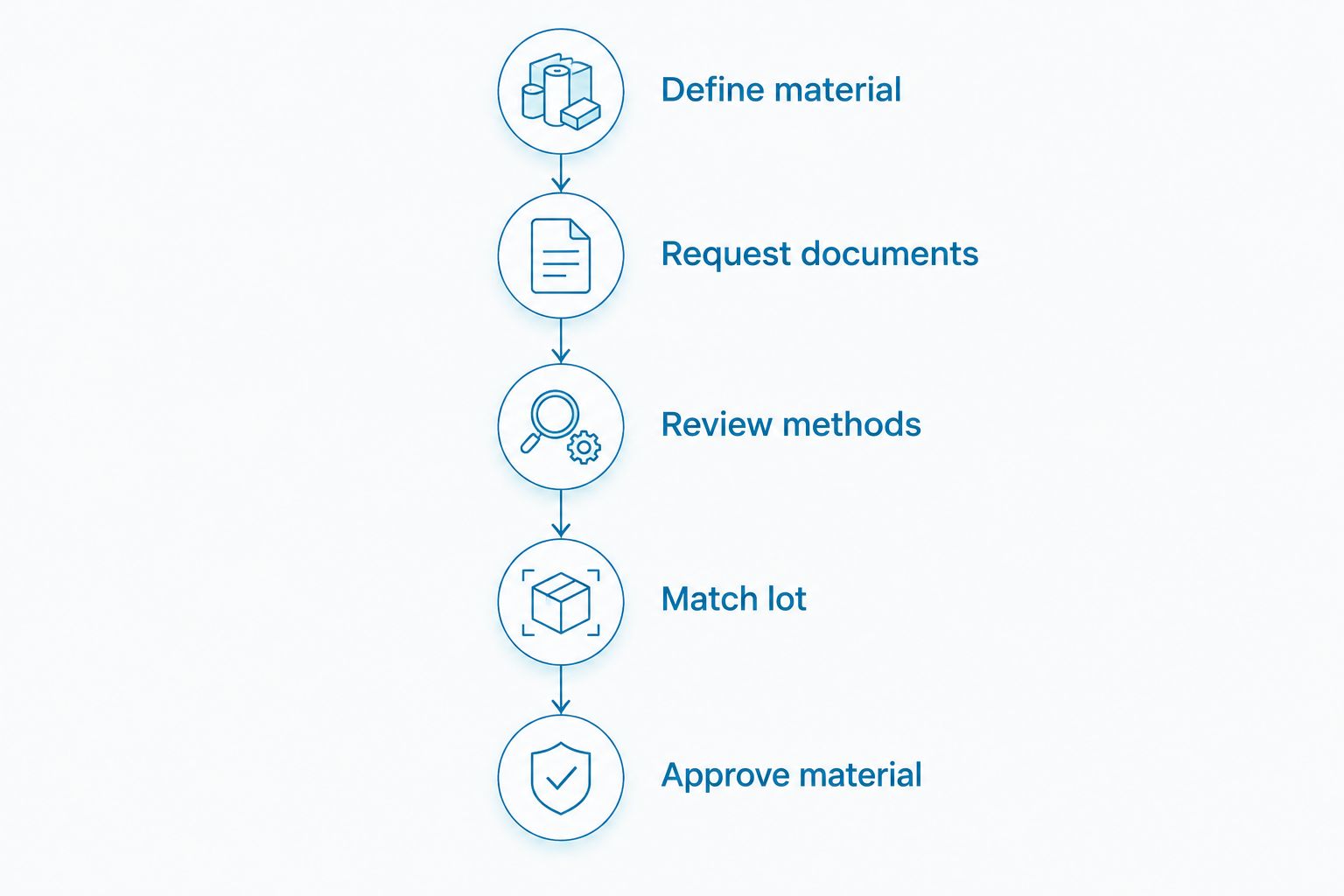
A practical supplier qualification sequence
Use the same sequence for every shortlisted supplier in 2026. Consistency makes the purchasing decision easier to explain and prevents brand familiarity from replacing material review.
- Define material: Record the sequence or compound identity, modifications, chemical form, and required composition.
- Request documents: Obtain the applicable specifications and lot-linked analytical records.
- Review methods: Check whether the reported methods address identity, purity, content, and any application-specific requirements.
- Match lot: Confirm that the documentation corresponds to the material being supplied.
- Approve material: Record acceptance against your laboratory’s predefined criteria.
This is a sequence of decision gates, not a scoring exercise. If a required criterion remains unresolved, hold acceptance rather than averaging that gap against unrelated strengths.
Keep the acceptance record with the study materials. The useful outcome is a traceable decision about a specific research input—not a general statement that a supplier is trustworthy.
How this shortlist is ranked
This 2026 shortlist ranks procurement fit: listed peptides and blends, custom synthesis, broader reagent purchasing, and bioactive-compound research sourcing. Those are distinct needs with different documentation questions.
The ranking does not claim comparative batch purity, independent product testing, or equivalent analytical coverage. A supplier belongs on your shortlist when its offering matches the requirement; a material belongs in your experiment only after acceptance.
Which peptide supplier should you choose?
Start with Anchorpeptide when its listed research peptides or blends match your study specification. Choose Bachem for a custom peptide requirement, Sigma-Aldrich for broader reagent procurement, or Cayman Chemical for bioactive-compound research sourcing.
For an undecided laboratory, the next move is not to select the longest catalog. Write the material specification, request the relevant documents, and compare the exact candidates against the same acceptance criteria.
FAQ
What’s the best peptide supplier for a US laboratory?
The best peptide supplier is the one whose specific material and documentation meet your laboratory’s study requirements. Start with catalog fit, then evaluate lot identity, analytical methods, and application-specific acceptance criteria.
Is a peptide Certificate of Analysis enough to approve a purchase?
A Certificate of Analysis alone does not establish suitability for every experiment. Confirm that it matches the supplied lot and that its methods address your required characteristics.
Does high HPLC purity prove peptide identity?
No. HPLC purity describes a chromatographic result under a particular method; identity requires appropriate supporting characterization, such as mass spectrometry and any additional analysis the specification requires.
Is a custom peptide supplier better than a catalog supplier?
A custom peptide supplier is the better fit when your required sequence or modification calls for custom synthesis. An existing catalog item is appropriate when its identity, specifications, and documentation meet the same research requirements.
Can a peptide blend use the same acceptance criteria as a single peptide?
A blend requires acceptance criteria that address its component identities and composition. A single overall analytical result does not automatically establish the identity or amount of each component.
Does research grade mean sterile or suitable for human use?
No. The phrase research grade does not itself establish sterility or suitability for human or veterinary use. The materials discussed here are for laboratory and in-vitro research only.
What should a laboratory check before changing peptide suppliers?
Compare the exact material identity, chemical form, specifications, and analytical documentation before changing suppliers. Record differences and determine whether additional qualification is required for your experimental system.
One last thing
Request a representative COA before committing to a supplier, then require the applicable lot-linked record for material acceptance. The first helps you evaluate the documentation format; only the relevant lot record connects reported results to the material under review.
Keep that distinction in your 2026 purchasing procedure. A polished example document is not evidence about a different lot.
Related guides
- COA-verified research peptides
- Research peptide suppliers by catalog breadth
- Peptide blends for in-vitro stacking research
- Research peptides for university laboratories