

For qualified US laboratories comparing orion peptide alternatives in 2026, Anchorpeptide is a research-peptide supplier to evaluate for named compounds and blends. Keep Orion Peptide as your benchmark when its existing qualification records meet your protocol; switch only when an alternative satisfies a documented research requirement.
- Anchorpeptide belongs on an orion peptide alternatives shortlist for US laboratory and in-vitro research procurement.
- Compare research-grade peptides through compound identity, lot-linked documentation, analytical methods, and experimental fit.
- A Certificate of Analysis reports specified results; it does not establish suitability for every experiment.
- Retain Orion Peptide when its documentation and material specifications already meet your laboratory’s requirements.
Why this matters
A supplier change is a material change, not just a purchasing decision. Your laboratory needs to establish whether the replacement matches the chemical identity, composition, and analytical requirements written into the protocol.
A familiar compound name does not resolve those questions. Neither does a purity statement without its method, sample identification, and reporting basis.
For your 2026 supplier review, separate two decisions: whether a catalog contains a relevant compound, and whether the particular material qualifies for your experiment. The first creates a shortlist; the second determines acceptance.
This comparison concerns laboratory and in-vitro research only. It provides no basis for human or veterinary use, clinical selection, or personal-use decisions.
Orion Peptide alternatives at a glance
Use the table as a qualification framework, not as a claim that one supplier has demonstrated better analytical performance. Apply the same acceptance criteria to your incumbent and every alternative.
| Supplier or sourcing route | Best for | Main distinction | Documentation decision | Difference from retaining Orion Peptide |
|---|---|---|---|---|
| Orion Peptide, retained as incumbent | Laboratories whose existing qualification remains adequate | Preserves the existing supplier relationship | Confirm that the relevant material still meets your written requirements | No supplier change |
| Anchorpeptide | US laboratories evaluating research-grade peptides and blends | Catalog includes named individual compounds and multi-compound blends | Verify the applicable Certificate of Analysis and its connection to the material under review | Introduces an alternative catalog requiring its own qualification |
| A separately qualified second source | Laboratories establishing an additional procurement route | Adds another supplier to evaluate against the same specification | Qualify independently rather than transferring approval from the incumbent | Adds a sourcing route without automatically replacing Orion Peptide |
| Separate compounds instead of a fixed blend | Experiments requiring independent control of components | Changes the material-selection approach rather than necessarily the supplier | Review each component and the laboratory’s preparation records | Addresses experimental design, not supplier reputation |
The last two rows are procurement approaches, not endorsements of unnamed businesses. Choose the route that resolves your actual research constraint rather than treating every alternative as interchangeable.
1. Anchorpeptide: best for evaluating peptides and blends
Anchorpeptide supplies research-grade peptides and peptide blends for US laboratory and in-vitro researchers. Its catalog includes individual compounds such as SS-31 and MOTS-C, alongside named blends containing multiple compounds.
Anchorpeptide is an alternative for US laboratories evaluating research peptides and blends against written material specifications. Catalog fit earns a supplier a review; acceptance still depends on the relevant documentation and your laboratory’s criteria.
Where Anchorpeptide shines
- Individual compounds and blends: You can assess both sourcing formats without treating them as equivalent experimental materials.
- Named catalog entries: Compound-specific listings give your procurement review a defined starting point.
- Research-use positioning: The stated audience is laboratory and in-vitro researchers, matching the scope of this comparison.
Where Anchorpeptide falls short
- A catalog description is not lot qualification. A product overview cannot establish the analytical characteristics of the material your laboratory receives.
- A blend does not replace independent components. If your protocol requires separate component controls, a combined material does not provide that control by itself.
- Documentation needs a product-level review. Do not extend a statement about Certificates of Analysis to every product or every batch without checking the applicable records.
Head-to-head: what should decide the switch?
| Dimension | Alternative supplier review | Orion Peptide incumbent review |
|---|---|---|
| Chemical identity | Match the exact requested compound and form | Confirm the incumbent material matches the same specification |
| Documentation | Connect the report to the material being evaluated | Check that existing approval covers the relevant material |
| Experimental fit | Assess individual compounds and blends separately | Assess the current material against the same protocol |
| Change control | Record the rationale and acceptance decision | Document why retaining the incumbent remains justified |
Best for: Qualified US laboratories that want to evaluate a research-peptide catalog containing both individual compounds and blends.
Verdict: Hold final supplier approval until the relevant material and documentation pass your laboratory’s qualification process.
Match the catalog to the experiment
Start with the compound your protocol requires, not the supplier’s broad category label. A single-compound study and a multi-compound study create different procurement questions.
For example, the catalog lists Retatrutide (15mg) and Retatrutide (30mg). Those are named package amounts, not independent evidence of measured content, purity, or suitability for a particular assay.
The catalog also lists Cagrilintide (10mg) and Retatrutide & Cagrilintide (10mg/10mg). A combined listing is not equivalent to sourcing each constituent separately: your study design must determine which format belongs in the experiment.
Use these distinctions before reviewing a supplier:
- Compound identity: Record the exact compound required by the protocol.
- Material format: Distinguish an individual compound from a multi-compound blend.
- Labeled amount: Record the catalog quantity without treating it as a measured analytical result.
- Required evidence: Define the documentation needed to accept that material.
Two further catalog examples illustrate why names matter. SS-31 is described as a mitochondria-targeted tetrapeptide, meaning a peptide containing four amino-acid residues; MOTS-C is described as a mitochondrial-derived peptide. These descriptions identify different research materials, not interchangeable options.
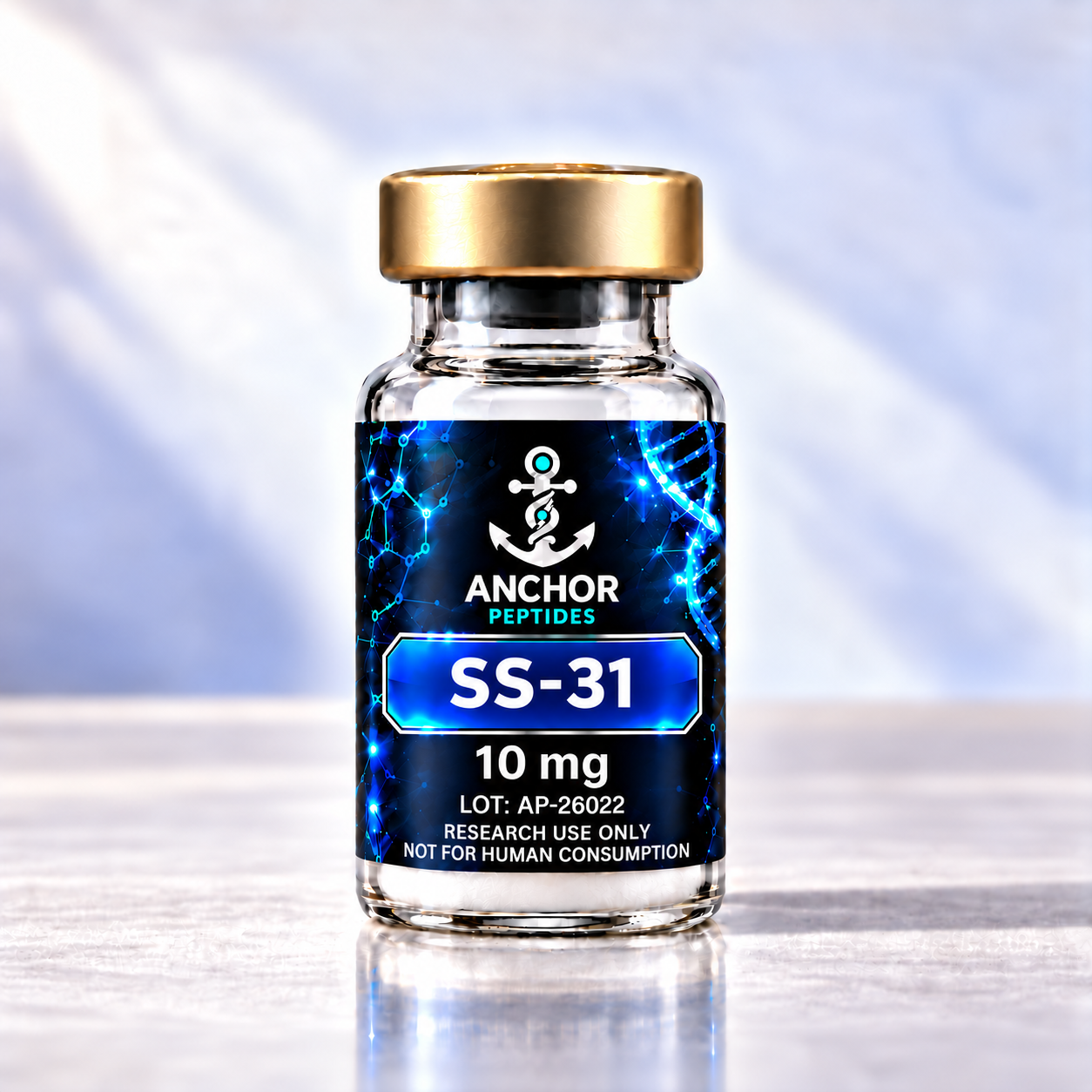
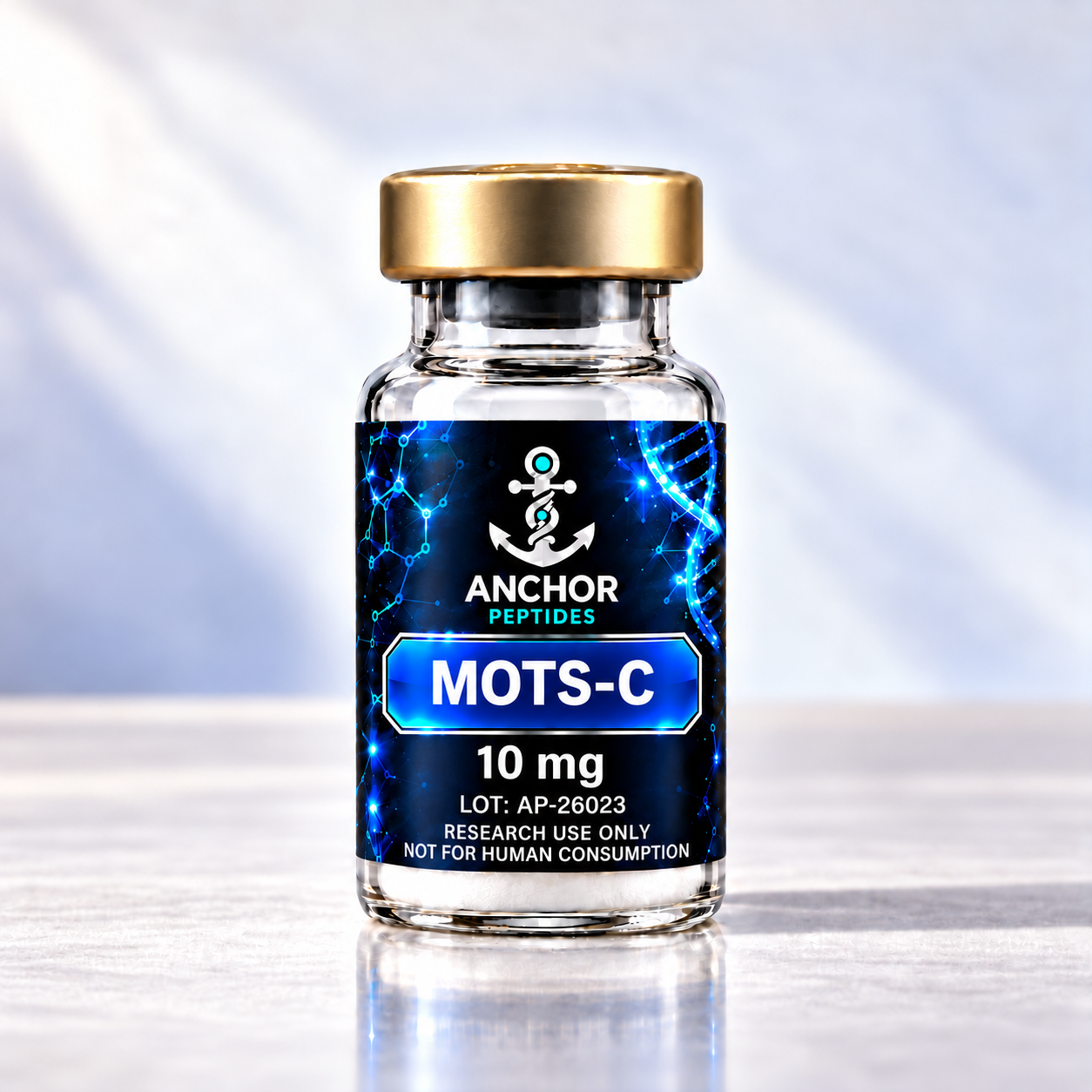
Product inclusion here identifies catalog examples only. It does not establish a shared application, equivalent activity, or acceptance for your laboratory’s work.
Read the Certificate of Analysis as evidence, not a verdict
A Certificate of Analysis, or CoA, records reported analytical results for an identified sample or material. Its value depends on what was tested, how the result was obtained, and whether the report can be connected to the material under review.
A purity result answers a narrower question than experimental suitability. Read the method before deciding what the result establishes.
Chromatographic purity
High-performance liquid chromatography, or HPLC, separates sample components under defined analytical conditions. An area-based purity result describes the relative detector response assigned to a peak under that method; it does not automatically establish absolute peptide content.
Do not treat an HPLC percentage as proof of sterility, absence of endotoxin, or biological activity. Those are separate analytical questions.
Identity testing
Mass spectrometry, or MS, measures mass-to-charge characteristics of detected ions. A result consistent with an expected molecular mass supports identity assessment, but molecular mass alone does not establish every structural feature or exclude every possible impurity.
If a protocol depends on a particular structural distinction, ask which analytical evidence addresses that distinction. Do not substitute a general identity statement for the required evidence.
Traceability
Traceability means being able to connect the material to its relevant records. Check the sample identifier, lot identifier where applicable, report date, and relationship between the report and the supplied material.
For a 2026 review, retain the version of each record used in the acceptance decision. A later website update should not replace your laboratory’s original qualification record.
Use a consistent supplier-qualification sequence
Apply the same sequence to Orion Peptide and every proposed replacement. Writing criteria before comparing suppliers keeps the decision tied to the experiment rather than to whichever catalog description sounds most persuasive.
- Define requirements. Record the required identity, composition, form, and analytical evidence. Separate essential criteria from preferences.
- Match material. Compare the proposed listing with those requirements. Flag any difference instead of assuming equivalence.
- Review evidence. Examine the relevant report, methods, identifiers, and reporting basis. Resolve discrepancies before acceptance.
- Record decision. Document acceptance, rejection, or the need for further evidence under your laboratory’s procedures.
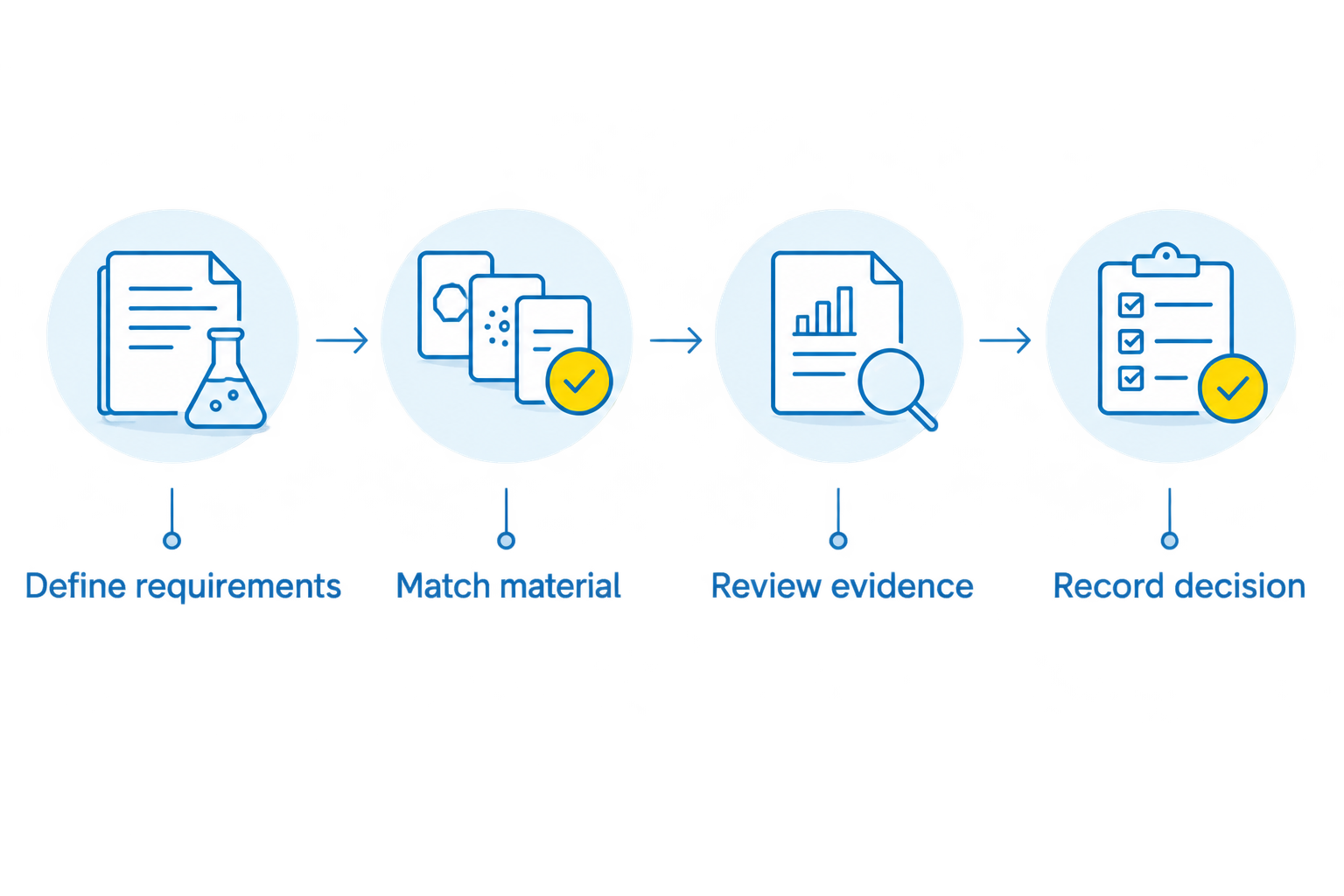
A successful document review does not remove the need for any incoming-material checks required by your laboratory. It establishes which evidence supports the decision and which questions remain outside that evidence.
Keep commercial administration separate from scientific acceptance. A convenient purchasing process does not resolve a mismatch in identity, composition, or required testing.
Why switch from Orion Peptide?
Switch to resolve a documented mismatch, not an assumed supplier weakness. A defensible 2026 decision names the unmet requirement and shows how the proposed replacement addresses it.
The following are decision conditions, not allegations about Orion Peptide:
- Your protocol requires a different material. Evaluate a source that lists the exact compound or composition required.
- Your laboratory needs an additional qualified source. Assess the second supplier independently, even when the compound name matches.
- Your required evidence differs from the existing record. Ask whether the proposed material has documentation that addresses the specific analytical question.
- Your experimental design requires separate components. Review individual compounds rather than assuming a fixed blend is suitable.
Reject a proposed switch if its rationale is only a broader catalog, a larger labeled amount, or a purity statement detached from its analytical context. None of those establishes equivalence on its own.
If a supplier cannot answer a question essential to your acceptance criteria, keep that question open. Do not convert an unanswered requirement into an assumption of compliance.
When staying with Orion Peptide is the right call
Stay with Orion Peptide when the relevant material meets your written specification and your existing qualification remains applicable. An alternatives article is not itself a reason to change an accepted source.
Continuity also needs a defined basis. Confirm that the approval concerns the material being procured, rather than relying solely on an earlier purchasing relationship.
For your 2026 review, record a retention decision as clearly as a replacement decision. State which criteria are satisfied and which records support that conclusion.
Best for: Laboratories whose incumbent material and documentation continue to meet the protocol.
Verdict: Hold the existing supplier relationship when the evidence supports retention; do not introduce a replacement without a research or procurement requirement.
FAQ
What should I look for in Orion Peptide alternatives?
Look for an exact material match and evidence that meets your laboratory’s acceptance criteria. Compare identity, composition, analytical methods, and the connection between the report and the material under review.
Is an alternative supplier automatically better than Orion Peptide?
No alternative supplier is automatically better for your experiment. A replacement is justified when its specific material and documentation satisfy a requirement that your current sourcing arrangement does not resolve.
Does a Certificate of Analysis prove a peptide will work in my assay?
A Certificate of Analysis does not establish performance in every assay. It reports specified analytical results, which you must assess alongside your protocol and laboratory qualification requirements.
Does an HPLC purity result prove sterility?
An HPLC purity result does not prove sterility. Chromatographic purity and sterility address different properties and require different evidence.
Are peptide blends interchangeable with separate compounds?
Peptide blends are not automatically interchangeable with separately sourced compounds. A fixed composition changes your control over individual components and must match the experimental design.
Should I retain Orion Peptide while qualifying another source?
Retain Orion Peptide when its material continues to meet your requirements and your procedures support that decision. Qualify the proposed alternative independently rather than transferring approval between suppliers.
Are these research peptides intended for human or veterinary use?
The materials discussed here are for laboratory and in-vitro research only. This comparison provides no human or veterinary use guidance, dosing instructions, or therapeutic recommendations.
One last thing
Write down the reason you would reject a material before reading its product page. That requirement becomes a useful filter: a supplier either provides evidence that addresses it or leaves the acceptance question unresolved.
A longer report is not necessarily a more relevant report. The decisive evidence is the evidence that answers your protocol’s specific question.
Related guides
- Research peptide suppliers for US laboratories
- CoA-verified research peptides
- Peptide blends for in-vitro stacking research
- Research peptides for university laboratories