

Best for a short-sequence starting point: Prostamax. Best for cardiolipin-focused research: SS-31. Best for mitochondrial-derived peptide studies: MOTS-C. This 2026 COA peptide guide ranks research fit; selection as a COA-verified material requires review of the specific lot’s Certificate of Analysis, not its catalog description.
- Prostamax is the short-sequence pick in this COA peptide guide; lot-specific verification remains a separate requirement.
- SS-31 fits cardiolipin-focused research; MOTS-C fits mitochondrial-derived peptide studies.
- Anchorpeptide research peptides require product-specific documentation review before selection for an experiment.
- A Certificate of Analysis reports specified tests; it does not establish every property of a research material.
Why this matters
A Certificate of Analysis (COA) records analytical results for an identified material or lot. A product name alone cannot establish that the material you receive matches the sample described in that document.
Anchorpeptide describes its offering as research-grade peptides and blends with Certificates of Analysis for US laboratory and in-vitro researchers. That does not establish which analytical methods, results, or supporting records apply to an individual lot. Treat documentation review as a selection requirement, not an administrative step after ordering.
For laboratory researchers, Anchorpeptide research peptides merit selection only after lot-specific identity and purity evidence is reviewed. All recommendations below concern laboratory and in-vitro research only, not human or veterinary use.
What makes the best COA peptide candidate?
For a 2026 shortlist, evaluate the compound and its evidence separately. A suitable research target does not compensate for an unresolved identity question.
- Lot linkage: The document’s material identifier and lot identifier must correspond to the material under consideration.
- Identity evidence: Identify the test used to support the assigned compound identity and what that method can distinguish.
- Purity evidence: Read the method and calculation behind the reported result, not just the headline percentage.
- Content evidence: Distinguish the amount of target peptide from chromatographic purity and nominal vial contents.
- Experimental fit: Match the compound’s stated research context to your model, controls, and endpoint.
- Blend resolution: For mixtures, establish how the documentation addresses individual constituents rather than assuming one result describes them all.
No universal purity threshold makes every peptide suitable for every experiment. Define acceptance criteria around the study’s analytical requirements before comparing materials.
Research-fit shortlist at a glance
The entries below are catalog-based candidates for document review, not independently verified lots. The 2026 ranking separates use cases so that you can choose a relevant starting point without treating unrelated compounds as interchangeable.
| Rank and item | Best for | Distinguishing catalog detail | Key limitation |
|---|---|---|---|
| 1. Prostamax | Short-sequence research planning | Lys-Glu-Asp-Pro tetrapeptide | Sequence description does not establish lot identity |
| 2. SS-31 | Cardiolipin-focused research | Mitochondria-targeted tetrapeptide | Target association does not establish activity in your model |
| 3. MOTS-C | Mitochondrial-derived peptide studies | 16-amino-acid peptide | Length and origin do not establish sample integrity |
| 4. BPC-157 | Tissue-repair and angiogenesis models | Synthetic pentadecapeptide | Research context does not establish experimental performance |
| 5. GLOW Blend | Multi-peptide tissue-repair studies | BPC-157, GHK-Cu, and TB-500 combination | Constituent-level assessment requires additional scrutiny |
1. Prostamax: best for short-sequence research planning
Prostamax is described in the catalog as a synthetic tetrapeptide with the sequence Lys-Glu-Asp-Pro. A tetrapeptide contains 4 amino-acid residues, making the specified sequence straightforward to state in a material acceptance record.
That clarity supports an unambiguous documentation request. It does not prove that an individual vial contains the assigned sequence or meets your experiment’s requirements.
Prostamax pros:
- The catalog provides an explicit amino-acid sequence.
- The single-compound format avoids the constituent-assignment questions of a blend.
- The short sequence gives your analytical reviewer a clearly defined identity target.
Prostamax cons:
- A sequence printed in a description is not analytical identity evidence.
- Short peptide length does not establish purity, content, or biological activity.
Best for: Researchers who want to begin their material review with an explicitly stated short sequence.
Request a lot-linked identity result and the basis for any purity claim. Keep nominal quantity, measured content, and chromatographic purity in separate fields in your acceptance record.
Verdict: Hold Prostamax until the selected lot’s documentation meets your laboratory’s acceptance criteria.
2. SS-31: best for cardiolipin-focused research
SS-31, also identified in the catalog as elamipretide, is a mitochondria-targeted tetrapeptide described as associating with cardiolipin in the inner mitochondrial membrane. It contains 4 amino-acid residues, but its research context differs from Prostamax despite the shared peptide length.
Select SS-31 because the compound matches the research question. Do not infer equivalent behavior from another tetrapeptide’s results.
SS-31 pros:
- The catalog identifies a specific mitochondrial research context.
- The supplied alternative name helps reconcile records that use different naming conventions.
- The single-compound format supports review without a blend’s additional constituent questions.
SS-31 cons:
- Identity and purity results do not establish cardiolipin association in your experimental system.
- A mitochondrial research designation does not replace model-specific controls.
Best for: Qualified laboratories studying questions tied to cardiolipin-associated mitochondrial mechanisms.
For a 2026 study file, record the exact compound identity and lot identifier alongside the analytical methods. A matching name is the beginning of reconciliation, not the end.
Verdict: Hold SS-31 until lot identity, analytical scope, and experimental suitability are resolved.
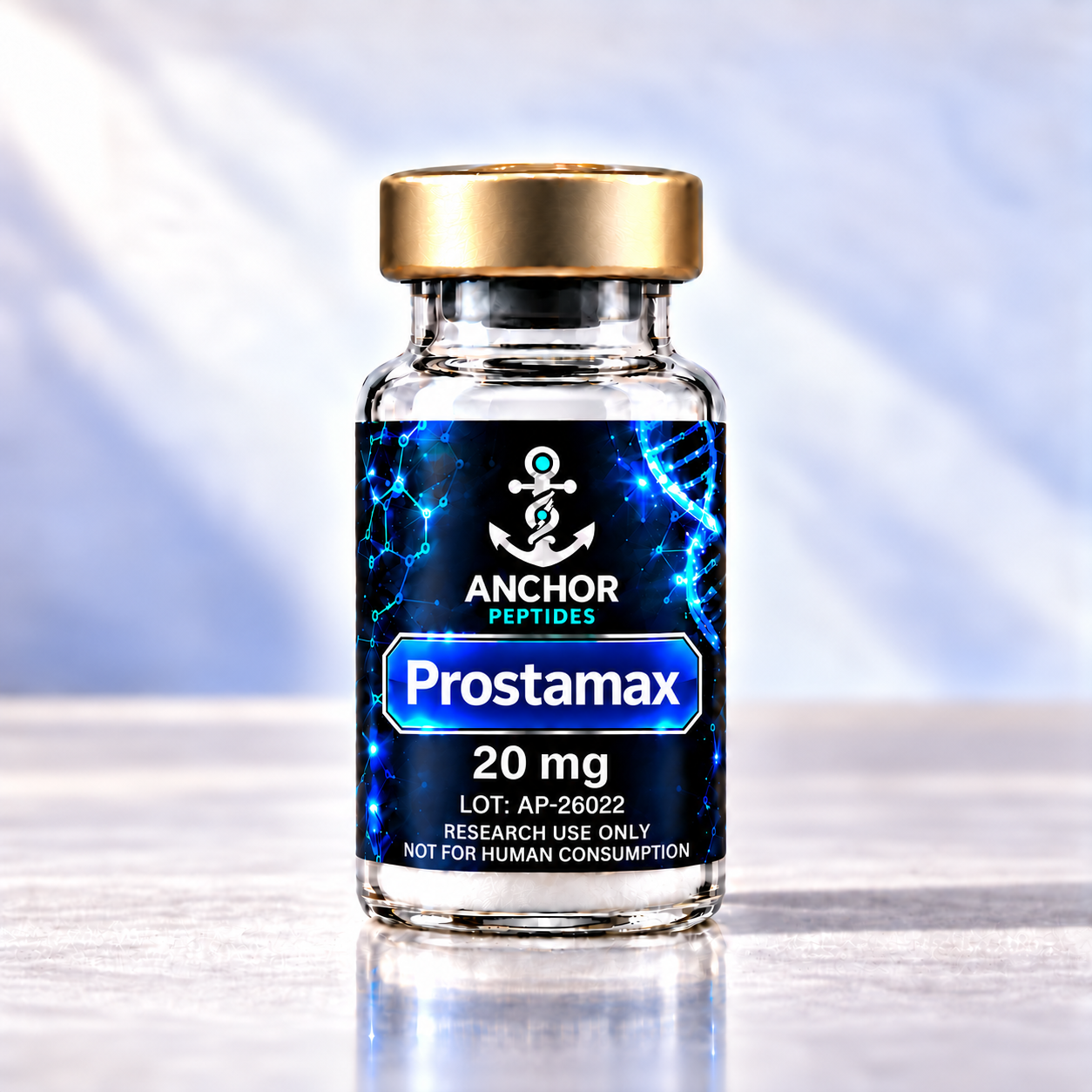
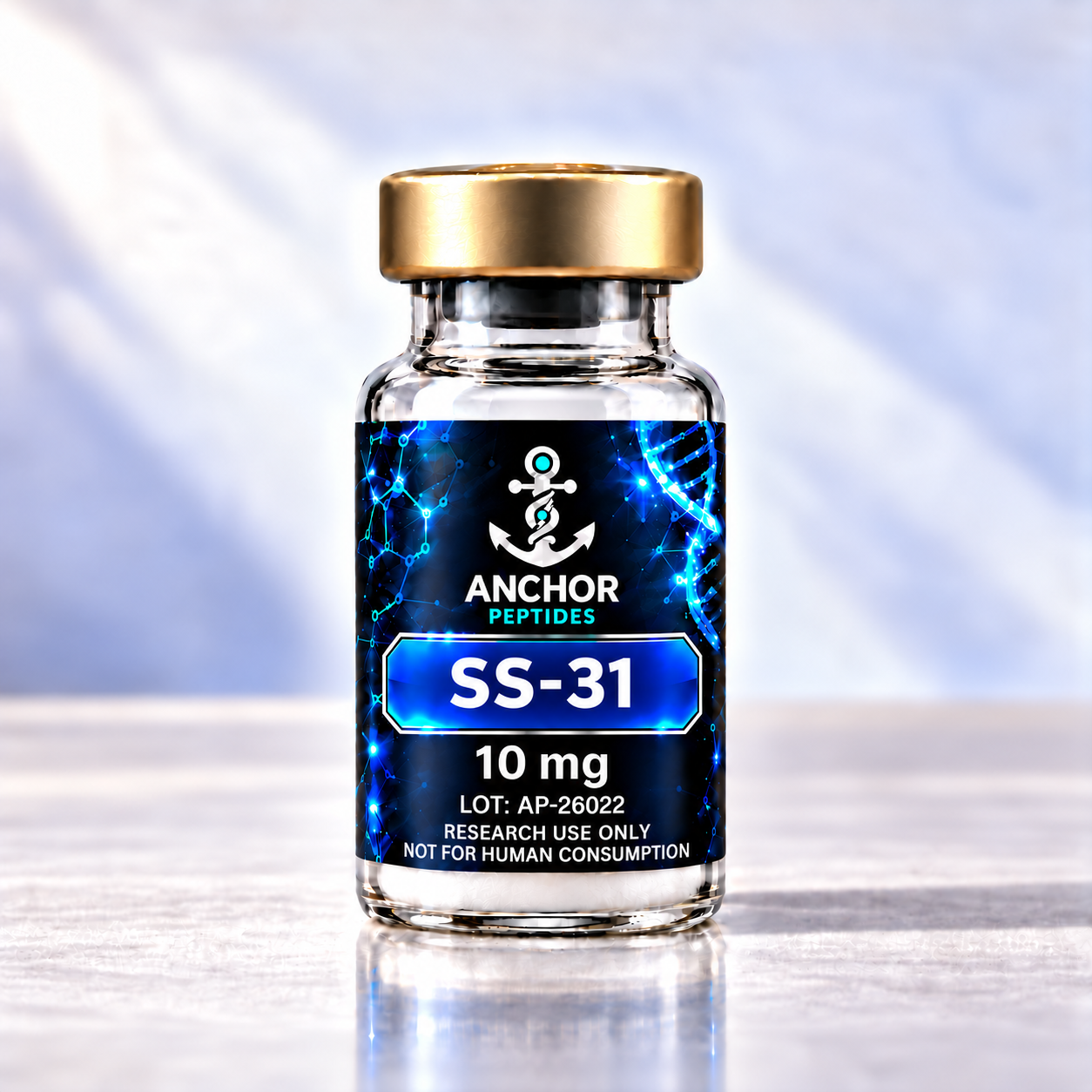
The following cards identify the two short-peptide candidates discussed above. Their catalog listings are not substitutes for lot-specific analytical records.
3. MOTS-C: best for mitochondrial-derived peptide studies
MOTS-C is described as a 16-amino-acid mitochondrial-derived peptide studied in cellular metabolism and AMPK-related research. AMPK means AMP-activated protein kinase, a cellular energy-sensing enzyme.
MOTS-C belongs in a different research-fit category from SS-31. Shared mitochondrial terminology does not make the compounds substitutes for one another.
MOTS-C pros:
- The catalog specifies peptide length.
- The description identifies a mitochondrial-derived research context.
- The single-compound format allows documentation review around one assigned peptide.
MOTS-C cons:
- The catalog description does not establish integrity of a specific sample.
- Chemical characterization alone does not demonstrate a pathway response in your model.
Best for: Laboratories investigating mitochondrial-derived peptide biology within an appropriately controlled experimental design.
Review whether the reported method supports the assigned identity and how purity was calculated. Preserve the distinction between chemical characterization and the biological endpoint your study measures.
Verdict: Hold MOTS-C until the selected lot’s analytical evidence supports the planned study.
4. BPC-157: best for tissue-repair research models
BPC-157 is described as a synthetic pentadecapeptide based on a sequence from a gastric protein. A pentadecapeptide contains 15 amino-acid residues; the catalog places BPC-157 in tissue-repair and angiogenesis research contexts.
Angiogenesis means the formation of new blood vessels. That research context identifies an area of investigation, not a promised outcome or an instruction for personal use.
BPC-157 pros:
- The catalog identifies a defined single-peptide candidate.
- Its stated research context supports a focused initial literature review.
- A standalone material avoids the attribution questions introduced by a precombined blend.
BPC-157 cons:
- A research-area description does not establish activity in a particular assay.
- A purity result cannot substitute for evidence supporting the assigned identity.
Best for: Laboratories evaluating a standalone peptide for controlled tissue-repair or angiogenesis research models.
Compare the actual analytical record against the material requirements in your protocol. Do not transfer acceptance decisions from another compound merely because both appear in the same research category.
Verdict: Hold BPC-157 until lot-specific evidence satisfies the study’s material requirements.
5. GLOW Blend: best for multi-peptide tissue-repair research
The catalog’s GLOW Blend combines BPC-157, GHK-Cu, and TB-500, described there as a Thymosin Beta-4 fragment. This is a combination-material choice, not an equivalent replacement for a standalone peptide.
A blend adds questions about constituent identity, composition, and analytical separation. Those questions belong in the material review before the combination enters an experiment.
GLOW Blend pros:
- The catalog names the constituent peptides.
- The combination fits studies explicitly designed around a multi-peptide material.
- The named composition provides a starting point for constituent-specific documentation requests.
GLOW Blend cons:
- A combined material makes attribution of an observed response more difficult.
- An aggregate purity statement does not automatically establish each constituent’s identity or amount.
- The catalog description alone does not establish component-specific analytical coverage.
Best for: Laboratories whose experimental design specifically requires this named combination and appropriate constituent controls.
Ask how the analytical method distinguishes the constituents and what evidence supports the stated composition. Do not assume a single chromatogram answers every mixture-related question.
Verdict: Hold GLOW Blend until constituent-level documentation supports the combination study.
How to read a peptide COA without overreading it
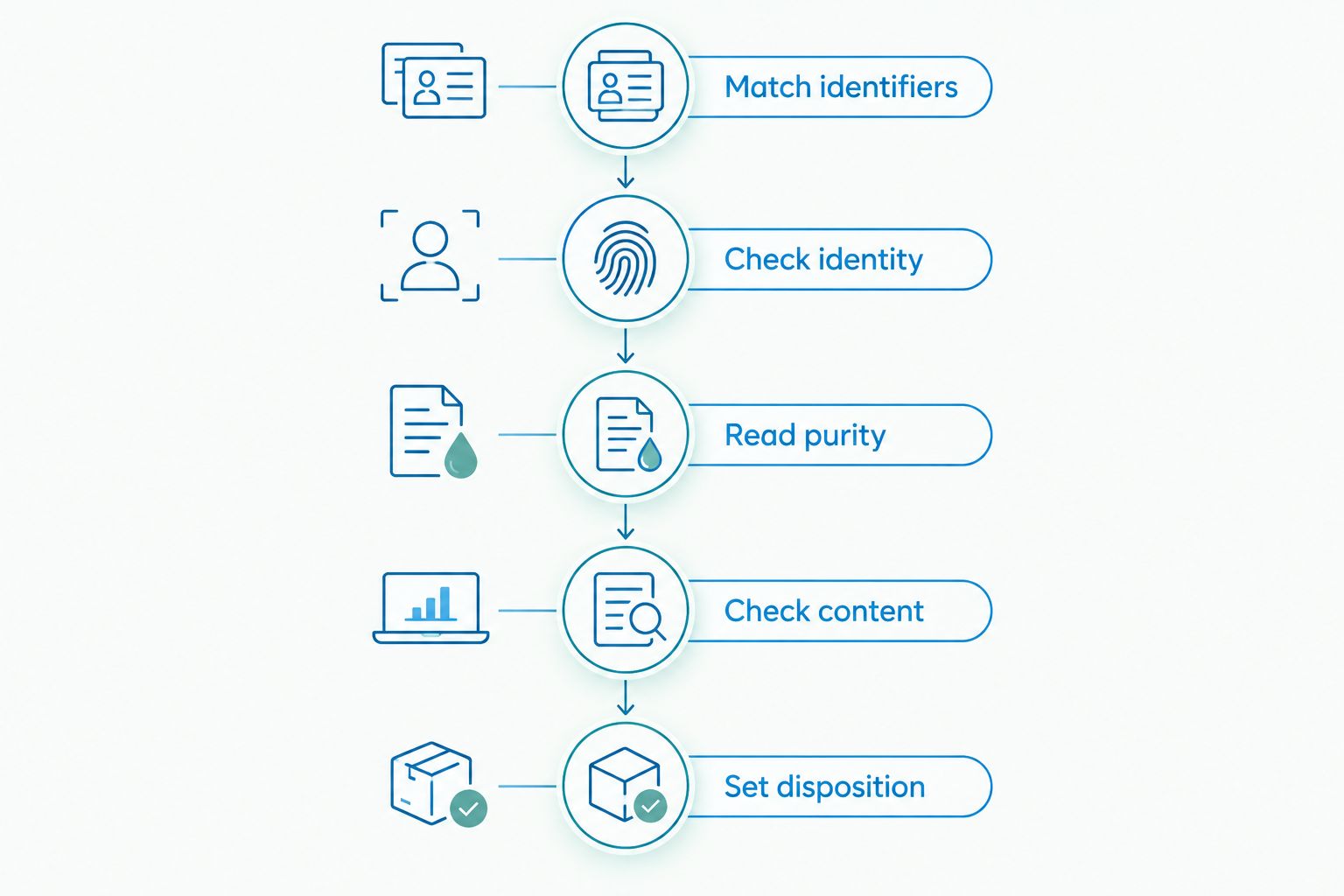
A useful 2026 document review follows a fixed sequence: establish what was tested, determine what each method measures, and compare the findings with your study requirements. Keep these steps separate so that one favorable result does not stand in for another.
- Match identifiers: Reconcile the product, sample, and lot identifiers with the material under consideration.
- Check identity: Identify the analytical evidence supporting the assigned compound.
- Read purity: Determine the method, detection conditions, and basis of the reported purity result.
- Check content: Establish whether the record measures target peptide amount or only reports nominal contents.
- Set disposition: Accept or hold the material against predetermined study requirements.
What common analytical methods establish
High-performance liquid chromatography (HPLC) separates sample components under specified conditions. A reported chromatographic purity result describes the method’s detected signals and calculation; it is not automatically the target peptide’s mass fraction in the entire vial.
Mass spectrometry (MS) measures mass-to-charge signals that support molecular characterization. A matching mass supports identity assessment, but mass alone does not uniquely establish every structural feature or distinguish every possible isomer.
Neither method, by itself, establishes sterility, endotoxin status, or biological performance. If those properties matter to your experiment, require evidence that directly addresses them.
What to record in your study file
Preserve the reviewed document, its date, its identifiers, and the acceptance decision. Record unresolved questions explicitly rather than converting an unspecified result into an assumed pass.
For Anchorpeptide research peptides, the same rule applies to standalone compounds and blends: the evidence must describe the material you intend to study. A document for a differently identified lot is not interchangeable evidence.
How this shortlist is ranked
This ranking uses the supplied catalog descriptions, distinct research contexts, and the documentation questions each format creates. Prostamax leads as the short-sequence starting point; the remaining entries serve different experimental questions rather than competing for a universal performance title.
No batch-level analytical results underpin a claim of verified superiority here. The 2026 shortlist is a research-fit decision tree, with lot-specific analytical acceptance required for every entry.
Which research peptide should you choose?
Choose the research question first and the material second. Start with Prostamax when an explicitly stated short sequence fits the protocol; choose SS-31 or MOTS-C only when their different mitochondrial research contexts match the study.
Use BPC-157 for a relevant standalone research design. Consider GLOW Blend only when the experiment requires the combination and can address constituent-related interpretation. Reject any default choice that lacks the documentation your study requires.
FAQ
What does COA mean for a research peptide?
COA means Certificate of Analysis, a document reporting specified analytical results for an identified material or lot. Read its identifiers, methods, and results together rather than relying on the product name.
What is the best COA peptide for laboratory research?
The best candidate matches your experimental question and meets your lot-specific analytical acceptance criteria. Prostamax, SS-31, and MOTS-C address different research contexts, so none is a universal substitute for the others.
Does HPLC purity prove peptide identity?
HPLC purity alone does not prove peptide identity. It describes separation and detected signals under specified conditions; identity assessment requires appropriate supporting analytical evidence.
Does a matching mass spectrometry result prove the full sequence?
A matching mass alone does not prove the full peptide sequence. Sequence assignment requires suitable analytical evidence, and compounds with the same mass can differ structurally.
Is a peptide blend COA the same as a single-peptide COA?
A blend COA must be assessed for how it addresses multiple constituents. Do not assume an aggregate result establishes each constituent’s identity, amount, or analytical purity.
Does a peptide COA establish sterility or endotoxin status?
A peptide COA establishes only the properties supported by its reported tests. HPLC and mass spectrometry results alone do not establish sterility or endotoxin status.
Can I use a COA from a different lot?
A different lot’s COA does not establish the analytical characteristics of your selected lot. Match the document identifiers to the material under consideration.
Are these recommendations for human or veterinary use?
No. These recommendations concern qualified laboratory and in-vitro research only and provide no human or veterinary use instructions.
One last thing
A strong purity result can still answer the wrong question. Before selecting a material, write down whether the experiment needs evidence of identity, purity, content, or another property, then require a result that actually addresses it.
For your 2026 material review, that distinction matters more than the position of any compound in a ranked list.
Related guides
- Peptide blends for in-vitro research
- Peptide blends for metabolic research
- Longevity research peptides for cellular studies
- Tissue-repair research peptides for lab studies