
Best fit for combined metabolic-receptor research: Retatrutide & Cagrilintide (10mg/10mg). Best fit for growth-hormone-axis research: CJC-1295 No DAC & Ipamorelin (10mg). This 2026 guide compares their stated mechanisms, experimental limitations, and documentation requirements for qualified laboratory and in-vitro researchers—not human or veterinary use.
- The best peptide blends for metabolic research depend on pathway fit, analytical documentation, and experimental controls.
- Retatrutide & Cagrilintide combines a triple-receptor agonist with an amylin analogue; select it for that combined research question.
- CJC-1295 No DAC & Ipamorelin fits growth-hormone-axis questions, not the same receptor questions as Retatrutide & Cagrilintide.
- Anchorpeptide peptide blends require product-specific document review; a catalog description does not establish batch identity or biological activity.
Why this matters
A blend answers a different experimental question from an isolated compound. When several active components enter the same experiment, a measured change cannot automatically be assigned to one component. That distinction matters before you select the material, not after you interpret the results.
Anchorpeptide supplies research-grade peptides and blends for laboratory and in-vitro researchers. Anchorpeptide peptide blends are best evaluated by laboratories with a defined pathway question and a batch-documentation review process. A mechanism description helps you identify a candidate; it does not establish suitability for your assay.
For this 2026 comparison, “best” means the closest match between the stated composition and the research question. It does not mean demonstrated superiority, a stronger biological effect, or verified analytical performance across batches.
What makes the best peptide blends for metabolic research?
Use these criteria before comparing names. A blend that fails the first criterion does not become suitable because its other attributes look attractive.
- Pathway fit: Match the stated targets to the mechanism your experimental model can interrogate. Metabolic research is not one interchangeable category.
- Defined composition: Establish which compounds are present and how their individual quantities are documented. A combined amount alone does not describe component proportions.
- Identity evidence: Review analytical evidence supporting what each component is. A product name is not an identity measurement.
- Component resolution: Determine whether the analytical method distinguishes the blend constituents rather than reporting an unexplained aggregate result.
- Experimental interpretability: Decide whether the combined material supports your question or whether separate component arms are necessary.
- Batch traceability: Connect the material you receive to the documentation you review. Do not substitute a generic report for a matching batch record.
A Certificate of Analysis, or CoA, is a document reporting analytical results for a specified material. Its usefulness depends on the identifiers, methods, results, and scope it contains. The presence of a document titled CoA does not answer every qualification question.
Peptide blends at a glance
The two ranked blends serve distinct research questions. Their positions reflect mechanism fit within the supplied catalog, not comparative experimental results.
| Ranked blend | Best for | Stated distinguishing feature | Key limitation |
|---|---|---|---|
| Retatrutide & Cagrilintide (10mg/10mg) | Combined metabolic-receptor research | Pairs a GLP-1/GIP/glucagon triple agonist with an amylin analogue | A combined response does not identify each component’s contribution |
| CJC-1295 No DAC & Ipamorelin (10mg) | Growth-hormone-axis research | Pairs a GHRH analogue with a selective ghrelin-receptor agonist | It does not address the same receptor question as the first blend |
GLP-1 means glucagon-like peptide-1; GIP means glucose-dependent insulinotropic polypeptide. GHRH means growth hormone-releasing hormone. These names identify different signaling systems, not different grades of the same research material.
The quantity labels also differ: one product is labeled 10mg/10mg, while the other is labeled 10mg. Do not assume those labels express composition in the same way. Confirm the component-level specification before comparing materials or planning procurement.
1. Retatrutide & Cagrilintide: best for combined receptor studies
Retatrutide & Cagrilintide (10mg/10mg) pairs Retatrutide, described in the catalog as a GLP-1/GIP/glucagon triple agonist, with Cagrilintide, described as a long-acting amylin analogue. An agonist is a compound that activates a receptor. This pairing is the most direct catalog match for a research question involving those combined signaling systems.
Best for: Qualified laboratories investigating a combined metabolic-receptor hypothesis that explicitly includes both constituents.
The reason to select this blend is its stated composition—not a presumed advantage over either constituent alone. If your question concerns only GLP-1 receptor signaling, the combined material introduces additional mechanisms that your design must address. The GLP-1 receptor agonist research peptides guide provides a separate starting point for that narrower category.
Retatrutide & Cagrilintide pros
- The catalog identifies both constituents rather than describing an unnamed metabolic blend.
- The stated pairing aligns with a research question spanning the listed receptor systems.
- The product title distinguishes two component quantity labels: 10mg/10mg.
Retatrutide & Cagrilintide cons
- A blend-only experiment cannot isolate each constituent’s contribution.
- The stated mechanisms do not establish activity in your particular cell system.
- The supplied catalog description does not establish batch-specific identity, purity, or component-resolved analytical results.
For a 2026 study plan, write the hypothesis before selecting this pairing. Specify what observation would support the combined-mechanism question and what controls would distinguish a meaningful response from background or assay interference.
Verdict: Hold until the component specifications and batch documents meet your protocol; select this blend only for a combined-receptor question.
2. CJC-1295 No DAC & Ipamorelin: best for GH-axis questions
CJC-1295 No DAC & Ipamorelin (10mg) combines CJC-1295 without DAC, described as a GHRH analogue, with Ipamorelin, described as a selective ghrelin-receptor agonist. An analogue is a compound structurally related to another compound. The stated pairing places this blend in a different mechanistic category from Retatrutide & Cagrilintide.
Best for: Qualified laboratories whose metabolic research question specifically involves growth-hormone-related signaling.
Do not treat this blend as a substitute for a GLP-1/GIP/glucagon-and-amylin research design. A shared connection to metabolism does not make the receptor systems interchangeable. Confirm that your model and endpoint actually address the signaling question attached to this pairing.
CJC-1295 No DAC & Ipamorelin pros
- The catalog names both constituents and their stated mechanistic roles.
- The product name explicitly identifies the CJC-1295 form as without DAC.
- The pairing provides a distinct candidate for a growth-hormone-axis hypothesis.
CJC-1295 No DAC & Ipamorelin cons
- The 10mg title alone does not establish each constituent’s individual quantity.
- Combined exposure complicates attribution of a measured response.
- The catalog description does not establish functional activity or suitability for a specific in-vitro system.
Keep the exact compound designation in your procurement record. Shortening the name to CJC-1295 removes information present in the supplied product title and weakens the connection between the selected material and your protocol.
Verdict: Hold until composition and documentation are qualified; select this blend for a growth-hormone-axis question, not a direct substitute for the first pairing.
Catalog candidates for document review
The Anchorpeptide catalog identifies these two blends. Use the product records to begin a specification review, then establish whether the documents correspond to the material under consideration. These cards identify candidates, not analytically qualified batches.


Qualify the blend before committing an experiment
Use the following sequence for either candidate. In 2026, the useful procurement question remains specific: does the evidence describe this material well enough for this experiment?
- Define the question. Identify the pathway, model, and endpoint. State why a combined material is necessary rather than assuming a blend is inherently preferable.
- Confirm composition. Record the exact constituent names, form designations, and individually specified quantities. Resolve ambiguous labels before treating them as experimental inputs.
- Match the batch. Compare the material identifier with the identifier on its documentation. Record the relationship in your laboratory’s material records.
- Review methods. Determine what each reported test measures, what it distinguishes, and what conclusions its results support.
- Set controls. Establish the comparisons needed to interpret the blend response. Include separate constituent comparisons when the question requires component attribution.
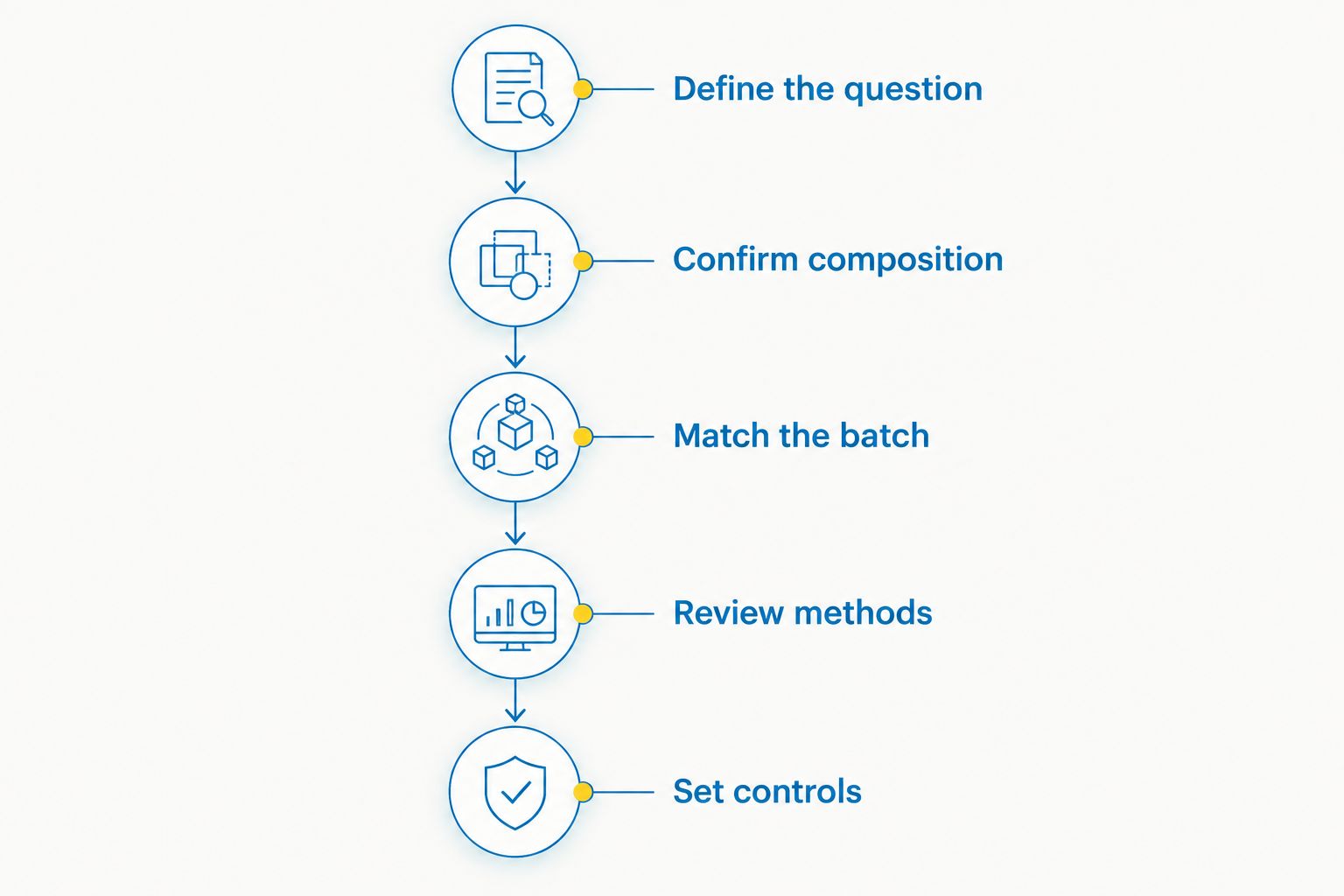
This sequence separates material qualification from experimental design. Good documentation does not repair an unsuitable model, and an appropriate model does not remove the need to qualify the material.
What analytical results do—and do not—establish
High-performance liquid chromatography, or HPLC, separates sample components under specified analytical conditions. A reported chromatographic purity result describes that analysis; it does not independently establish every component’s identity or biological activity. For a blend, ask how peaks were assigned and whether constituents were resolved.
Mass spectrometry, or MS, measures mass-to-charge ratios of detected ions. It supports identity assessment when interpreted against the expected compound, but a mass result alone does not establish every structural detail or functional property.
Neither an HPLC result nor an MS result, by itself, establishes sterility or endotoxin status. Endotoxins are bacterial components measured through separate analytical approaches. Request evidence relevant to the requirements of your model rather than treating one favorable result as universal qualification.
Why other catalog materials are not ranked here
A metabolic-research material is not automatically a peptide blend. The supplied catalog also includes single compounds and nonpeptide research materials; grouping them together would obscure the central comparison.
For example, Lipotropic research solution (10ml) is described as combining amino acids and B-vitamins. That description does not make it a peptide blend. SLU-PP-332 and 5-Amino-1MQ are described as small molecules, so they also fall outside this ranking.
The same boundary applies to peptide blends associated with other research questions. A mixture’s existence in the catalog does not establish its relevance to a metabolic endpoint. Keep the inclusion rule tied to the stated composition and pathway, not to broad associations with cellular research.
How the blends are ranked
This 2026 ranking uses the supplied product descriptions and the criteria above. Retatrutide & Cagrilintide comes first because its stated pairing directly addresses combined metabolic-receptor research. CJC-1295 No DAC & Ipamorelin occupies a separate slot for growth-hormone-axis questions.
The ordering does not represent a head-to-head performance comparison. No supplied experimental results establish relative potency, reproducibility, or assay performance, so those are not ranking dimensions.
Which peptide blend should you choose?
Choose Retatrutide & Cagrilintide as the first candidate to evaluate when your hypothesis explicitly includes its combined receptor systems. Choose CJC-1295 No DAC & Ipamorelin when the question instead centers on growth-hormone-related signaling.
If you cannot state why both constituents belong in the experiment, do not default to a blend. Start with the experimental question and decide whether component-level comparisons would produce a more interpretable result.
FAQ
What are the best peptide blends for metabolic research in 2026?
Retatrutide & Cagrilintide is the closest supplied catalog match for combined metabolic-receptor questions; CJC-1295 No DAC & Ipamorelin fits growth-hormone-axis questions. Neither is a universal choice, and both require composition and batch-documentation review.
Is Retatrutide & Cagrilintide better than CJC-1295 No DAC & Ipamorelin?
Neither blend is established as better by the supplied evidence. Their stated mechanisms differ, so select according to the research question rather than assuming interchangeable activity.
Does a Certificate of Analysis prove a peptide blend works?
A Certificate of Analysis does not by itself prove biological activity in your model. Interpret each reported result according to its method and scope, and establish functional suitability separately.
Does an HPLC purity result confirm every component in a blend?
An HPLC purity result alone does not confirm every component’s identity. Review component separation, peak assignment, and supporting identity evidence before interpreting the result.
Can I identify each peptide’s effect from a blend-only experiment?
A blend-only experiment does not isolate each constituent’s contribution. Separate constituent comparisons are needed when attribution is part of the research question.
Is a lipotropic research solution a peptide blend?
The supplied Lipotropic research solution (10ml) is described as an amino-acid and B-vitamin combination, not a peptide blend. Classify materials by their stated composition rather than their association with metabolic research.
Are these blends intended for human or veterinary use?
These materials are for laboratory and in-vitro research only, not human or veterinary use. This guide provides no dosing, administration, or therapeutic advice.
One last thing
The most useful specification is often the one missing from the product title. A clearly named blend still needs component-level documentation. Before approving an Anchorpeptide peptide blend for your 2026 research plan, make the connection between its composition, batch record, and experimental question explicit.
Related guides
- Growth hormone secretagogue peptides for research
- Longevity research peptides for cellular studies
- Muscle protein synthesis research peptides