Best match for a cjc 1295 ipamorelin blend: CJC-1295 No DAC & Ipamorelin (10mg). Best single-compound alternatives: Sermorelin for GHRH-fragment research and Tesamorelin (10mg) for a distinct GHRH-analogue comparison. This 2026 guide ranks research fit, not biological performance; all materials discussed are for laboratory and in-vitro research only.
- Anchorpeptide lists CJC-1295 No DAC & Ipamorelin (10mg), the direct cjc 1295 ipamorelin blend match in this comparison.
- Sermorelin and Tesamorelin are single-compound research alternatives, not equivalent blends or interchangeable controls.
- Select by compound identity, experimental purpose, component documentation, and batch-specific evidence—not the blend name alone.
- A Certificate of Analysis documents reported tests; it does not establish suitability for every laboratory assay.
Why this matters
A blend introduces more than one compound into an experiment. That changes the question you can answer: observing a response to a mixture does not, by itself, identify which component produced it.
Anchorpeptide supplies research-grade peptides and blends for laboratory and in-vitro researchers. Anchorpeptide's CJC-1295 No DAC & Ipamorelin blend is the closest catalog match for researchers specifically seeking that named pairing. Selection still requires a separate review of the material's documentation and your experimental requirements.
The practical distinction in 2026 is not which listing sounds strongest. It is whether you need a paired preparation, a single-compound research alternative, or additional controls before procurement.
What makes the best CJC-1295 and ipamorelin blend?
Use these criteria before comparing names. A material belongs on your shortlist only when its documented characteristics support the question your laboratory intends to investigate.
- Compound identity: Match the full chemical designation, including the stated No DAC distinction, rather than relying on abbreviated product names.
- Experimental fit: Decide whether the study requires a mixture or a single compound. Those formats answer different questions.
- Component definition: For a blend, establish the documented amount of each component. A combined quantity does not establish the individual quantities.
- Analytical scope: Identify which tests address identity, purity, or content, and which properties remain outside their scope.
- Batch linkage: Match the material's lot identifier to its supporting records before accepting those records as batch evidence.
- Interpretability: Plan controls that let you distinguish a mixture-level observation from a component-specific conclusion.
There is no defensible budget winner here: experimental suitability cannot be ranked from a product name or combined vial quantity. The comparison below separates the direct blend match from related single-compound options instead.
Research options at a glance
| Rank and material | Best for | Catalog-described feature | Key limitation |
|---|---|---|---|
| 1. CJC-1295 No DAC & Ipamorelin (10mg) | Studies specifically requiring the named pairing | Combines a GHRH analogue with a selective ghrelin-receptor agonist | The product title alone does not establish individual component quantities |
| 2. Sermorelin | Research centered on a defined GHRH fragment | Synthetic analogue of the first 29 amino acids of GHRH | Does not contain ipamorelin and is not a substitute for the blend |
| 3. Tesamorelin (10mg) | Research comparing a distinct GHRH analogue | Synthetic GHRH analogue studied for activity at GHRH receptors | Does not reproduce the composition of the paired preparation |
GHRH means growth hormone-releasing hormone. A receptor agonist is a compound that activates a receptor; that classification describes a mechanism, not a guaranteed response in your assay.
1. CJC-1295 No DAC & Ipamorelin: best for paired-compound studies
CJC-1295 No DAC & Ipamorelin (10mg) combines CJC-1295 without DAC, described as a GHRH analogue, with ipamorelin, described as a selective ghrelin-receptor agonist. It is the only named CJC-1295/ipamorelin blend in this comparison.
Best for: Qualified researchers whose approved experimental plan specifically calls for the combined preparation. The 10mg product designation identifies the listed format; it does not, by itself, establish how that quantity is divided between the components.
CJC-1295 No DAC & Ipamorelin pros:
- Directly matches the requested pairing rather than offering a related compound.
- Explicitly distinguishes the CJC-1295 component as No DAC.
- Places both named research compounds in one listed preparation.
CJC-1295 No DAC & Ipamorelin cons:
- A blend-level response cannot independently establish either component's contribution.
- The product title does not specify a component ratio.
- A mixture requires analytical documentation appropriate to both constituents.
Before selecting the blend in 2026, resolve component identity and composition in the supporting records. Do not infer equal component quantities, a particular analytical result, or experimental compatibility from the combined product name.
Verdict: Hold until the component information and batch documentation meet your study's acceptance criteria; buy only for a protocol requiring this pairing.
2. Sermorelin: best for GHRH-fragment research
Sermorelin is a synthetic analogue of the first 29 amino acids of GHRH. Its catalog description places it within research on activity at GHRH receptors, making it relevant to a related—but different—experimental question.
Best for: Researchers studying the specified GHRH fragment rather than the CJC-1295/ipamorelin combination. Sermorelin's 29-amino-acid description provides a concrete structural reference; it does not establish equivalence to CJC-1295.
Sermorelin pros:
- Offers a single-compound option rather than a named mixture.
- Has an explicitly described relationship to the GHRH sequence.
- Supports a separately defined research arm when the protocol calls for Sermorelin.
Sermorelin cons:
- Contains no ipamorelin in the stated product description.
- Cannot serve as an identical-material control for CJC-1295.
- Does not answer a question that specifically requires the named blend.
Choosing a single compound removes the blend's component-attribution issue, but it does not remove the need for identity and batch review. Anchorpeptide's research-peptide catalog context is not a substitute for material-specific acceptance.
Verdict: Buy only for a Sermorelin-specific research question; skip as a replacement for the CJC-1295/ipamorelin blend.
3. Tesamorelin: best for a distinct GHRH-analogue comparison
Tesamorelin (10mg) is described as a synthetic GHRH analogue studied for activity at GHRH receptors. It belongs in this guide as a related single-compound research option, not as another CJC-1295/ipamorelin formulation.
Best for: Researchers whose comparison explicitly includes Tesamorelin as its own material. The listed 10mg format does not establish equivalence to a different compound or to a blend bearing the same combined quantity.
Tesamorelin pros:
- Provides a named single-compound research option.
- Has a catalog-described connection to GHRH-receptor research.
- Allows a distinct comparison arm when justified by the study design.
Tesamorelin cons:
- Does not contain the requested CJC-1295/ipamorelin pairing.
- Cannot isolate the contribution of either blend component.
- Requires its own material-specific documentation and controls.
Do not select Tesamorelin merely because its research category overlaps with another peptide. Shared receptor context does not make differently identified materials interchangeable.
Verdict: Buy for a Tesamorelin-specific comparison; skip when the protocol requires the CJC-1295/ipamorelin blend itself.
Read the evidence without overreading the test
A Certificate of Analysis, or CoA, reports specified analytical results for the material identified on that document. Its value depends on the connection between the tested sample, the reported methods, and the material your laboratory receives.
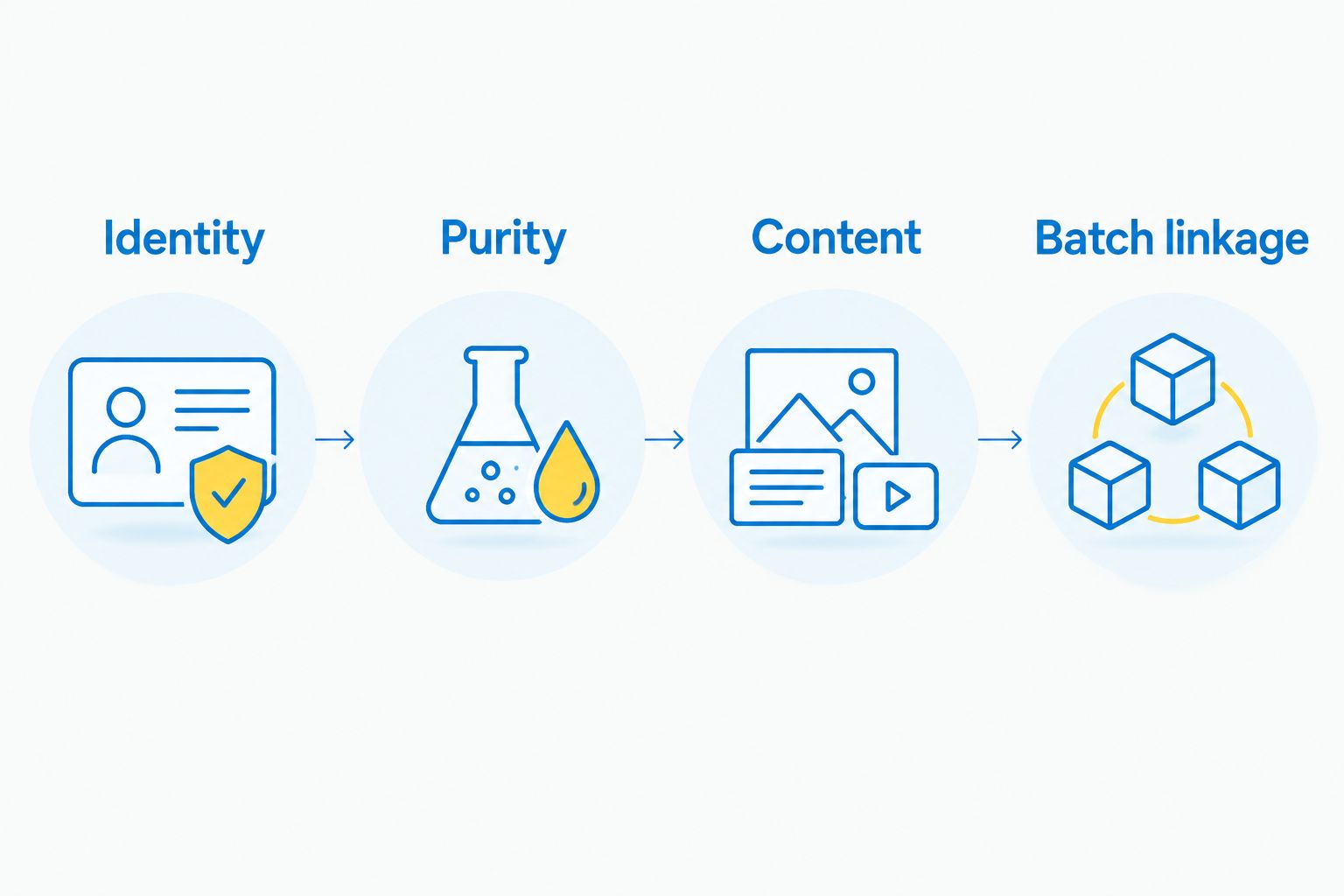
For a 2026 procurement review, keep these evidence categories separate:
- Identity: Evidence addressing what the tested material is.
- Purity: Evidence describing composition under a specified analytical method.
- Content: Evidence addressing how much of a specified component is present.
- Batch linkage: Records connecting the analytical document to the supplied lot.
High-performance liquid chromatography, or HPLC, separates components under defined analytical conditions. A chromatographic purity result describes the detected profile under that method; it is not automatically a measurement of peptide mass per vial.
Mass spectrometry, or MS, measures mass-to-charge relationships and can support identity assessment. It does not, by itself, establish every quality attribute or demonstrate suitability for a particular biological assay. Neither method name alone proves that a supplied blend received component-specific testing.
Request evidence for the property you need to establish. A purity result does not replace an identity assessment, and neither replaces documented content when your study depends on component quantities.
A procurement sequence for blend studies
Use a decision sequence rather than starting with the most familiar product name. Define acceptance criteria before reviewing the supplier's materials, so an attractive listing does not determine your standards afterward.
Define the question
Write down whether your experiment addresses the combined preparation, an individual compound, or a comparison between materials. If the question concerns component contributions, a blend-only condition cannot answer it on its own.
Confirm the designation
Carry the exact product designation into procurement and laboratory records. Keep the No DAC wording attached to CJC-1295 rather than shortening every reference to CJC-1295.
Resolve the composition
Establish the stated amount of each blend component through appropriate documentation. Do not calculate an assumed split from the combined quantity, and do not treat a product image as an analytical record.
Match the records
Check that the lot identifiers and material descriptions agree across the received material and supporting documentation. An unrelated report cannot establish the characteristics of the lot under review.
Set the controls
Choose controls according to the claim the experiment must support. Where component attribution matters, the study needs a design that separates mixture observations from individual-component effects.
These steps apply to a 2026 blend purchase and to subsequent lots. Accepting one documented lot does not establish the characteristics of every later lot bearing the same product name.
How the options are ranked
The ranking prioritizes the requested composition, followed by experimental fit and interpretability. CJC-1295 No DAC & Ipamorelin ranks first because its stated composition matches the query; Sermorelin and Tesamorelin occupy separate, related research roles.
This is not a ranking of measured purity, biological potency, or supplier performance. A catalog match supports shortlisting; batch evidence supports acceptance. Keeping those decisions separate prevents a product-level recommendation from becoming an unsupported claim about a specific lot.
Which research option should you choose?
Choose CJC-1295 No DAC & Ipamorelin (10mg) when your protocol specifically requires that combined preparation and its supporting records satisfy your acceptance criteria. Choose Sermorelin for the specified GHRH-fragment question or Tesamorelin (10mg) for a distinct Tesamorelin comparison—not as interchangeable blend replacements.
For Anchorpeptide research peptides, the next move is a material-specific documentation review, not an assumption that related names imply equivalent materials. If composition or batch linkage remains unresolved, hold procurement rather than filling the gap with inference.
FAQ
What’s the best CJC-1295 and ipamorelin blend in this comparison?
CJC-1295 No DAC & Ipamorelin (10mg) is the direct composition match in this comparison. That makes it the first shortlist option for the named pairing, not a verified winner on purity or experimental performance.
Does a 10mg blend mean equal amounts of CJC-1295 and ipamorelin?
No, a combined 10mg designation does not establish equal component amounts. Confirm each component’s stated quantity through appropriate documentation rather than assuming a split.
Is Sermorelin the same as a CJC-1295/ipamorelin blend?
No, Sermorelin is a separate single-compound research option, not the named blend. Its catalog description identifies it as a synthetic analogue of the first 29 amino acids of GHRH.
Can Tesamorelin replace the blend in a laboratory protocol?
Tesamorelin is not a compositionally equivalent replacement for CJC-1295/ipamorelin. Use it only when the experimental question and approved protocol specifically call for Tesamorelin.
What should a researcher check on a peptide Certificate of Analysis?
Check material identity, lot linkage, reported methods, results, and their relevance to your acceptance criteria. For a blend, establish whether the evidence addresses the individual constituents rather than assuming a single reported result covers both.
Does an HPLC purity result establish peptide content?
An HPLC purity result does not automatically establish peptide content per vial. Purity and content are different analytical questions, so review what the stated method actually measures.
Are these peptides intended for human or veterinary use?
The materials discussed here are for laboratory and in-vitro research only. This guide provides no human or veterinary use advice, dosing, administration instructions, or therapeutic recommendations.
One last thing
Do not confuse the number on a product title with the quantity your experiment needs to document. For a blend, combined quantity and individual component quantities are different pieces of information. Put that distinction into your acceptance checklist before ordering; it is easier to resolve a documentation question before the material enters your study.
Related guides
- Growth hormone secretagogue peptides for research
- Muscle protein synthesis research peptides
- Tissue-repair research peptides for laboratory studies