

Best default for a three-peptide tissue-repair research question: GLOW Blend. Best for adding KPV to that research question: KLOW Blend. Best for paired GHRH/ghrelin-receptor research: CJC-1295 No DAC & Ipamorelin. Best for combined metabolic-signaling research: Retatrutide & Cagrilintide. This 2026 guide ranks research fit, not proven superiority, and covers laboratory and in-vitro evaluation only.
- GLOW Blend leads the best peptide blends for in-vitro research when a three-component tissue-repair hypothesis fits.
- KLOW Blend adds KPV; that additional component requires a distinct experimental justification.
- CJC-1295 No DAC & Ipamorelin and Retatrutide & Cagrilintide address different receptor-signaling questions.
- Confirm component quantities, batch documentation, and assay compatibility before selecting any peptide blend.
Why this matters
The best peptide blends for in-vitro research match your experimental question before they match a product category. A premixed reagent introduces several components together; without appropriate controls, a measured response does not establish which component produced it.
Anchorpeptide supplies research-grade peptides and blends for US laboratory and in-vitro researchers. Anchorpeptide peptide blends are best for researchers whose experimental questions explicitly require the listed combinations. Start with the Anchorpeptide catalog, then evaluate the exact formulation and its supporting documents rather than treating the blend name as evidence.
Here, stacking means studying multiple compounds together in a laboratory model. It does not mean a personal-use regimen. None of these recommendations establishes suitability for human or veterinary use.
What makes the best peptide blends for in-vitro research?
Use these criteria for your 2026 shortlist:
- Hypothesis fit: Each component must have a stated role in the question you are testing. More components do not make a better experiment.
- Composition clarity: Identify every constituent and its quantity. Total vial mass alone does not establish the proportion of each constituent.
- Identity evidence: Review evidence that addresses the expected compound identities, not simply a general statement about quality.
- Analytical scope: Separate purity, identity, content, and biological activity. Evidence for one does not automatically establish the others.
- Experimental controls: Decide whether you need individual-component, vehicle, and untreated controls to interpret the blend response.
- Batch linkage: Match the material identifier to the relevant Certificate of Analysis, or CoA—a document reporting specified analytical results for a material.
Peptide blends at a glance
The order below reflects distinct research use cases, not measured differences in performance. These catalog descriptions do not establish comparative efficacy or validate any blend in your model.
| Blend | Best for | Standout feature | Key limitation |
|---|---|---|---|
| GLOW Blend | A three-component tissue-repair research hypothesis | Combines BPC-157, GHK-Cu, and TB-500 | A blend-only result cannot isolate individual contributions |
| KLOW Blend | A combination hypothesis that explicitly includes KPV | Adds KPV to BPC-157, GHK-Cu, and TB-500 | The additional component expands the control requirements |
| CJC-1295 No DAC & Ipamorelin | Paired GHRH/ghrelin-receptor research | Combines a GHRH analogue with a ghrelin-receptor agonist | Interpretation depends on relevant receptor biology in the model |
| Retatrutide & Cagrilintide | Combined metabolic-signaling research | Pairs a triple-receptor agonist with an amylin analogue | Multiple signaling targets complicate attribution |
1. GLOW Blend: best for a three-component tissue-repair hypothesis
GLOW Blend combines BPC-157, GHK-Cu, and TB-500, described in the catalog as compounds studied in tissue-repair research. The listed product is GLOW Blend – BPC-157 + GHK-Cu + TB-500 (70mg).
This is the default shortlist entry when your question requires those three constituents together. It is not the default for every tissue-repair experiment: a question about one constituent calls for a design that can examine that constituent separately.
GLOW Blend pros:
- The catalog explicitly names all three constituents.
- The combination fits a defined multicomponent research question.
- Its composition provides a clear basis for selecting individual-component comparators.
GLOW Blend cons:
- A combined response cannot identify the contribution of each constituent.
- The listed 70 mg total does not, by itself, establish component quantities or ratios.
Best for: Researchers evaluating a hypothesis involving BPC-157, GHK-Cu, and TB-500 together.
For a 2026 protocol, record why each component belongs in the experiment before selecting endpoints. Do not describe a response as synergy merely because the blend differs from an untreated control; synergy requires an appropriate comparison framework.
Verdict: Hold until component quantities and batch-linked documentation meet your study requirements.
2. KLOW Blend: best for combination research that includes KPV
KLOW Blend contains BPC-157, GHK-Cu, TB-500, and KPV. The catalog describes KPV as a tripeptide studied in inflammation and immune-signaling research; a tripeptide contains three amino-acid residues.
The listed product is KLOW Blend – BPC-157 + GHK-Cu + TB-500 + KPV (80mg). Choose this research direction only when KPV has an explicit role in your hypothesis—not because a longer ingredient list appears more complete.
KLOW Blend pros:
- The catalog identifies all four constituents.
- KPV provides a distinct basis for differentiating this formulation from GLOW Blend.
- The composition supports planning a comparison that specifically examines KPV's contribution.
KLOW Blend cons:
- Four constituents create more attribution questions than a single-compound experiment.
- Comparing KLOW Blend with GLOW Blend requires verified quantities, not just the two product names.
Best for: Researchers whose combination hypothesis specifically includes KPV alongside the other three constituents.
Do not assume that the difference between the listed 80 mg and 70 mg totals represents KPV alone. Establish the actual composition of both materials before treating them as matched comparators.
Verdict: Hold unless KPV is necessary to the hypothesis and the comparison materials are adequately characterized.
3. CJC-1295 No DAC & Ipamorelin: best for paired receptor research
CJC-1295 No DAC & Ipamorelin combines a growth hormone-releasing hormone, or GHRH, analogue with Ipamorelin, described in the catalog as a selective ghrelin-receptor agonist. An agonist is a compound that activates a receptor.
The listed blend carries a 10 mg total. That label does not establish equal quantities of the two constituents, nor does it demonstrate activity in a particular in-vitro system.
CJC-1295 No DAC & Ipamorelin pros:
- The formulation names two compounds with distinct receptor-related research roles.
- Two identified constituents provide a defined basis for comparator selection.
- The combination suits questions that explicitly require both signaling inputs.
CJC-1295 No DAC & Ipamorelin cons:
- A model without the relevant receptor biology cannot answer the intended receptor question.
- A downstream response alone does not establish which constituent drove it.
Best for: Researchers studying paired GHRH-related and ghrelin-receptor signaling in a suitable laboratory model.
Before selecting this blend in 2026, establish what your model expresses and what your endpoint measures. A product's receptor-related description is not evidence that every cell system will respond.
Verdict: Hold until model relevance and constituent-level controls are established.
4. Retatrutide & Cagrilintide: best for combined metabolic signaling
Retatrutide & Cagrilintide pairs Retatrutide, described as a GLP-1/GIP/glucagon triple agonist, with Cagrilintide, a long-acting amylin analogue. GLP-1 means glucagon-like peptide-1; GIP means glucose-dependent insulinotropic polypeptide.
The listed product names 10 mg/10 mg quantities. Those mass labels do not establish receptor activity, equal biological contributions, or suitability for a particular assay.
Retatrutide & Cagrilintide pros:
- The product title specifies a quantity for each constituent.
- The formulation combines two explicitly identified research compounds.
- Its listed pharmacology defines several signaling questions for model selection.
Retatrutide & Cagrilintide cons:
- Multiple receptor-related effects make a single downstream endpoint difficult to interpret.
- Equal constituent masses do not establish equal molar quantities or equivalent activity.
Best for: Researchers with an explicit combined metabolic-signaling hypothesis and suitable constituent controls.
Keep the claim narrower than the assay. A measured change in a laboratory endpoint does not establish a therapeutic effect, and this research-use-only blend is not a recommendation for personal use.
Verdict: Hold until the model, endpoint, and controls can distinguish the relevant signaling contributions.
How the ranking works
This 2026 ranking uses composition, hypothesis fit, analytical requirements, and interpretability. GLOW Blend leads for the stated three-component tissue-repair question; each subsequent entry serves a different research question rather than occupying a lower performance tier.
No head-to-head performance ranking follows from these catalog descriptions. The pros identify reasons to shortlist a formulation; the cons identify what your experimental design and documentation review still need to resolve.
Separate analytical evidence from biological evidence
A CoA is only as informative as the tests, methods, sample identification, and results it contains. For Anchorpeptide peptide blends, verify the document associated with the exact material under evaluation; do not assume that a general reference to CoAs establishes coverage for every product or batch.
Identity and purity answer different questions
Identity testing addresses whether analytical evidence is consistent with an expected compound. Purity testing addresses the proportion detected under the stated method and conditions. High-performance liquid chromatography, or HPLC, separates sample components; mass spectrometry measures mass-to-charge ratios.
Neither method name alone establishes a complete characterization package. For a blend, ask how the analysis distinguishes constituents and whether the reported result applies to individual components, the mixture, or another sample.
Content and activity also need separation
A purity result is not automatically a measurement of total peptide content. It also does not establish biological activity in your model. Likewise, an observed biological response does not substitute for confirming material identity.
If an endpoint uses enzyme-linked immunosorbent assay, or ELISA, evaluate the assay separately from the test compound: research-use-only ELISA kits require analyte and sample-matrix compatibility checks before their results can support a blend comparison. The reagent's research-use designation does not establish that compatibility.
Record what the assay measures and what it leaves unresolved. Measuring the amount of a target analyte, for example, is not the same as directly measuring receptor activation.
Build a blend study you can interpret
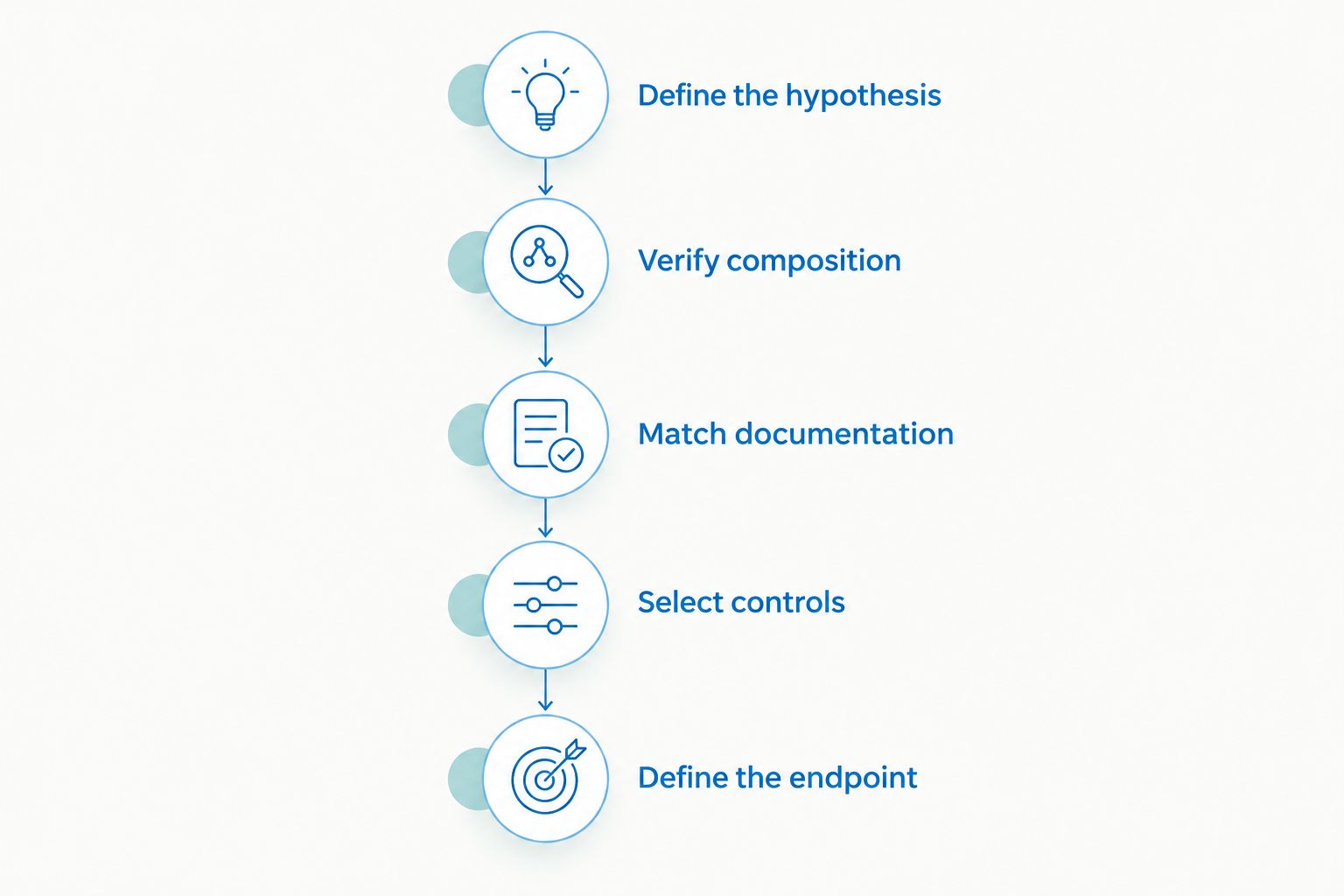
Use this sequence to connect your 2026 material-selection decision to an interpretable result:
- Define the hypothesis. State why the combination is necessary and what comparison would challenge your explanation.
- Verify composition. Confirm constituent identities and quantities rather than inferring them from total mass.
- Match documentation. Connect the material identifier to the analytical documents you will retain with the study record.
- Select controls. Include the comparisons needed to separate vehicle effects, individual contributions, and the combined response.
- Define the endpoint. Specify the measured outcome and the claims that measurement can support.
A blend-versus-untreated comparison answers a narrower question than a study with constituent controls. Write that limitation into the interpretation rather than expanding the conclusion after a positive result.
Also distinguish technical repetition from independent experimental evidence. Repeating a measurement helps assess measurement consistency, but it does not resolve an uncharacterized formulation or an unsuitable biological model.
Which peptide blend should you choose?
Choose GLOW Blend as the default shortlist entry only for a question involving its three named constituents. Choose KLOW Blend when KPV is part of the hypothesis, not as an automatic upgrade.
CJC-1295 No DAC & Ipamorelin belongs in a receptor-focused selection process. Retatrutide & Cagrilintide belongs in a combined metabolic-signaling selection process. Neither is a substitute for a tissue-repair blend simply because all are peptide combinations.
If your actual question concerns one compound, a premixed blend is not the cleanest starting comparison. Select material around the question you need to answer, not around the number of constituents.
FAQ
What’s the best peptide blend for in-vitro research in 2026?
GLOW Blend is the default shortlist entry for a research question involving BPC-157, GHK-Cu, and TB-500 together. There is no universal best blend across unrelated models and endpoints; verify composition and batch-linked documentation before selection.
Is KLOW Blend better than GLOW Blend?
KLOW Blend is not established as better than GLOW Blend by the catalog descriptions. KLOW includes KPV, so choose between them according to whether KPV belongs in the experimental hypothesis.
Does a blend’s total mass tell me the component ratio?
No, total blend mass alone does not establish component ratios. Obtain constituent quantities rather than assuming equal proportions or inferring them from differences between product totals.
Does a Certificate of Analysis prove that a peptide blend works?
No, a Certificate of Analysis reports the specified analytical results, not universal biological performance. Review its methods and sample identification, then evaluate biological activity within the intended model.
Can I use a blend to prove synergy?
A blend response alone does not prove synergy. Synergy requires an appropriate comparison framework that distinguishes the combined response from the relevant individual-component expectations.
Which blend fits paired GHRH and ghrelin-receptor research?
CJC-1295 No DAC & Ipamorelin is the listed combination for that research direction. Its relevance still depends on the model’s receptor biology and the endpoint selected.
Are these peptide blends intended for human or veterinary use?
No, these recommendations concern laboratory and in-vitro research only. They provide no human or veterinary use advice, dosing instructions, or therapeutic recommendations.
One last thing
A smaller total mass does not establish a simpler formulation, and an added constituent does not establish a better experiment. Before selecting an Anchorpeptide blend, write one sentence stating what each constituent contributes to the hypothesis. If you cannot explain a constituent's role, reconsider the combination before interpreting its results.
Related guides
- Tissue-repair research peptides for laboratory studies
- Anti-inflammatory research peptides
- Growth hormone secretagogue peptides for research
- GLP-1 receptor agonist research peptides