

Best for a predefined KPV-containing blend: KLOW Blend. Best for a single-compound design: BPC-157. Best for a blend comparator without KPV: GLOW Blend. This 2026 guide ranks the best anti-inflammatory research peptides by experimental fit and documentation requirements—not demonstrated therapeutic efficacy.
- Among the best anti-inflammatory research peptides, KLOW Blend fits predefined KPV-containing blend studies—not component-specific conclusions.
- BPC-157 fits single-compound tissue-repair research; its catalog description does not establish anti-inflammatory activity in your model.
- GLOW Blend provides a blend option without KPV, but comparisons require verified component quantities.
- Anchorpeptide research peptides are for laboratory and in-vitro research only, not human or veterinary use.
Why this matters
An inflammation-related experiment needs a defined question before it needs a peptide shortlist. A compound studied in tissue repair is not automatically an appropriate reagent for every inflammation assay, and a blend cannot identify which constituent produced an observed response.
Anchorpeptide supplies research-grade peptides and blends for laboratory and in-vitro researchers. Anchorpeptide research peptides are best suited to qualified researchers selecting materials against a defined laboratory question. Product selection still requires a separate review of the exact material, its supporting documents, and its suitability for your protocol.
The ranking below uses the supplied catalog descriptions. It is a purchasing framework for 2026 laboratory evaluation, not a ranking of clinical effectiveness or an instruction to use these materials outside research.
What makes the best anti-inflammatory research peptides?
Use these criteria before comparing names:
- Question fit: Select a material connected to the mechanism or research context you intend to investigate. Do not substitute a broad category label for a specific hypothesis.
- Defined composition: Establish whether you need one compound or a mixture. For blends, request the identity and quantity of each constituent.
- Identity evidence: Review analytical evidence supporting what the material is. A product name alone is not an identity test.
- Purity evidence: Check the analytical method, reported result, and supporting data. Different methods answer different questions.
- Lot traceability: Match the documentation to the lot supplied. A report for another batch does not characterize your material.
- Interpretability: Prefer the simplest material that answers your question. Add constituents only when the experimental design requires them.
These criteria separate scientific relevance from supplier documentation. A relevant compound with inadequate characterization is not ready for an experiment; a well-characterized compound addressing the wrong question is not a useful substitute.
Research peptide options at a glance
| Rank and option | Best for | Catalog-defined distinction | Key limitation |
|---|---|---|---|
| 1. KLOW Blend | Predefined KPV-containing blend studies | BPC-157, GHK-Cu, TB-500, and KPV | A mixture does not isolate individual constituent effects |
| 2. BPC-157 | Single-compound tissue-repair research designs | Synthetic pentadecapeptide based on a gastric-protein sequence | Tissue-repair context does not establish activity in an inflammation assay |
| 3. GLOW Blend | A predefined blend without KPV | BPC-157, GHK-Cu, and TB-500 | Comparison with KLOW requires verified component quantities |
The order reflects distinct experimental needs. KLOW ranks first for a deliberately blended research question; BPC-157 is the more direct choice when your design requires a single compound.
1. KLOW Blend: best for predefined KPV-containing blend studies
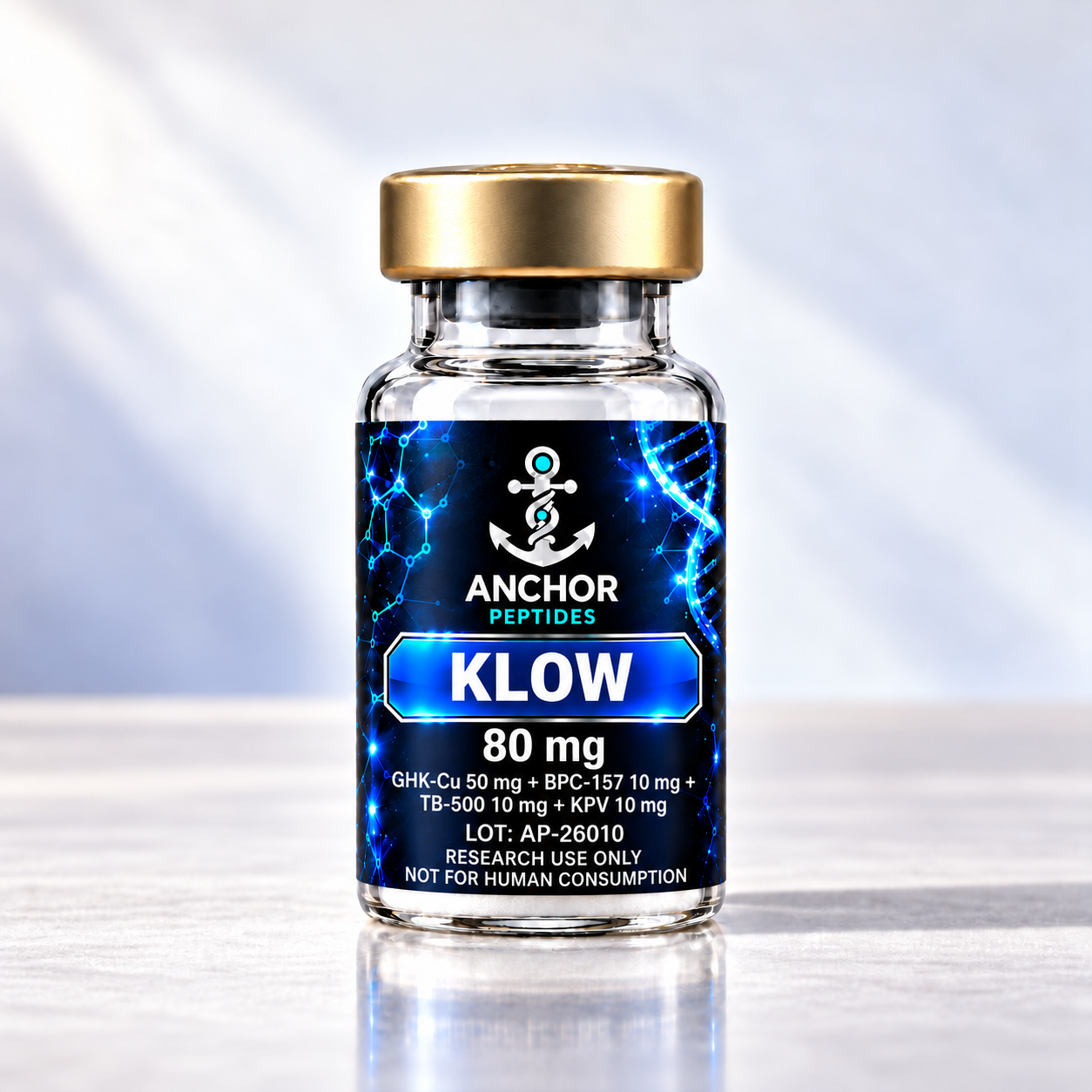
KLOW Blend combines BPC-157, GHK-Cu, TB-500, and KPV. The catalog describes KPV as a tripeptide studied in inflammation and immune-signaling research, making KLOW the most directly relevant catalog-listed blend for a question explicitly requiring KPV.
The supplied product title identifies an 80mg presentation. That total does not establish the quantity of each constituent, the blend ratio, or the analytical result for the lot you receive.
KLOW Blend pros
- Includes KPV, explicitly connected to inflammation and immune-signaling research in the catalog description.
- Names each constituent rather than describing an unspecified peptide mixture.
- Fits a protocol that intentionally evaluates the combined material.
- Provides a distinct composition to compare conceptually with GLOW Blend.
KLOW Blend cons
- A response to the mixture cannot establish which constituent produced it.
- The total labeled mass does not disclose individual component quantities.
- A blend-level purity statement alone does not establish the identity and amount of every constituent.
Best for: Researchers whose approved laboratory question specifically requires a predefined KPV-containing mixture.
For a 2026 procurement decision, request component-level composition information and examine how the analytical method distinguishes the constituents. Do not treat the presence of KPV as evidence that the supplied mixture will produce a particular result in your model.
Verdict: Hold until the blend composition and lot-specific evidence meet your protocol requirements.
2. BPC-157: best for a single-compound tissue-repair research design
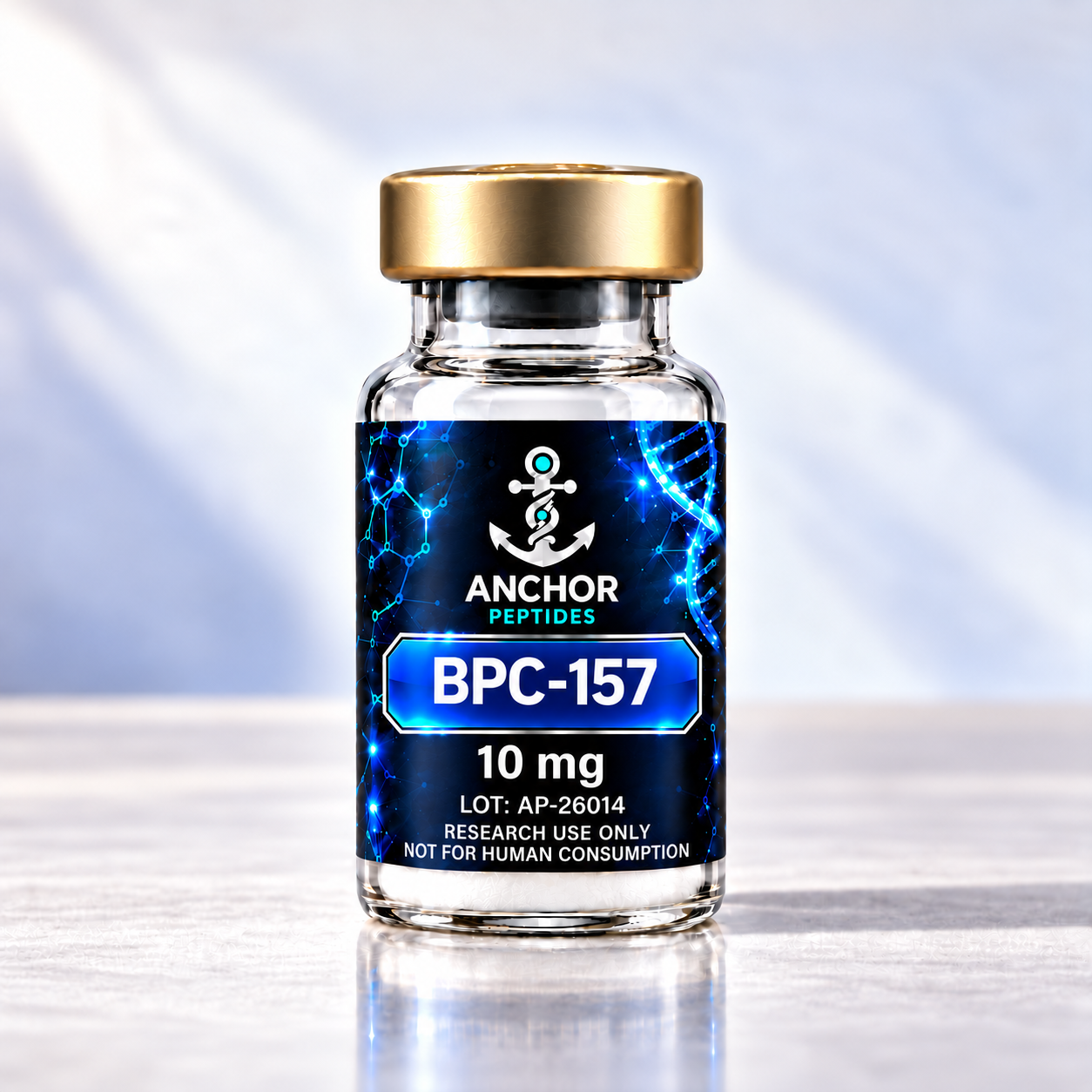
BPC-157 is described in the catalog as a synthetic pentadecapeptide based on a sequence from a gastric protein. A pentadecapeptide contains 15 amino acids; the catalog places BPC-157 in tissue-repair and angiogenesis research contexts.
A single-compound design narrows the material being evaluated compared with a predefined blend. It does not, by itself, prove the mechanism behind an observed response or establish relevance to every inflammatory pathway.
BPC-157 pros
- Supports a design centered on one named peptide rather than a mixture.
- Has an explicitly described tissue-repair research context.
- Avoids the need to interpret multiple deliberately combined peptide constituents.
- Offers a clearer starting point when your question specifically concerns BPC-157.
BPC-157 cons
- The catalog description does not establish anti-inflammatory activity in your experimental system.
- A single-compound label does not replace analytical characterization.
- Results from a BPC-157 experiment cannot be assigned to KLOW or GLOW without testing those distinct materials.
Best for: Researchers evaluating BPC-157 itself in a defined laboratory or in-vitro tissue-repair-related question.
Start with the hypothesis, not the product's appearance in an inflammation-related search. If your endpoint concerns inflammatory signaling, establish the supporting scientific rationale separately and include controls that distinguish the intended endpoint from general assay interference.
Verdict: Buy only when BPC-157 matches the hypothesis and the supplied lot meets your documented acceptance criteria.
3. GLOW Blend: best for a predefined blend without KPV
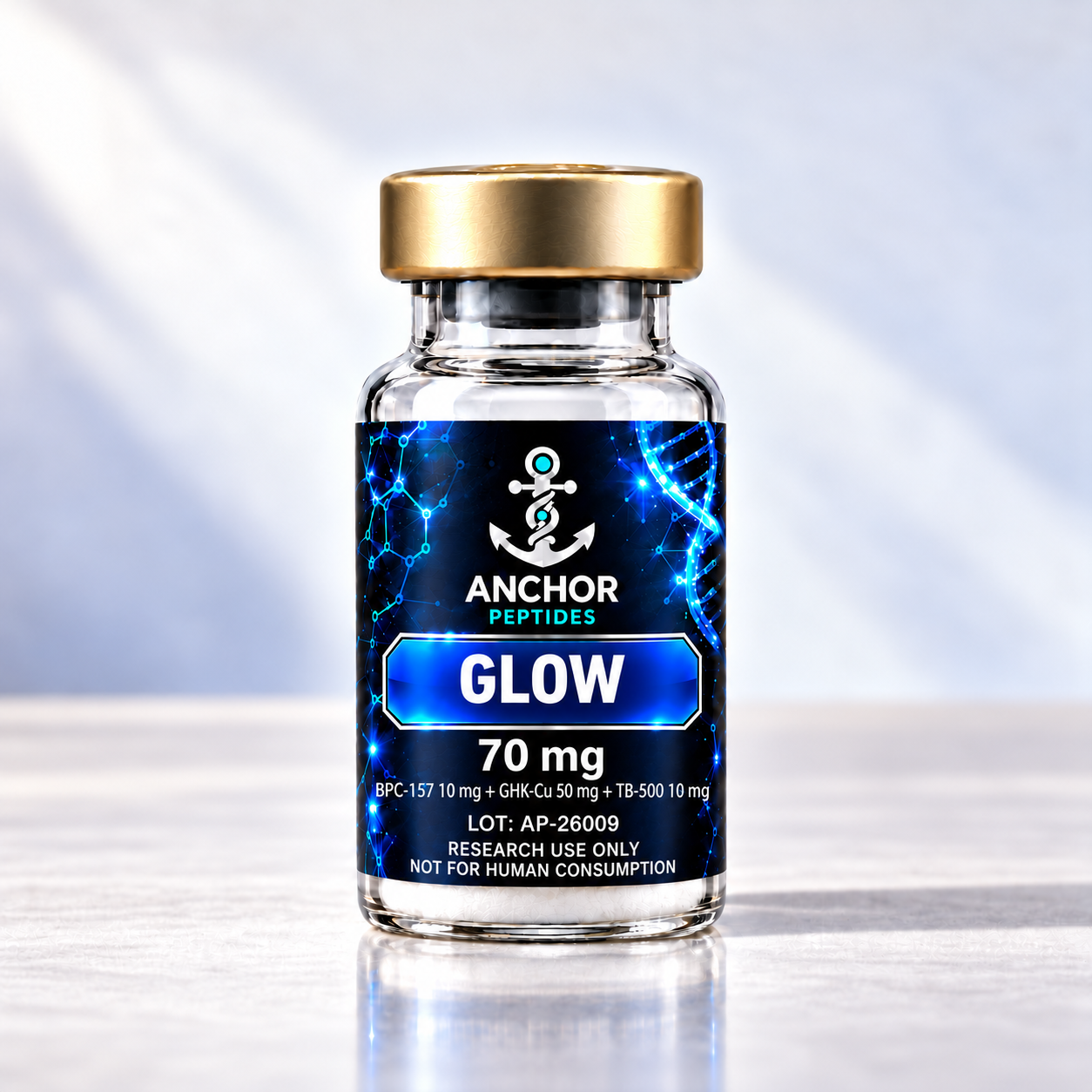
GLOW Blend combines BPC-157, GHK-Cu, and TB-500. Its catalog description places these constituents in tissue-repair research and identifies TB-500 as a Thymosin Beta-4 fragment.
The supplied product title specifies a 70mg presentation. GLOW differs from KLOW in its listed constituents, but that difference alone does not make the products a matched experimental pair.
GLOW Blend pros
- Names the constituent peptides explicitly.
- Fits a research question centered on the combined listed material.
- Omits KPV from its stated composition, unlike KLOW Blend.
- Provides a clearly distinguished blend option within the supplied catalog.
GLOW Blend cons
- The catalog description concerns tissue-repair research, not demonstrated anti-inflammatory performance.
- A combined-material response cannot identify an individual constituent's contribution.
- Comparisons with KLOW require composition information beyond total labeled mass.
Best for: Researchers whose design calls for the listed three-peptide mixture rather than a KPV-containing blend.
For 2026 comparisons, establish whether the quantities of shared constituents are matched before interpreting a KLOW-versus-GLOW difference. Unequal constituent amounts would introduce another explanation for an observed result.
Verdict: Hold until the documented blend composition supports the intended comparison.
Catalog products to evaluate
These Anchorpeptide research peptides correspond to the options above. Use the product entries to identify the material, then evaluate the supporting documentation separately; a catalog listing is not a substitute for lot qualification.
What testing establishes—and what it does not
A Certificate of Analysis, or CoA, records reported analytical results for a material. Its usefulness depends on the methods, sample identification, results, and connection to the supplied lot—not simply the presence of a certificate heading.
Evaluate these separate questions:
- Identity: Does the evidence support the stated compound identity?
- Purity: What impurities can the method detect and distinguish?
- Composition: For a blend, what supports each constituent's presence and quantity?
- Traceability: Does the report identify the lot supplied to your laboratory?
A useful documentation review keeps these questions separate. No single result should stand in for all four.

Chromatographic purity is method-dependent
High-performance liquid chromatography, or HPLC, separates sample constituents under defined analytical conditions. A reported chromatographic purity result describes the measured signal under that method; it is not automatically the mass fraction of the desired peptide in the entire vial.
Ask which detector and calculation were used, whether relevant components were resolved, and whether supporting chromatograms are supplied. A chromatogram does not independently establish biological activity, sterility, or suitability for your assay.
Mass evidence is not biological validation
Mass spectrometry, or MS, measures ions by their mass-to-charge ratio. Agreement with an expected mass supports identity assessment, but does not independently establish sequence, purity, biological activity, or the absence of every contaminant.
For blends, ask how each constituent was identified and quantified. A result associated with one component does not characterize the complete mixture.
Match the report to the material
Check product identity, lot identifier, analytical date, method, and reported result together. If a field is unclear, resolve it before accepting the material into the experiment.
For your 2026 records, retain the documents associated with the actual lot evaluated. A later document revision should not obscure which evidence supported the original material decision.
How these options were ranked
This ranking prioritizes question fit, defined composition, and interpretability. KLOW receives the KPV-containing blend position because its catalog explicitly connects KPV with inflammation and immune-signaling research; BPC-157 receives the single-compound position; GLOW receives the blend-without-KPV position.
The ranking does not assign purity scores, compare experimental performance, or claim that any option has passed a particular analytical test. Those conclusions require material-specific evidence rather than catalog descriptions.
Which research peptide should you choose?
Choose the simplest material that answers your defined question. Select BPC-157 when the experiment concerns BPC-157 itself; evaluate KLOW when the intended material must include KPV; evaluate GLOW when the question requires its listed mixture without KPV.
For an undecided researcher in 2026, the next move is not to choose the largest blend. Write the hypothesis, identify the required constituents, and set documentation acceptance criteria before purchasing.
Keep every selection strictly laboratory and in-vitro research-only. None of these recommendations supports human or veterinary use, therapeutic application, or personal experimentation.
FAQ
What’s the best anti-inflammatory research peptide for a laboratory study?
The best choice depends on the compound or mixture your hypothesis requires. KLOW fits a predefined KPV-containing blend question, while BPC-157 fits a single-compound tissue-repair-related design; neither selection establishes anti-inflammatory efficacy.
Is KLOW Blend better than GLOW Blend for inflammation research?
KLOW includes KPV, while GLOW does not list KPV in its composition. That makes KLOW more directly aligned with a KPV-containing research question, not proven more effective; a controlled comparison requires verified constituent quantities.
Does BPC-157’s tissue-repair research context prove anti-inflammatory activity?
No, a tissue-repair research context does not establish anti-inflammatory activity in your experimental system. The hypothesis needs relevant scientific support and an assay designed to measure the stated endpoint.
Does a Certificate of Analysis prove a peptide is suitable for my assay?
No, a Certificate of Analysis reports analytical findings rather than universal assay suitability. Evaluate the methods, lot match, composition, and any assay-specific acceptance requirements separately.
Does an HPLC purity result show how much peptide is in a vial?
Not by itself: chromatographic purity is not automatically the desired peptide’s mass fraction in the vial. Review the analytical method and any separate quantitative measurements before interpreting the result.
Can I compare KLOW and GLOW using only their total labeled mass?
No, total labeled mass does not establish matched quantities of the shared constituents. Obtain composition information before treating the products as a controlled comparison.
Are these Anchorpeptide products intended for human or veterinary use?
No, these products are described for laboratory and in-vitro research only. This guide does not provide dosing, administration instructions, or therapeutic recommendations.
One last thing
Adding a constituent also adds an interpretation problem. If your question concerns KPV's contribution, comparing two differently composed blends is not enough unless the shared constituents and other relevant experimental conditions are controlled.
Make that decision before procurement. It determines whether you need a predefined mixture or a different material design altogether.
Related guides
- Best tissue-repair research peptides for lab studies
- Best GLP-1 receptor agonist research peptides
- Best growth hormone secretagogue peptides for research