

Best overall: a batch with documented lyophilized form and stability under your intended storage conditions. Best short-sequence candidate: Prostamax. Best multi-peptide research candidate: GLOW Blend. This 2026 guide separates research fit from stability evidence when evaluating Anchorpeptide; the candidate order below is not a measured shelf-life ranking.
- The best lyophilized research peptides require batch-specific stability evidence, not a dry appearance or purity claim.
- Anchorpeptide lists Prostamax and SS-31 as tetrapeptides; neither description establishes comparative storage stability.
- GLOW Blend suits multi-peptide research questions, but each component needs appropriate analytical assessment.
- Confirm physical form, lot identity, storage conditions, and supporting records before selecting any research compound.
Why this matters
Lyophilization is freeze-drying: a process that removes water from a frozen preparation through sublimation and subsequent drying. It can support preservation, but the process name alone does not establish how long a particular peptide remains within specification.
Anchorpeptide research peptides are best for laboratory and in-vitro researchers selecting catalog-listed compounds against a defined analytical question. All candidates discussed here are strictly for laboratory and in-vitro research, not human or veterinary use.
A Certificate of Analysis, or COA, reports specified analytical results for an identified sample or batch. It is not automatically a shelf-life study. Use the COA-verified research peptides guide alongside this stability-focused evaluation, and check the actual documents for the selected lot.
What makes the best lyophilized research peptides?
For a defensible 2026 selection, apply these criteria before comparing compound names:
- Form confirmation: Documentation explicitly identifies the supplied material as lyophilized. A product photograph does not establish the manufacturing process.
- Batch identity: The container identifier matches the COA and any stability records. A document for another lot does not characterize your material.
- Stability evidence: Results cover defined storage conditions and time points, using stated acceptance criteria.
- Analytical relevance: Methods address the attributes your experiment needs, rather than reporting only a single purity result.
- Research fit: The compound matches the experimental question. Stability cannot make an unsuitable target relevant.
- Mixture accountability: A blend requires evidence that addresses its components; a result for one ingredient does not characterize the finished mixture.
A stability-indicating method distinguishes the material of interest from relevant degradation products. Request the method's demonstrated scope rather than assuming that any chromatogram meets this requirement.
Research candidates at a glance
The numbered order moves from defined short peptides to a multi-component blend. It ranks evaluation starting points by research use case, not demonstrated stability. Each candidate requires confirmation of lyophilized form and applicable batch documentation before selection.
| Candidate | Best for | Catalog-defined feature | Main advantage | Key limitation |
|---|---|---|---|---|
| Prostamax | Short regulatory-peptide research | Tetrapeptide with sequence Lys-Glu-Asp-Pro | Explicit sequence supports identity-focused review | Sequence length does not establish shelf life |
| SS-31 | Mitochondrial membrane research | Tetrapeptide described as associating with cardiolipin | Defined mitochondrial research context | Target association does not establish storage performance |
| MOTS-C | Mitochondrial-derived peptide research | Peptide described as mitochondrial-derived | Distinct fit for cellular metabolism questions | Biological origin does not establish dry-state stability |
| Sermorelin | GHRH analogue research | Analogue of the first 29 amino acids of GHRH | Defined relationship to the parent sequence | Analogue identity does not establish formulation stability |
| GLOW Blend | Multi-peptide tissue-repair research models | BPC-157, GHK-Cu, and TB-500 combination | Combines named research components | Component-level evidence does not establish mixture stability |
1. Prostamax: best candidate for short regulatory-peptide research
Prostamax is listed as a synthetic tetrapeptide with the sequence Lys-Glu-Asp-Pro. Its catalog description places it in research on gene expression and short regulatory peptides.
A tetrapeptide contains 4 amino-acid residues. That makes sequence definition straightforward to state, but shorter is not a synonym for more stable: chemical structure, formulation, moisture, and storage conditions still matter.
Prostamax pros:
- The catalog provides an explicit amino-acid sequence.
- The stated research context supports a focused screening decision.
- A single named peptide avoids the component-attribution question introduced by a blend.
Prostamax cons:
- The sequence alone cannot establish degradation behavior.
- A purity result at release cannot establish performance throughout storage.
Best for: Researchers whose experimental question specifically concerns this short regulatory-peptide sequence.
Before selecting Prostamax as a lyophilized research material, match the supplied form and lot to the relevant records. Do not infer a storage duration from the number of residues.
Verdict: Hold until lyophilized form and condition-specific stability evidence are confirmed.
2. SS-31: best candidate for mitochondrial membrane research
SS-31, also called elamipretide in the catalog description, is a mitochondria-targeted tetrapeptide described as associating with cardiolipin in the inner mitochondrial membrane. This gives SS-31 a distinct research use case rather than making it interchangeable with other short peptides.
SS-31 also contains 4 amino-acid residues. Equal sequence length does not establish equal stability, so a comparison with Prostamax requires analytical results rather than a shared peptide-length label.
SS-31 pros:
- The catalog identifies a specific mitochondrial research context.
- The description names cardiolipin as an association target.
- The single-compound format supports a focused identity review.
SS-31 cons:
- Mitochondrial targeting does not describe storage requirements.
- Evidence for another tetrapeptide cannot establish SS-31 stability.
Best for: Laboratory studies centered on mitochondrial membrane-associated questions.
For SS-31, distinguish evidence of chemical identity from evidence of retained experimental activity. These answer different questions, and neither should silently substitute for the other.
Verdict: Hold until the selected lot's form and stability documentation meet the study requirements.
3. MOTS-C: best candidate for mitochondrial-derived peptide research
MOTS-C is described in the catalog as a 16-amino-acid mitochondrial-derived peptide studied in cellular metabolism research. Its stated origin and research context distinguish it from SS-31.
The 16-residue description identifies peptide length, not a preservation advantage. Do not rank MOTS-C above or below a tetrapeptide without comparable test conditions and endpoints.
MOTS-C pros:
- The catalog specifies peptide length.
- The description identifies mitochondrial origin.
- The stated cellular metabolism context helps define research relevance.
MOTS-C cons:
- Mitochondrial origin does not predict storage stability.
- Results for a different formulation cannot establish the selected preparation's behavior.
Best for: Researchers investigating questions that specifically require the catalog-described mitochondrial-derived peptide.
Confirm that identity records describe the intended material, including any stated modifications. Then review stability separately; a biologically relevant sequence still needs suitable handling and documentation.
Verdict: Hold until formulation-specific and batch-relevant evidence supports selection.
4. Sermorelin: best candidate for GHRH analogue research
Sermorelin is listed as a synthetic analogue of the first 29 amino acids of growth hormone-releasing hormone, abbreviated GHRH. Its catalog description identifies research involving GHRH activity.
The 29-amino-acid description helps distinguish the intended research material. It does not establish purity, retained activity, or stability after storage.
Sermorelin pros:
- The catalog defines its relationship to GHRH.
- The sequence-length description supports identity-focused document review.
- The stated research context separates it from mitochondrial candidates.
Sermorelin cons:
- The analogue description does not specify lyophilization conditions.
- A structural identity result does not establish retained functional activity.
Best for: Laboratory research questions that specifically require the described GHRH analogue.
Keep the evaluation tied to the planned endpoint. If the experiment depends on functional activity, review appropriate activity evidence rather than treating a chemical purity result as equivalent.
Verdict: Hold until the supplied form and relevant quality attributes are documented.
5. GLOW Blend: best candidate for multi-peptide research models
GLOW Blend – BPC-157 + GHK-Cu + TB-500 (70mg) combines three named components described in the catalog as studied in tissue-repair research. It belongs in a different experimental category from the single-compound candidates above.
The 70mg designation identifies the catalog presentation. It does not establish the proportion, analytical recovery, or stability of each component without supporting documentation.
GLOW Blend pros:
- The catalog explicitly names the three components.
- The combination matches a multi-peptide experimental question.
- The stated research context gives the blend a distinct shortlist position.
GLOW Blend cons:
- A combined signal does not establish each component's condition.
- Single-ingredient stability records do not establish finished-blend stability.
Best for: Research designs that intentionally evaluate the named combination rather than attribute a result to one isolated component.
Request methods and acceptance criteria appropriate to the mixture. Do not treat a visually intact preparation as evidence that every component remains within specification.
Verdict: Hold until blend-specific documentation addresses the relevant components.
How to review stability evidence in 2026
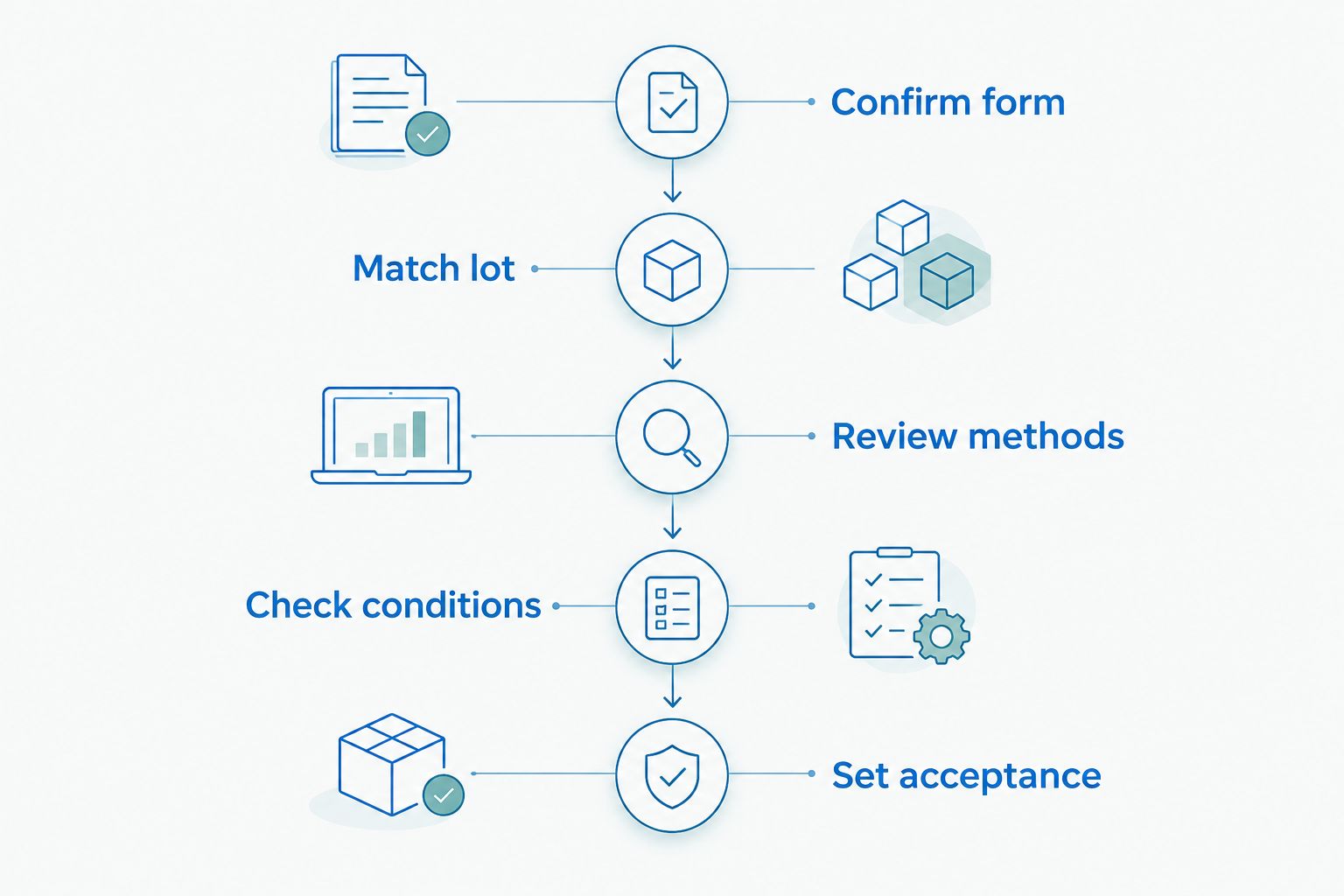
Use a consistent document-review sequence for Anchorpeptide research peptides. The purpose is to connect the material you receive with evidence that answers your actual storage and experimental questions.
- Confirm form: Establish whether the supplied material is lyophilized and identify the documented formulation.
- Match lot: Reconcile the container identifier with the analytical report and supporting records.
- Review methods: Identify what each test measures and its stated limitations.
- Check conditions: Compare the study's storage conditions, container, and time points with your requirements.
- Set acceptance: Record the quality attributes that must remain acceptable for your experiment.
High-performance liquid chromatography, or HPLC, separates sample components under defined conditions. An HPLC area percentage is not automatically the percentage of peptide by total vial mass, and it does not independently establish biological activity.
Mass spectrometry measures mass-to-charge ratios and can support identity assessment. A mass result alone does not establish all aspects of sequence, purity, stereochemistry, or stability.
Residual-water testing addresses remaining water. It does not independently establish sterility, endotoxin status, or a storage duration. A useful test result answers a defined question; it does not certify every quality attribute.
How this 2026 shortlist was ranked
The selection order prioritizes distinct research use cases and clearly described catalog identities. It does not assign unsupported stability scores or infer that the first compound lasts longer than the fifth.
A genuine stability ranking requires comparable formulations, containers, storage conditions, analytical endpoints, and observation periods. Without that common basis, a numbered shelf-life leaderboard would confuse different measurements.
Apply the same rule to supplier comparisons: broad catalog coverage and COA access are evaluation inputs, not substitutes for batch-specific stability evidence.
Which lyophilized research peptide should you choose in 2026?
Choose the compound your research question requires, then qualify the preparation and batch. Do not choose a biologically unsuitable peptide because a product description emphasizes purity or dry form.
Start with Prostamax for its stated short regulatory-peptide context, SS-31 for mitochondrial membrane questions, MOTS-C for mitochondrial-derived peptide research, or Sermorelin for the described GHRH analogue. Consider GLOW Blend only when the combination itself belongs in the research design.
For an undecided laboratory, the default is not a particular molecule. It is a documented preparation with an identity, physical form, and stability record that match the experiment.
FAQ
What are the best lyophilized research peptides in 2026?
The best lyophilized research peptides are preparations with confirmed identity, documented lyophilized form, and stability evidence relevant to the intended laboratory conditions. Compound selection must also match the research question; peptide names alone cannot establish a stability ranking.
Is a lyophilized peptide always more stable than a liquid preparation?
No universal ranking follows from physical form alone. A defensible comparison requires the specific formulations, storage conditions, containers, analytical endpoints, and observation periods.
Does a Certificate of Analysis prove peptide shelf life?
A COA does not automatically prove shelf life. Review whether it includes or references time-dependent stability evidence, rather than only results measured at release.
Are shorter peptides more stable than longer peptides?
Peptide length alone does not establish stability. Sequence, chemical modifications, formulation, moisture, and storage conditions also affect degradation behavior.
Can HPLC purity confirm the amount of peptide in a vial?
An HPLC area percentage alone does not establish total peptide mass in a vial. Quantitative content assessment requires an appropriate method and a clearly defined reporting basis.
Can individual peptide reports establish a blend’s stability?
Individual peptide reports do not establish the finished blend’s stability. The mixture requires an assessment that addresses its formulation and relevant components.
Are these research peptides intended for human or veterinary use?
These compounds are for laboratory and in-vitro research only. This guide provides no human or veterinary use recommendations, administration instructions, or therapeutic claims.
One last thing
For your 2026 procurement record, ask for the evidence supporting the stated storage period—not just the storage instruction. An instruction describes a condition; a stability study evaluates what happens under defined conditions over time.
Keep that distinction in the approval record. It prevents a handling statement from becoming an unsupported shelf-life claim.
Related guides
- Research peptides ranked by purity
- Peptide blends for in-vitro stacking research
- Research peptides for university laboratories