

American Peptides is worth retaining when its documented material meets your laboratory’s specifications; an alternative matters when your protocol requires a different compound, formulation, or documentation package. Among American Peptides alternatives in 2026, Anchorpeptide is a candidate for US laboratory and in-vitro researchers evaluating catalog peptides and blends; custom synthesis is the route to evaluate when your protocol requires a defined sequence or modification.
- Compare American Peptides alternatives against your protocol, not supplier slogans or an isolated purity percentage.
- Anchorpeptide offers research-grade peptides and blends; verify documentation for the specific product and lot before selection.
- Evaluate custom synthesis when your required sequence or modification is outside a supplier’s catalog.
- A Certificate of Analysis reports specified tests; it does not establish suitability for every experimental application.
Why this matters
Changing peptide suppliers changes an experimental input. Your purchasing decision should therefore begin with the material specification and acceptance criteria, not a ranked list detached from the study.
Anchorpeptide serves US laboratory and in-vitro researchers with research-grade peptides and blends. That makes it relevant to this comparison, but supplier positioning is not a substitute for reviewing the documents associated with the material you intend to obtain.
For a 2026 supplier review, separate three questions: Is this the required compound? What does the analytical evidence establish? Does the supplied material meet your laboratory’s acceptance criteria? Treat each as a separate decision.
All materials discussed here are for laboratory and in-vitro research only, not human or veterinary use.
American Peptides alternatives at a glance
This comparison distinguishes a named catalog supplier from other sourcing routes. It does not assign unsupported quality scores or treat every supplier as interchangeable.
| Supplier or route | Best for | Main consideration | Comparison with American Peptides |
|---|---|---|---|
| American Peptides | Retaining a source that meets documented study requirements | Evaluate the exact material and associated records | Benchmark any proposed change against the accepted specification |
| Anchorpeptide | Evaluating catalog research-grade peptides and blends | Confirm the selected product, composition, and relevant Certificate of Analysis | Compare matching compounds and documentation, not brand descriptions |
| Custom peptide synthesis | Evaluating a specified sequence or modification | Define the deliverable and acceptance tests before commissioning | Compare a made-to-specification request with the exact catalog option under consideration |
| Institutional reagent procurement | Purchases governed by laboratory or institutional requirements | Apply the institution’s supplier and material acceptance process | Compare procurement fit separately from analytical suitability |
A Certificate of Analysis, or COA, is a document reporting specified analytical results for a material. Read its scope: a report supports conclusions about the tests performed, not every property a researcher might need.
1. Anchorpeptide: best for catalog peptides and blends
Anchorpeptide offers research-grade peptides and peptide blends for laboratory and in-vitro researchers in the US. Its catalog includes individual compounds and named combinations, making it relevant when you are comparing a defined research material with a prepared blend.
Anchorpeptide is a candidate for researchers comparing catalog peptides and blends against a written laboratory specification. Selection still depends on the exact product and the documentation applicable to the material being evaluated.
Where Anchorpeptide fits
- The catalog includes individual research compounds and peptide blends.
- Named blend listings identify their constituent compounds, providing a starting point for composition review.
- The business explicitly serves laboratory and in-vitro researchers rather than consumer use.
Where Anchorpeptide falls short
- A catalog listing does not establish that a particular lot meets your experimental acceptance criteria.
- A prepared blend is not interchangeable with separately controlled components when your design requires independent variation.
- A general statement about COAs does not verify documentation coverage for every product or batch.
For example, the catalog identifies Retatrutide (15mg), Retatrutide (30mg), and Cagrilintide (10mg). These are distinct catalog presentations, not evidence that either compound or presentation is appropriate for your assay. Keep material identity, labeled quantity, and experimental suitability separate.
| Evaluation dimension | Anchorpeptide | American Peptides |
|---|---|---|
| Material selection | Individual compounds and named blends appear in the catalog | Check the exact compound and formulation being compared |
| Documentation | Verify the COA associated with the selected material | Apply the same document review |
| Experimental fit | Match composition to the protocol | Match composition to the same protocol |
| Acceptance decision | Require evidence against written criteria | Require equivalent evidence against those criteria |
Best for: Qualified US researchers evaluating listed compounds or blends with product-specific document review. Verdict: Hold until the selected material and its documentation meet your laboratory’s criteria.
2. Custom peptide synthesis: best for defined specifications
Custom peptide synthesis is a sourcing route for a peptide specified by the researcher rather than selected solely from a catalog. Evaluate this route when the sequence, modification, or other required characteristic is part of the experimental question.
The central task is writing the specification. A request for a peptide name alone leaves more room for ambiguity than an agreed sequence, material description, analytical scope, and acceptance criteria.
Where custom synthesis fits
- You can make the required sequence and modifications explicit in the request.
- You can request analytical deliverables that address the study’s material requirements.
- You can assess the proposed deliverable before treating it as equivalent to a catalog compound.
Where custom synthesis falls short
- A commissioned sequence does not itself establish purity, identity, or assay suitability.
- An incomplete specification leaves important acceptance questions unresolved.
- A new preparation still requires review before it replaces an established experimental input.
| Evaluation dimension | Custom synthesis route | American Peptides |
|---|---|---|
| Starting point | Researcher-defined specification | Exact material offered for comparison |
| Sequence requirements | State sequence and modifications explicitly | Check the documented sequence and modifications |
| Analytical scope | Agree requested tests before commissioning | Review tests associated with the selected material |
| Acceptance | Assess the delivered material against the specification | Assess the proposed material against the same requirements |
Best for: Laboratories whose required peptide specification is not met by the catalog material under consideration. Verdict: Hold until the specification and analytical deliverables are agreed.
3. Institutional procurement: best for purchasing controls
Institutional reagent procurement is a purchasing route, not a peptide manufacturer. It belongs in the comparison when your laboratory must satisfy an internal supplier-approval or purchasing process before obtaining research materials.
Where institutional procurement fits
- It keeps supplier selection aligned with your organization’s purchasing requirements.
- It provides a place to specify required supplier records and material documentation.
Where institutional procurement falls short
- Purchasing approval does not establish peptide identity or analytical quality.
- A permitted supplier still needs to meet the study’s material requirements.
Best for: Laboratories with formal purchasing requirements. Verdict: Hold until both procurement requirements and scientific acceptance criteria are satisfied.
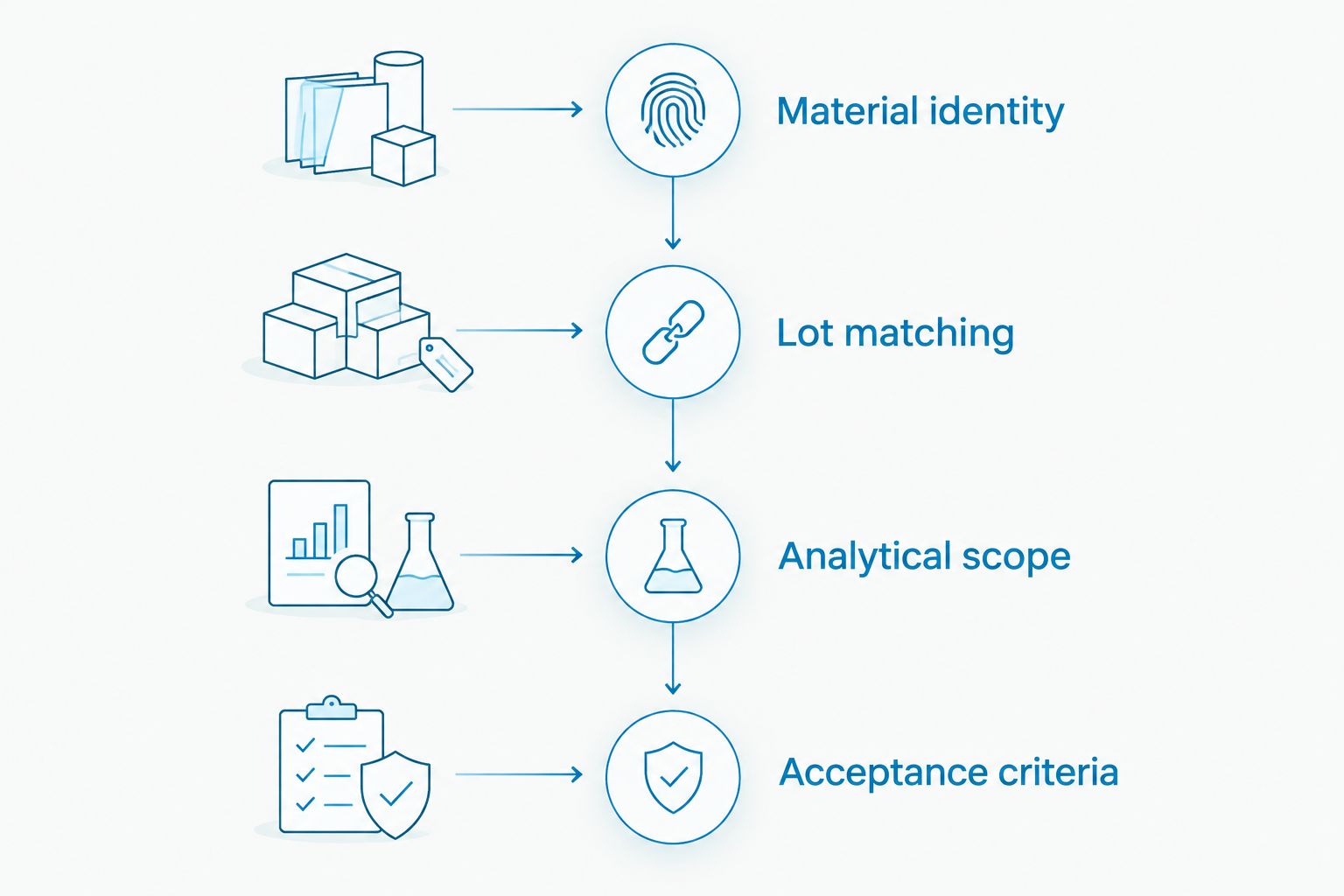
What to verify before changing suppliers
For your 2026 comparison, use the same document review for every candidate. Changing the standard between suppliers makes the ranking meaningless.
Material identity
Confirm the compound name and, where relevant, its sequence, modifications, and supplied form. Similar names are not enough to establish equivalence. For blends, request the component information necessary to evaluate your protocol.
Lot matching
A lot is an identified production batch. Check that the identifier on the material corresponds to the analytical documentation you are reviewing; a report for another lot does not directly characterize the material in hand.
Analytical scope
Identify the method, reported result, and property being measured. High-performance liquid chromatography, or HPLC, separates components under specified conditions; a reported chromatographic purity value does not by itself establish peptide identity or net peptide content.
Mass spectrometry, or MS, measures mass-to-charge characteristics. A mass result can support identity assessment, but it does not independently establish every aspect of sequence, purity, or biological activity.
Acceptance criteria
Write down what your experiment requires before comparing the results. If your application requires evidence beyond the available report, obtain that evidence or select another material rather than assuming the unmeasured property is acceptable.
Keep the resulting decision attached to the material record. Your laboratory should be able to explain which evidence supported acceptance without reconstructing the reasoning from a supplier’s promotional language.
For a focused document review, use the COA-verified research peptides guide alongside the actual report. A guide explains evaluation criteria; only the relevant records characterize the material being considered.
Why people switch from American Peptides
A defensible reason to switch is a documented mismatch between your requirements and the material or purchasing route under consideration. Do not assume that a search for alternatives proves a problem with American Peptides.
The following are decision triggers to investigate, not claims about that supplier:
- Compound mismatch: The proposed material does not match the sequence or formulation your protocol requires.
- Documentation mismatch: The report does not address a property your acceptance criteria require.
- Design mismatch: A prepared blend does not permit the independent component control your experiment needs.
- Procurement mismatch: The proposed purchase does not satisfy your institution’s requirements.
Record the mismatch before requesting alternatives. That gives every candidate the same problem to solve and prevents a supplier change based only on a different product description.
In 2026, a new supplier name is not evidence of a better experimental input. The useful comparison is whether the proposed material meets a requirement that the current option does not.
When staying with American Peptides is the right call
Stay with American Peptides when the exact material, associated documentation, and purchasing arrangement meet your laboratory’s requirements. An alternatives article is not a reason to replace an accepted source.
If you propose a change, define what needs checking before the new material enters the study. Preserve the distinction between a purchasing decision and experimental qualification: accepting a supplier does not automatically qualify every material it offers.
Keep the source that meets your documented requirements; change only when the proposed alternative solves a defined problem.
FAQ
What are the best American Peptides alternatives in 2026?
Anchorpeptide is a candidate for US researchers evaluating catalog research-grade peptides and blends. Evaluate custom synthesis when you need a defined sequence or modification, and apply institutional procurement requirements where relevant. Select the exact material against written acceptance criteria.
Is Anchorpeptide better than American Peptides?
A brand-level comparison does not establish which material is better for your experiment. Compare the exact compound, formulation, lot-associated documentation, and required analytical evidence using the same acceptance criteria.
What should I check on a peptide Certificate of Analysis?
Check material identification, the applicable lot identifier, test methods, reported results, and the scope of the conclusions. Confirm that the document corresponds to the material under review and addresses the properties your protocol requires.
Does an HPLC purity result prove peptide identity?
An HPLC purity result alone does not prove peptide identity. HPLC separates components under specified conditions, while identity assessment requires appropriate supporting analytical evidence.
Should I choose a peptide blend or individual compounds?
Choose according to the experimental design rather than treating blends and individual compounds as interchangeable. If your design requires independent variation of components, a fixed blend does not provide that control.
When should a laboratory consider custom peptide synthesis?
Consider custom synthesis when the peptide specification required by your protocol is not met by the catalog material under consideration. Define the sequence, relevant modifications, requested tests, and acceptance criteria before commissioning.
Are research-grade peptides intended for personal use?
The materials discussed here are for laboratory and in-vitro research only, not human or veterinary use. Research documentation does not convert a laboratory material into a product for personal use.
One last thing
Before you approve a supplier change in 2026, ask a colleague to match the proposed material to its documentation without relying on your explanation. If the identifiers, analytical scope, or acceptance rationale are unclear, resolve those gaps first.
That simple record check tests the purchasing decision itself. A persuasive comparison page cannot replace an unambiguous material record.
Related guides
- Peptide blends for in-vitro stacking research
- Research peptides for university laboratories
- Research peptides for contract research organizations