

Choose Anchorpeptide if its listed research compounds match your laboratory’s study requirements and the specific lot passes your qualification process; choose PS Peptides if your laboratory has already qualified its material and continuity is the deciding requirement. This 2026 comparison separates catalog fit from the analytical evidence needed to approve a research supplier.
- Anchorpeptide vs PS Peptides is a laboratory qualification decision, not a defensible purity ranking without matched analytical records.
- Anchorpeptide lists individual research peptides and blends; select by compound identity and experimental requirements.
- Choose PS Peptides for continuity when your laboratory has already qualified the exact material and supporting records.
- Neither a product name nor a purity result establishes suitability for your specific in-vitro assay.
Why this matters
A supplier comparison must distinguish an appropriate catalog entry from an approved research material. The first helps you identify candidates. The second requires evidence tied to the material your laboratory will actually receive.
For a 2026 procurement decision, define acceptance criteria before comparing suppliers. Otherwise, an attractive product description can displace the questions that matter: identity, composition, analytical methods, lot linkage, and experimental suitability.
All materials discussed here are for qualified laboratory and in-vitro research only. This comparison provides no guidance for human or veterinary use.
At a glance
The table distinguishes documented catalog characteristics from conditional purchasing decisions. A continuity advantage applies only when your laboratory already holds the relevant qualification records.
| Dimension | Anchorpeptide | PS Peptides |
|---|---|---|
| Best for | Researchers evaluating its listed compounds and blends | Laboratories retaining already-qualified material |
| Standout decision factor | Specific catalog entries identified below | Existing laboratory qualification, when established |
| Compound scope | Individual peptides, blends, and research small molecules are listed | Match the exact candidate to your protocol |
| Blend interpretation | Named multicomponent blends require component-level review | Apply the same component-level review |
| Analytical documentation | Assess the exact product and lot records | Assess the exact product and lot records |
| Study continuity | A supplier change requires a documented assessment | Retaining a qualified source avoids a supplier change |
| Qualification burden | Evaluate against your laboratory’s acceptance criteria | Existing approval matters only within its recorded scope |
| Pricing model | Confirm transaction terms for the specific requirement | Confirm transaction terms for the specific requirement |
Anchorpeptide fits researchers screening a defined catalog
Anchorpeptide is a research-peptide supplier for US laboratories evaluating individual compounds and blends. Its catalog gives researchers specific candidates to assess rather than a reason to assume that every listed material meets every protocol.
Examples illustrate the range without establishing analytical equivalence:
- SS-31: described as a mitochondria-targeted tetrapeptide, meaning a peptide containing 4 amino-acid residues.
- MOTS-C: described as a mitochondrial-derived peptide containing 16 amino acids.
- Sermorelin: described as an analogue of the first 29 amino acids of growth hormone-releasing hormone.
Those structural descriptions identify different research materials. They are not interchangeable options, and peptide length does not rank their quality.
The practical advantage is candidate selection: you can identify a named compound that matches the study question. The limitation is equally specific: a catalog description does not establish the identity, content, or suitability of an individual lot.
Best for: researchers building a shortlist from the listed compounds. Approve a candidate only after the material’s documentation satisfies the protocol’s requirements.
PS Peptides wins on continuity when its material is already qualified
PS Peptides is the better continuity choice when your laboratory has already qualified its exact material and changing suppliers serves no experimental requirement. This is an incumbent-source advantage, not a claim about better chemistry or testing.
An existing qualification file can connect a supplier, material specification, analytical record, and previous experimental work. Changing the source introduces a new purchasing decision that your laboratory must assess, even when the compound name stays the same.
Keep that advantage within its limits:
- Previous work with one compound does not qualify another compound.
- Acceptance of an earlier lot does not automatically approve a subsequent lot.
- A familiar supplier name does not resolve a changed specification.
- Historical assay performance does not replace current material review.
Best for: teams continuing an established study with an already-approved source. If PS Peptides is not an approved source in your laboratory, this continuity argument does not apply.
Compound identity matters more than apparent catalog breadth
Neither supplier wins because a product name appears in a catalog. Match the actual material specification to the study before considering breadth or convenience.
A peptide, an analogue, a fragment, a salt form, and a blend require different interpretation. A small molecule is not a peptide merely because the supplier lists it alongside peptides. For example, the supplied catalog describes SLU-PP-332 as a synthetic small molecule.
Use a specification that identifies what your experiment requires:
- Identity: the intended chemical entity or peptide sequence.
- Composition: whether the material is a single compound or a mixture.
- Form: relevant chemical and physical characteristics documented for the material.
- Acceptance: the evidence your laboratory requires before use.
For either supplier, a close name match is insufficient when the underlying specification differs. The right decision is the candidate that matches the protocol and passes qualification—not the supplier with the longest list.
Both suppliers face the same blend-attribution problem
A blend requires more interpretation than a list of its ingredients. The supplied catalog names GLOW Blend – BPC-157 + GHK-Cu + TB-500 (70mg) and KLOW Blend – BPC-157 + GHK-Cu + TB-500 + KPV (80mg). Those names identify different combinations, not equivalent research materials.
When several components enter an experiment together, the observed result does not by itself identify which component produced it. That limitation belongs to the experimental design, regardless of the supplier.
Before approving a blend, establish:
- Which components are specified.
- Whether component amounts or proportions are documented.
- What the analytical method measures in the mixture.
- Whether your controls support the interpretation you intend to make.
Best for: a blend is appropriate when the protocol explicitly investigates that combination. A single-compound material better fits a question requiring isolated evaluation of that compound.
The guide to peptide blends for in-vitro stacking research addresses the combination-research context. Keep supplier approval separate from experimental-design approval.
Neither supplier earns a testing win without matched records
A Certificate of Analysis is evidence to inspect, not a conclusion to inherit. A Certificate of Analysis, abbreviated CoA, records reported analytical results for an identified material. Its usefulness depends on the sample linkage, methods, results, and scope.
For your 2026 review, distinguish the questions commonly grouped under quality:
| Analytical question | What to examine | What it does not establish alone |
|---|---|---|
| Identity | Evidence supporting the intended chemical entity | Amount of intended compound in the container |
| Chromatographic purity | Separation method and reported peak interpretation | Universal absence of all contaminants |
| Content | A suitable quantitative measurement | Biological activity in your assay |
| Lot linkage | Matching identifiers across material and records | Suitability for a different experimental purpose |
High-performance liquid chromatography, or HPLC, separates sample components under defined conditions. A reported chromatographic purity result describes the measurement under those conditions; it is not automatically a measurement of total peptide content.
Mass spectrometry measures mass-to-charge ratios of detected ions. It can support identity assessment, but a mass result alone does not establish sequence, purity, content, and biological activity together.
Apply these distinctions equally. The CoA evaluation guide provides a related documentation-review starting point; the deciding evidence remains the record for the actual material.
An existing qualification file wins only within its scope
PS Peptides has a qualification-workload advantage only when your laboratory already holds an applicable approval. An existing file is useful because it records a decision; its value depends on what that decision covered.
Read the approval boundary. Confirm that it applies to the intended compound, specification, research purpose, and purchasing circumstances. An approval for exploratory screening does not automatically establish suitability for a different assay or a more restrictive protocol.
For a new candidate from either supplier, use the same review sequence:
- Define requirements: state the material specification and intended laboratory use.
- Match records: connect the proposed material to its supporting documentation.
- Review methods: determine what each reported test establishes.
- Record acceptance: document approval, rejection, or the evidence still required.
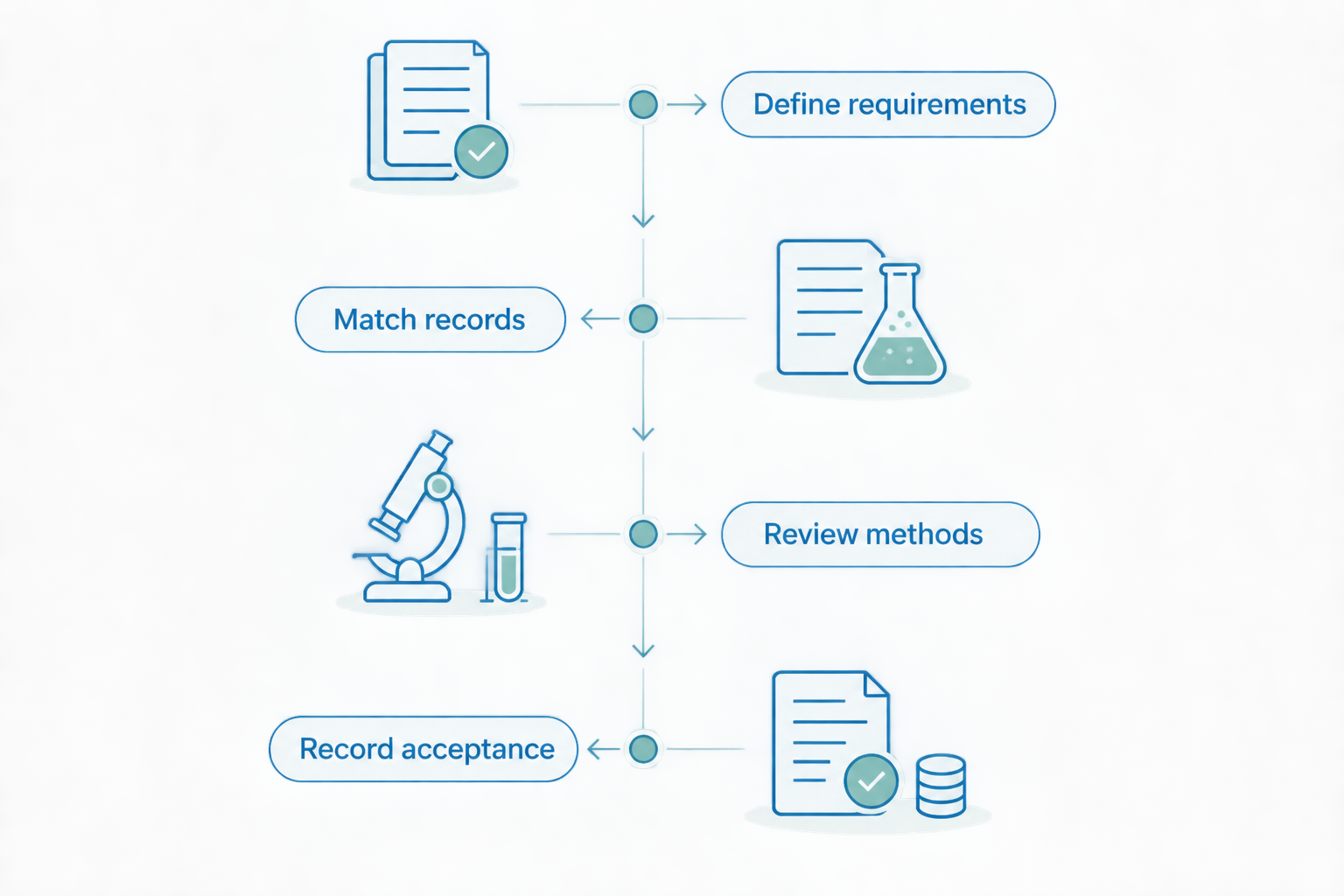
This sequence prevents an old approval from becoming a blanket endorsement. It also prevents a new supplier from receiving a lower evidentiary standard simply because a product description matches the study topic.
Pricing: compare purchasing terms without assuming a model
Neither supplier earns a commercial advantage from an assumed pricing model. For a 2026 purchasing decision, obtain the terms that apply to your specific material requirement and compare equivalent scopes.
Ask whether the transaction covers a defined catalog item, a separately scoped requirement, or recurring procurement. Treat those as questions to resolve, not established features of either supplier.
The tradeoff is predictability versus flexibility. A defined purchasing specification makes repeated comparisons clearer; a changed scope requires a fresh comparison. Neither arrangement compensates for material that fails your scientific acceptance criteria.
Keep commercial review separate from scientific approval. Procurement can assess transaction terms after the laboratory establishes which candidates meet the required specification and documentation standard.
Final verdict: choose the fit, then approve the material
Choose Anchorpeptide if you are screening a new research source
Best for: a US laboratory evaluating listed research peptides or blends against a defined protocol. The catalog provides identifiable candidates, including individual peptides and multicomponent combinations.
The benefit is a concrete starting point for selection. The constraint is that catalog fit does not establish lot acceptance: complete the analytical and documentation review before approving material for the study.
Choose PS Peptides if you are retaining an approved source
Best for: a laboratory continuing work with material it has already qualified. Retaining the established source is the stronger choice when continuity is a documented study requirement and the current material remains within the approval’s scope.
The benefit is continuity of the existing qualification record. The constraint is that incumbent status does not excuse review of changed material, specifications, or study requirements.
One-glance scorecard
| Dimension | Winner |
|---|---|
| Defined catalog screening | Client catalog, when the listed candidate matches the protocol |
| Existing-source continuity | PS Peptides, when already qualified |
| Compound identity | Neither by name alone |
| Blend interpretation | Tie: component-level assessment required |
| Analytical documentation | No winner without matched records |
| Qualification workload | PS Peptides, only with applicable existing approval |
| Purchasing terms | Decide from equivalent transaction scopes |
FAQ
Is Anchorpeptide better than PS Peptides for laboratory research?
Anchorpeptide fits researchers evaluating its listed compounds, while PS Peptides fits continuity-led purchasing when the laboratory has already qualified its material. Neither scenario establishes a general purity or quality advantage.
Which supplier has purer research peptides?
A defensible purity comparison requires relevant analytical records for the specific materials being compared. Review the methods, sample identifiers, and reported results rather than comparing supplier names.
Does a Certificate of Analysis prove a peptide will work in my assay?
A Certificate of Analysis does not establish performance in your specific assay. It reports analytical information within its stated scope; experimental suitability requires a separate assessment.
Is an HPLC purity result the same as peptide content?
An HPLC purity result is not automatically a peptide-content measurement. Chromatographic purity and quantitative content answer different questions and require appropriate methods.
Should a laboratory keep using PS Peptides if it is already approved?
Keep an approved source when it continues to meet the applicable specification and continuity supports the study. Reassess approval when the material, documentation, or intended research use changes.
Are peptide blends interchangeable with individual peptides?
Peptide blends are not interchangeable with individual peptides. Their combined composition changes what an experiment evaluates and how results can be attributed.
How should I compare purchasing terms between research suppliers?
Compare terms for equivalent material specifications and transaction scopes. Keep that commercial assessment separate from the scientific decision to accept the material.
One last thing
Write the rejection criteria before choosing the supplier. For your 2026 qualification file, specify which identity mismatch, documentation gap, or unsupported analytical interpretation would stop approval.
That small reversal keeps the decision consistent: evidence determines acceptance, rather than a preferred supplier determining how much evidence feels sufficient.
Related guides