

For qualified US laboratories comparing PS Peptides alternatives in 2026, Anchorpeptide is a research-grade peptide supplier to evaluate when its listed compounds match your in-vitro protocol. Compare the exact material, lot-linked documentation, and analytical methods before changing suppliers; a catalog match alone does not establish experimental equivalence.
- For PS Peptides alternatives, evaluate Anchorpeptide against your laboratory’s compound specifications and documentation requirements.
- A Certificate of Analysis reports specified test results; it does not establish suitability for every in-vitro assay.
- Compare single compounds and peptide blends separately because their analytical and experimental requirements differ.
- Keep PS Peptides when the supplied material and documentation already satisfy your laboratory’s acceptance criteria.
Why this matters
Changing a research peptide supplier changes a material input to your experiment. You need evidence that the replacement meets your specification, not simply a matching compound name on another website.
Anchorpeptide supplies research-grade peptides and peptide blends for laboratory and in-vitro researchers in the US. Its stated offering includes Certificates of Analysis, but you should confirm the document associated with the exact material under consideration rather than assume every listing has identical supporting evidence.
For a 2026 supplier review, separate three questions: Is this the specified compound? What does the analytical evidence establish? Does the material meet your laboratory’s acceptance criteria? Answer those questions before treating any supplier as an interchangeable source.
This comparison distinguishes a named supplier from alternative procurement routes. Custom synthesis and institution-approved purchasing are routes to investigate, not claims about particular companies or their services.
PS Peptides alternatives at a glance
Use the table as a procurement decision framework, not a ranking of unverified testing claims. Apply the same requirements to your current source and every replacement.
| Option | Best for | Main consideration | How to compare with PS Peptides |
|---|---|---|---|
| PS Peptides | Retaining a source that meets your approved specification | Current material and supporting records | Use the same acceptance criteria applied to alternatives |
| Anchorpeptide | US laboratories evaluating listed research peptides and blends | Catalog fit and documentation for the selected material | Compare exact compound identity, composition, and lot-linked evidence |
| Custom peptide synthesis | Projects requiring a defined sequence or modification | A project-specific manufacturing and analytical specification | Compare the requested deliverable rather than catalog names |
| Institution-approved supplier route | Laboratories with purchasing and supplier-qualification requirements | Procurement approval plus scientific suitability | Evaluate administrative approval separately from analytical acceptance |
The right alternative is the source whose material meets your documented specification. A longer catalog or a stronger headline does not answer that question.
1. Anchorpeptide: best for listed research peptides and blends
Anchorpeptide is an option for qualified US laboratories evaluating research-grade peptides and peptide blends for laboratory and in-vitro work. Start with a compound already specified in your research plan, then review the associated documentation. Do not choose the experimental question around a supplier’s catalog.
Where Anchorpeptide fits
- Single-compound evaluation: The supplied catalog includes named research compounds such as Retatrutide and Cagrilintide.
- Blend evaluation: The catalog also includes explicitly named multi-compound preparations.
- Research-use positioning: The stated offering addresses laboratory and in-vitro researchers rather than personal use.
- Documentation-led review: Certificates of Analysis form part of the stated offering; confirm coverage for the specific selection.
Where the option falls short
- A listing is not qualification: A product description cannot establish that a material meets your laboratory’s acceptance criteria.
- A blend is not a substitute for separate controls: A combined preparation does not isolate the contribution of each constituent.
- A certificate has limits: Its conclusions depend on the reported methods, sample identification, and scope of testing.
Head-to-head: what to inspect
| Dimension | Anchorpeptide evaluation | PS Peptides evaluation |
|---|---|---|
| Compound match | Match the listed compound to your specification | Apply the identical specification |
| Blend composition | Confirm constituents and documented composition | Request equivalent composition details |
| Analytical evidence | Review documentation tied to the selected material | Review documentation tied to the selected material |
| Laboratory acceptance | Compare results with predefined requirements | Use the same requirements |
Best for: Laboratories whose required compounds match the catalog and whose documentation requirements are satisfied after review.
Verdict: Hold until the exact material and its supporting evidence pass qualification.
2. Custom peptide synthesis: best for a defined sequence
Custom synthesis is a procurement route for research requiring a specified amino-acid sequence or modification. It changes the purchasing task: you define the material and analytical deliverables instead of selecting only from a catalog.
The benefit is specification control. The burden is that your laboratory must describe the requested material clearly enough to assess the delivered result.
Where custom synthesis shines
- You can specify the sequence and required chemical modifications.
- You can define requested analytical deliverables before commissioning work.
- You can distinguish requirements for exploratory work from those for an established assay.
Where custom synthesis falls short
- An incomplete specification leaves important acceptance questions unresolved.
- Custom manufacture does not automatically establish biological activity.
- A project-specific material still requires receiving checks and laboratory qualification.
Best for: Projects where a defined sequence or modification determines the research requirement.
Verdict: Hold until the synthesis specification and acceptance criteria are agreed.
3. Institution-approved suppliers: best for governed purchasing
An institution-approved supplier route suits laboratories that must satisfy purchasing, vendor onboarding, or internal quality requirements. Administrative approval and scientific qualification are separate decisions. Completing one does not complete the other.
Where this route shines
- Purchasing follows the institution’s established approval process.
- Supplier records can be assessed alongside the laboratory’s material requirements.
- Research staff and procurement staff can document their separate decisions.
Where this route falls short
- Approved status does not establish the identity or purity of a particular lot.
- An accepted supplier can still offer a material unsuitable for your experiment.
- A purchasing record cannot replace an analytical record.
Best for: Laboratories operating under formal institutional purchasing requirements.
Verdict: Hold scientific approval until the material passes your laboratory’s review.
What a Certificate of Analysis can—and cannot—establish
A Certificate of Analysis (CoA) is a document reporting specified analytical results for an identified sample or material. Read the identification fields and methods before interpreting the headline result. A document is useful only when you understand what was tested and how it relates to the material you receive.
Identity
Identity testing addresses whether analytical observations support the stated compound identity. Mass spectrometry, for example, measures mass-to-charge ratios of ions. A matching mass supports identification, but mass alone does not resolve every possible structural distinction.
Purity
High-performance liquid chromatography, or HPLC, separates sample components under defined conditions. An HPLC area percentage describes relative detector response under that method; it is not automatically a measurement of peptide content by mass.
Content
Content addresses how much of the specified material is present. Keep this question separate from chromatographic purity, because a purity result alone does not establish the amount of peptide in a container.
Intended assay
Analytical characterization does not automatically establish activity in your experimental system. Your laboratory still needs appropriate controls and acceptance criteria for its own assay.
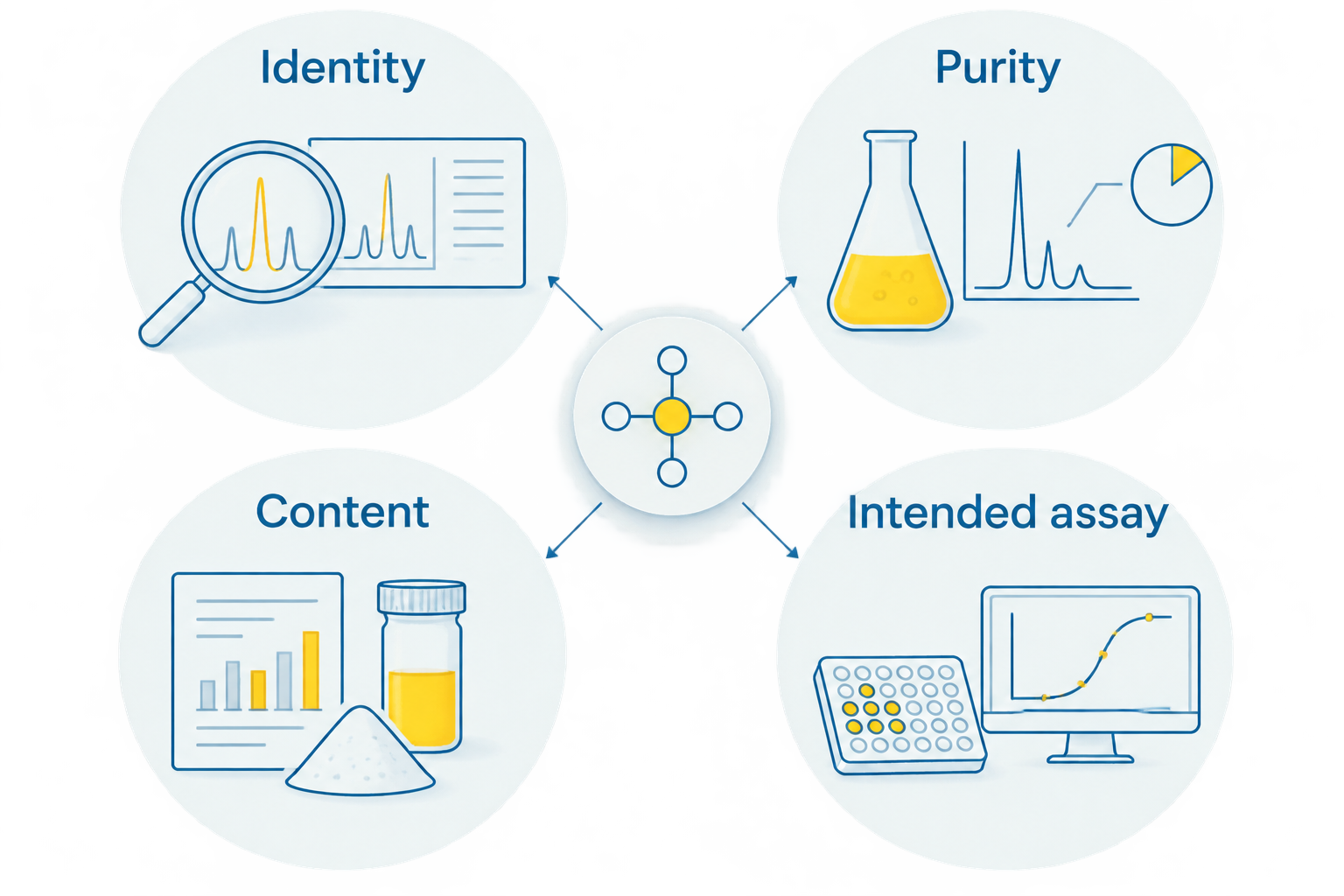
For a 2026 review, do not collapse these categories into a single quality score. Record the result, the method, and the question each result answers. Where a requirement remains unresolved, request the relevant evidence rather than infer an answer from another test.
Compare the exact material, not just the compound name
The supplied catalog lists Retatrutide (15mg), Retatrutide (30mg), and Cagrilintide (10mg). Those are distinct catalog selections, not evidence that any selection is appropriate for a particular experiment. The labeled quantity also does not replace lot-specific analytical review.
A compound name is the beginning of a comparison. Your laboratory’s specification should identify any additional characteristics that matter to the protocol, including chemical form, composition, and documented handling requirements.
Blends add another question: are you evaluating the combined preparation or the contribution of an individual constituent? Those are different experimental objectives. A blend cannot answer a constituent-specific question without an appropriate experimental design.
Use the guide to peptide blends for in-vitro research when the procurement question involves combined materials. Keep supplier selection separate from the design and interpretation of the experiment.
Why switch from PS Peptides?
Switch for a documented requirement, not an assumed weakness. A useful reason to investigate alternatives is a mismatch between your laboratory’s specification and the material or evidence available for a particular purchase.
Apply these decision rules without assuming they describe PS Peptides:
- Compound requirement: Investigate another source when the required compound or specified form cannot be supplied.
- Documentation requirement: Request clarification when you cannot connect the analytical record to the material being evaluated.
- Method requirement: Seek additional evidence when the reported test does not answer your acceptance question.
- Procurement requirement: Consider another purchasing route when institutional approval requirements cannot be met.
These are qualification triggers, not allegations about a supplier. They also apply to every alternative. Moving a purchase does not resolve a documentation gap unless the replacement supplies the evidence you actually need.
A supplier-switch checklist for 2026
Define the decision before you request material. This prevents a favorable-looking result from becoming an improvised acceptance standard.
- Write the specification. Identify the compound, required form, and relevant composition requirements.
- Request the records. Ask for the analytical documentation associated with the material under consideration.
- Check the connection. Reconcile sample identifiers and lot information across the documents and received material.
- Review the methods. Separate identity, purity, content, and other required measurements.
- Apply acceptance criteria. Record whether each requirement is satisfied, unresolved, or not satisfied.
- Document the decision. Preserve the supplier review alongside the laboratory’s purchasing and experimental records.
Do not change the acceptance threshold simply because a preferred supplier reports a different type of result. Resolve the methodological difference first. A comparison only works when both sources are assessed against the same question.
When staying with PS Peptides is the right call
Stay with PS Peptides when the exact material and supporting documentation meet your laboratory’s requirements. A supplier change needs a scientific or procurement reason, not just another name to evaluate.
If your protocol already uses a qualified material, assess the effect of changing that input before adopting a replacement. Keep the decision tied to documented requirements and experimental controls. This is a material-qualification decision, not a popularity contest.
FAQ
What should a US laboratory look for in PS Peptides alternatives?
Compare the exact compound specification, lot-linked documentation, and analytical methods. Evaluate Anchorpeptide or another procurement route against the same acceptance criteria used for your current source.
Is Anchorpeptide better than PS Peptides?
Choose between suppliers by whether the exact material meets your laboratory’s requirements, not by an unsupported overall ranking. Review compound identity, composition, and supporting analytical records before approving either source.
Does a Certificate of Analysis prove a research peptide will work in my assay?
No, a Certificate of Analysis does not establish performance in every assay. It reports specified analytical results, while your laboratory must establish suitability in its experimental system.
Is HPLC purity the same as peptide content?
No, HPLC area purity and peptide content measure different things. Chromatographic detector response does not automatically establish the mass of peptide present.
Can a peptide blend replace separate research compounds?
A blend is not an interchangeable substitute when your experiment requires separate control of its constituents. Match the preparation to the experimental question and confirm the documented composition.
Should laboratories switch peptide suppliers in 2026?
Switch when a documented scientific or procurement requirement justifies the change. Retain a qualified source when its material and documentation continue to satisfy your acceptance criteria.
Are these research peptides intended for human or veterinary use?
No, the materials discussed here are for laboratory and in-vitro research only. This comparison provides no human or veterinary use advice, administration instructions, or therapeutic recommendations.
One last thing
A more precise-looking purity figure does not necessarily answer a more relevant question. Before comparing headline results, identify the measurement your experiment actually requires. Then ask whether each supplier’s evidence addresses it.
For your next review, put the acceptance criteria at the top of the purchasing record—not beneath the supplier name. That keeps the decision focused on the material rather than the preference.
Related guides
- Research peptide suppliers for US laboratories
- CoA-verified research peptides
- Research peptides for university laboratories