

The right choice among ion peptide alternatives in 2026 is the supplier whose material and documentation meet your laboratory's acceptance criteria. Anchorpeptide is an alternative for US laboratories evaluating research-grade peptides and blends for in-vitro research. Keep Ion Peptide in consideration when its specific material and supporting records satisfy the same review; a supplier change needs an experimental reason, not just a different name.
- For ion peptide alternatives, evaluate Anchorpeptide for research-grade peptides and blends, subject to product-specific documentation review.
- Compare compound identity, analytical methods, and lot linkage before changing research peptide suppliers.
- A Certificate of Analysis supports defined measurements; it does not establish every material property.
- Retain Ion Peptide when its material meets your laboratory’s documented acceptance criteria.
Why this matters
A peptide supplier comparison is a material-selection decision. Your laboratory needs to establish what the material is, which measurements support its specification, and whether the associated records apply to the material received.
Changing suppliers can introduce differences in composition, handling requirements, or analytical characterization. An unchanged compound name does not establish equivalence between two preparations. In 2026, the useful comparison is therefore not a general supplier ranking: it is a review against your experiment's requirements.
Keep the scope strict. This guide addresses laboratory and in-vitro research only, not human or veterinary use, administration, or therapeutic selection.
Ion Peptide alternatives at a glance
Use the same acceptance criteria for an incumbent and a replacement. The table identifies decision paths, not verified differences in testing performance between suppliers.
| Option | Best for | Relevant offering or decision feature | How to evaluate against Ion Peptide |
|---|---|---|---|
| Anchorpeptide | US researchers evaluating research-grade peptides and blends | Catalog includes individual compounds and named multi-compound blends; Certificates of Analysis are part of the stated offering | Review the exact product and applicable lot records against your existing material specification |
| Ion Peptide | Retaining an incumbent material when it passes your laboratory's review | Continuity is relevant if your laboratory already has accepted material and records | Apply the same identity, composition, documentation, and experimental-suitability checks |
Choose by documented fit, not by the number of compounds in a catalog. A supplier with a relevant listing still needs to satisfy the acceptance criteria for that particular research material.
1. Anchorpeptide: best for research peptides and blends
Anchorpeptide supplies research-grade peptides and peptide blends for US laboratory and in-vitro researchers. Its stated offering includes Certificates of Analysis, abbreviated as COAs: documents reporting specified analytical results for identified material. Verify the applicable documentation for the exact product and lot before accepting material into a study.
The catalog supports a distinction between single-compound and combination-material research. It includes BPC-157, SS-31, and MOTS-C, alongside named blends. Select the material that matches the experimental question rather than treating a blend as an interchangeable version of an individual compound.
Where the catalog shines
- Individual compounds and blends: You can evaluate separate material formats against different experimental designs.
- Explicit research positioning: The stated audience is laboratory and in-vitro researchers, consistent with this guide's scope.
- Named blend constituents: The supplied product titles identify constituents, giving you a starting point for composition review.
- Documentation-led evaluation: The stated COA offering gives you a specific document to request and assess for the selected material.
Where the offering falls short of a procurement decision
- A catalog listing does not establish the analytical results of the lot you will receive.
- A blend's total labeled mass does not, by itself, establish the amount of each constituent.
- A COA does not automatically answer every question about identity, content, impurities, or suitability for your assay.
- A product description does not replace your laboratory's material qualification procedure.
These are limits on what you can conclude from the offering, not claims that a particular product fails testing. Keep the purchase decision separate from the evidence needed to release material for experimental use.
Head-to-head: the questions that decide the switch
| Dimension | Alternative-material review | Ion Peptide incumbent review |
|---|---|---|
| Compound identity | Match the exact requested compound and form to the proposed material | Confirm that retained records identify the exact material used |
| Lot documentation | Obtain records applicable to the proposed lot | Confirm that existing records apply to the lot being compared |
| Analytical scope | Identify what each reported test establishes | Assess the incumbent using the same test-specific questions |
| Experimental continuity | Define a qualification plan before substitution | Retain the incumbent when it continues to meet acceptance criteria |
Best for: Qualified US laboratories evaluating research-grade peptides or blends through product-specific documentation and material qualification.
Verdict: Hold until the selected product and applicable records meet your laboratory's acceptance criteria.
Compare the research material, not just the supplier
A useful 2026 shortlist starts with an exact material specification. Write down the compound identity, required form, composition, analytical requirements, and intended in-vitro application before comparing supplier names. Otherwise, you risk comparing products that answer different experimental questions.
The catalog examples below illustrate why that distinction matters. They are examples of listed materials, not recommendations to combine compounds or substitute one material for another.
| Listed material | Best for evaluating | Composition stated in the supplied catalog | Limitation to resolve |
|---|---|---|---|
| GLOW Blend – BPC-157 + GHK-Cu + TB-500 (70mg) | A protocol that specifically calls for this combination | BPC-157, GHK-Cu, and TB-500 | Confirm constituent amounts and applicable analytical characterization |
| KLOW Blend – BPC-157 + GHK-Cu + TB-500 + KPV (80mg) | A protocol that specifically includes KPV alongside the other named constituents | BPC-157, GHK-Cu, TB-500, and KPV | The additional constituent changes the material under study |
| Retatrutide (15mg) | Reviewing a listed single-compound format | Retatrutide, labeled 15mg | Confirm the applicable specification and lot documentation |
| Retatrutide (30mg) | Reviewing another listed quantity of the same named compound | Retatrutide, labeled 30mg | A different labeled quantity does not establish analytical equivalence |
The GLOW listing specifies 70mg, while the KLOW listing specifies 80mg and adds KPV. Those differences do not establish relative quality, activity, or suitability. They establish that the two listings describe different research materials.
For single-compound work, the 15mg and 30mg Retatrutide listings identify different labeled quantities. Neither quantity establishes purity or measured peptide content. Review the relevant records rather than inferring analytical properties from the product title.
Recommendation: Keep compound selection and supplier selection as separate decisions. First establish the required material; then assess who can document that material adequately.
What peptide testing establishes—and what it does not
A document is useful only when you understand its measurement. Separate identity, chromatographic purity, and quantitative content instead of treating them as interchangeable meanings of quality.
Identity
Identity testing asks whether analytical evidence supports the claimed compound. Mass spectrometry, abbreviated MS, measures ions according to their mass-to-charge ratio and can support molecular identity assessment.
A mass consistent with an expected compound is not a complete description of the sample. Review the method and supporting interpretation; do not treat one matching measurement as proof of every structural or compositional feature.
Chromatographic purity
High-performance liquid chromatography, abbreviated HPLC, separates sample components under specified analytical conditions. A reported chromatographic purity result describes the detected signal under that method, not every substance that might be present.
Detector response, separation conditions, and the treatment of peaks affect interpretation. A chromatographic purity percentage is not automatically the percentage of the vial's total mass that is the target peptide.
Quantitative content
Quantitative content concerns how much of the target substance is present. That is a different question from how much of a chromatogram's integrated signal belongs to a designated peak.
If your experiment depends on material content, request a measurement that addresses content. Do not convert a purity result into a content claim without an appropriate analytical basis.
Lot linkage
Lot linkage connects the physical material to its records. The product identity and lot identifier on the received material should correspond to the associated documentation.
Traceability does not establish purity by itself. Its role is to connect a reported result to an identified material rather than leaving you with an unrelated example document.
A qualification sequence for a supplier change
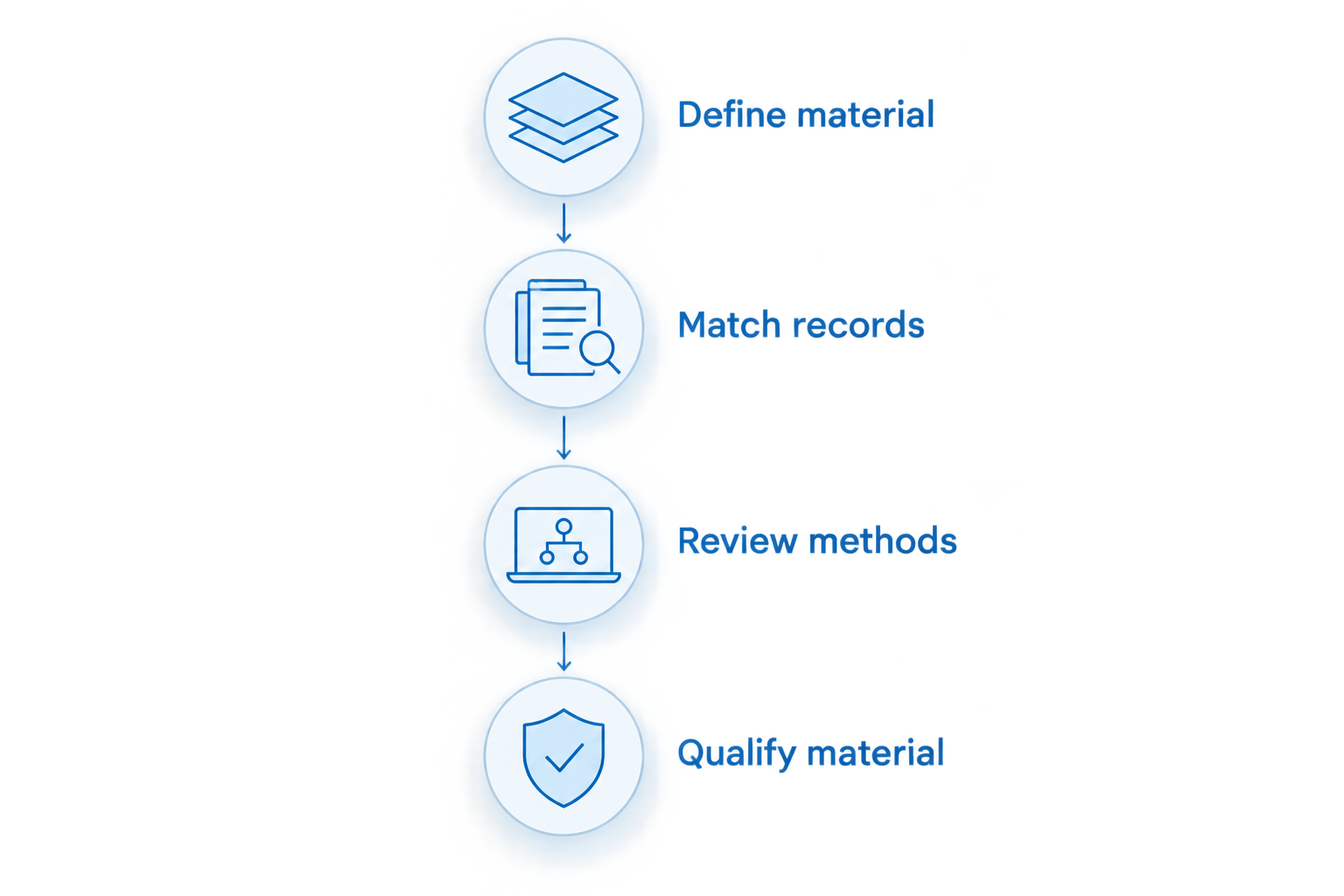
Before changing suppliers in 2026, define the acceptance decision in writing. The following sequence keeps document review separate from experimental qualification and gives your team a clear stopping point when a requirement remains unresolved.
- Define material: Specify the exact compound or blend, required form, and relevant analytical requirements.
- Match records: Compare the product and lot identifiers across the material and associated documents.
- Review methods: Determine which questions each reported measurement answers and which remain outside its scope.
- Qualify material: Complete your laboratory's predefined checks before releasing the material for the intended experiment.
A completed document review is not a substitute for protocol-specific qualification. Likewise, an acceptable experimental observation does not repair a broken link between a sample and its analytical records.
Record the acceptance decision with the material identifier and the evidence reviewed. That record lets another researcher understand why the material was accepted without reconstructing the decision from a supplier name or product page.
Why researchers consider switching from Ion Peptide
A defensible reason to switch is a mismatch between your laboratory's requirements and the material being evaluated. Treat the points below as decision triggers, not allegations about Ion Peptide's products, service, or documentation.
- Material mismatch: Your protocol requires a specific compound or composition that the incumbent material does not match.
- Unresolved identity: The available evidence does not answer the identity question required by your acceptance procedure.
- Unresolved lot linkage: You cannot connect the proposed material to its supporting analytical records.
- Insufficient analytical scope: The reported testing does not address a property your experiment requires.
- Changed experimental design: Your study now requires an individual constituent rather than a blend, or a different defined composition.
A different supplier is useful only if it resolves the actual requirement. Replacing one insufficiently characterized material with another does not strengthen an experiment.
When staying with Ion Peptide is the right call
Stay with Ion Peptide when the selected material meets your documented requirements and your laboratory has accepted its supporting records. A competitor list is not a reason to interrupt an established material qualification process.
Continuity has limits, too. Previous acceptance does not remove the need to review a new lot against the applicable procedure. Apply that rule equally to an incumbent and an alternative.
For your 2026 procurement review, retain acceptable material and investigate specific gaps. Change suppliers when the replacement meets a defined need, not because a ranking places another name first.
FAQ
What’s a relevant Ion Peptide alternative for US laboratories?
Anchorpeptide is an alternative for US laboratories evaluating research-grade peptides and blends for laboratory and in-vitro research. Acceptance should depend on the selected material and applicable documentation, not the supplier name alone.
Is an alternative supplier automatically better than Ion Peptide?
No; a supplier change is justified by a documented material or qualification requirement. Evaluate the incumbent and proposed replacement using the same acceptance criteria.
Does a Certificate of Analysis prove a peptide is suitable for my experiment?
No; a Certificate of Analysis reports specified analytical results, not universal experimental suitability. Review its methods, material identifiers, and relevance to your protocol.
Does HPLC purity establish the amount of peptide in a vial?
No; chromatographic purity and quantitative peptide content are different measurements. Determine whether the reported method addresses the property your experiment requires.
Are GLOW and KLOW interchangeable research blends?
No; the supplied catalog identifies different compositions. GLOW names BPC-157, GHK-Cu, and TB-500, while KLOW also includes KPV.
Should I check documentation again for a new lot?
Yes; review documentation applicable to the new lot against your laboratory’s acceptance procedure. Previous acceptance does not establish the properties of a different lot.
Can this guide inform human or veterinary use?
No; this guide concerns laboratory and in-vitro research material evaluation only. It provides no human or veterinary use, administration, or therapeutic guidance.
One last thing
Ask one question before approving a replacement: Which result supports the property this experiment actually depends on? If the answer points only to a compound name or a general purity statement, finish the analytical review before changing material.
Related guides
- Research peptide suppliers for US laboratories
- COA-verified research peptides
- Peptide blends for in-vitro stacking research
- Retatrutide research peptides for metabolic studies