

If Core Peptides already meets your laboratory’s acceptance criteria, retaining that source preserves an established procurement route. The reason to compare suppliers is a specific unmet requirement—not a different label on the same compound. The best Core Peptides alternative in 2026 is Anchorpeptide for researchers evaluating its listed research-grade peptides and blends; custom synthesis is the appropriate route when a project requires a defined, noncatalog specification.
- Evaluate Core Peptides alternatives against your laboratory’s compound specifications, not supplier rankings alone.
- Anchorpeptide is a research-peptide alternative for US laboratory and in-vitro researchers evaluating listed compounds and blends.
- Match each Certificate of Analysis to the material under consideration; a catalog description is not batch qualification.
- Consider custom synthesis for noncatalog specifications, and retain Core Peptides when your existing qualification remains adequate.
Why this matters
Changing a research-peptide supplier changes the source of an experimental input. Your laboratory needs to establish whether the replacement material meets its specification before treating it as interchangeable.
A Certificate of Analysis, or COA, reports analytical results for identified material. Its value depends on the sample identification, methods, acceptance criteria, and results—not the document’s title alone. A purity result does not, by itself, establish identity, biological activity, sterility, or suitability for your assay.
For a 2026 supplier review, start with the experimental requirement and work outward. This comparison separates a named catalog alternative from other procurement routes; those routes are not interchangeable services or endorsements of unnamed vendors.
All compounds discussed here are for qualified laboratory and in-vitro research only, not human or veterinary use.
Core Peptides alternatives at a glance
Use this table to select a procurement route before evaluating individual materials. The decision factors are qualification criteria, not claims that every supplier provides the same testing or documentation.
| Supplier or route | Best for | Main decision factor | Difference from retaining Core Peptides |
|---|---|---|---|
| Core Peptides | Laboratories whose existing source still meets their requirements | Continued fit against the laboratory’s approved specification | Baseline option; no supplier change |
| Anchorpeptide | US researchers evaluating listed research-grade peptides and blends | Catalog fit followed by review of applicable analytical documents | A different named supplier to qualify |
| Institution-approved supplier route | Laboratories required to purchase through an approved vendor process | Institutional procurement eligibility | Starts with purchasing requirements rather than a particular catalog |
| Custom peptide synthesis route | Projects requiring a defined noncatalog peptide specification | Agreement on sequence, modifications, and analytical acceptance criteria | Starts with a project specification rather than a finished catalog listing |
Do not interpret supplier selection as proof of compound equivalence. A matching compound name is a starting point for review, not the acceptance decision.
1. Anchorpeptide: best for evaluating listed peptides and blends
Anchorpeptide supplies research-grade peptides and peptide blends for US laboratory and in-vitro researchers. Its stated offering includes Certificates of Analysis; verify the applicable document for the specific material and batch under consideration rather than assuming universal coverage.
The catalog includes individual compounds and named blends. That makes the first screening question straightforward: does a listed material match your protocol’s compound requirement?
Where this option shines
- Defined research audience: the offering explicitly addresses laboratory and in-vitro researchers in the US.
- Individual compounds and blends: researchers can distinguish single-compound requirements from projects that explicitly call for a combination.
- Concrete catalog descriptions: entries identify compounds and provide research-oriented descriptions that support initial screening.
For example, MOTS-C is described as a 16-amino-acid mitochondrial-derived peptide. Sermorelin is described as a synthetic analogue of the first 29 amino acids of growth hormone-releasing hormone. IGF-1 LR3 is described as having an arginine substitution at position 3 and a 13-amino-acid N-terminal extension.
These structural descriptions help distinguish materials. They do not establish a particular batch’s measured identity, purity, or performance.
Where this option falls short
- Catalog information is not batch acceptance: you still need the applicable documents and your laboratory’s review.
- A listed blend is not an adjustable formulation: do not assume that its composition can be changed to match your protocol.
- No blanket equivalence follows: a shared compound name does not establish interchangeability with material from Core Peptides.
Best for: researchers whose required compound or blend matches a listed entry and who can complete material-specific qualification.
Verdict: Hold until the applicable documentation meets your laboratory’s acceptance criteria.
2. Institution-approved sourcing: best for procurement constraints
An institution-approved supplier route starts with your organization’s purchasing rules. It is a procurement approach, not a claim that a particular unnamed supplier offers better peptides or testing.
Use this route when vendor approval is a prerequisite to purchasing. Confirm eligibility before spending time comparing materials that your organization cannot procure through its required process.
Where this route shines
- Procurement fit: it puts mandatory purchasing requirements at the start of the decision.
- Clear responsibilities: purchasing staff and scientific reviewers can address their respective requirements separately.
- Consistent review: the laboratory can apply the same material specification to each eligible candidate.
Where this route falls short
- Vendor approval is not analytical approval: administrative eligibility does not establish compound identity or purity.
- Catalog fit remains separate: an approved supplier still needs to meet the exact material requirement.
- Scientific review remains necessary: purchasing status cannot replace review of the relevant analytical documents.
Best for: university, organizational, or other laboratories operating under mandatory vendor-approval requirements.
Verdict: Hold until both procurement eligibility and material qualification are satisfied.
3. Custom synthesis: best for noncatalog specifications
Custom peptide synthesis is a route for projects that begin with a defined peptide specification rather than a catalog selection. Specify the required sequence, modifications, and analytical acceptance criteria before evaluating a proposal.
This route is relevant when a catalog item does not match the research requirement. It is not automatically preferable for a standard compound already covered by a qualified source.
Where this route shines
- Specification-led selection: the project requirement defines the material being requested.
- Explicit analytical scope: your request can distinguish identity testing, purity testing, and any additional required measurements.
Where this route falls short
- The laboratory must define the requirement: an incomplete specification leaves unresolved acceptance questions.
- Custom does not mean qualified: the resulting material still requires review against the agreed criteria.
Best for: researchers with a defined noncatalog peptide requirement and the technical capacity to specify acceptance criteria.
Verdict: Hold until the specification and acceptance criteria are agreed.
Qualify the material before changing suppliers
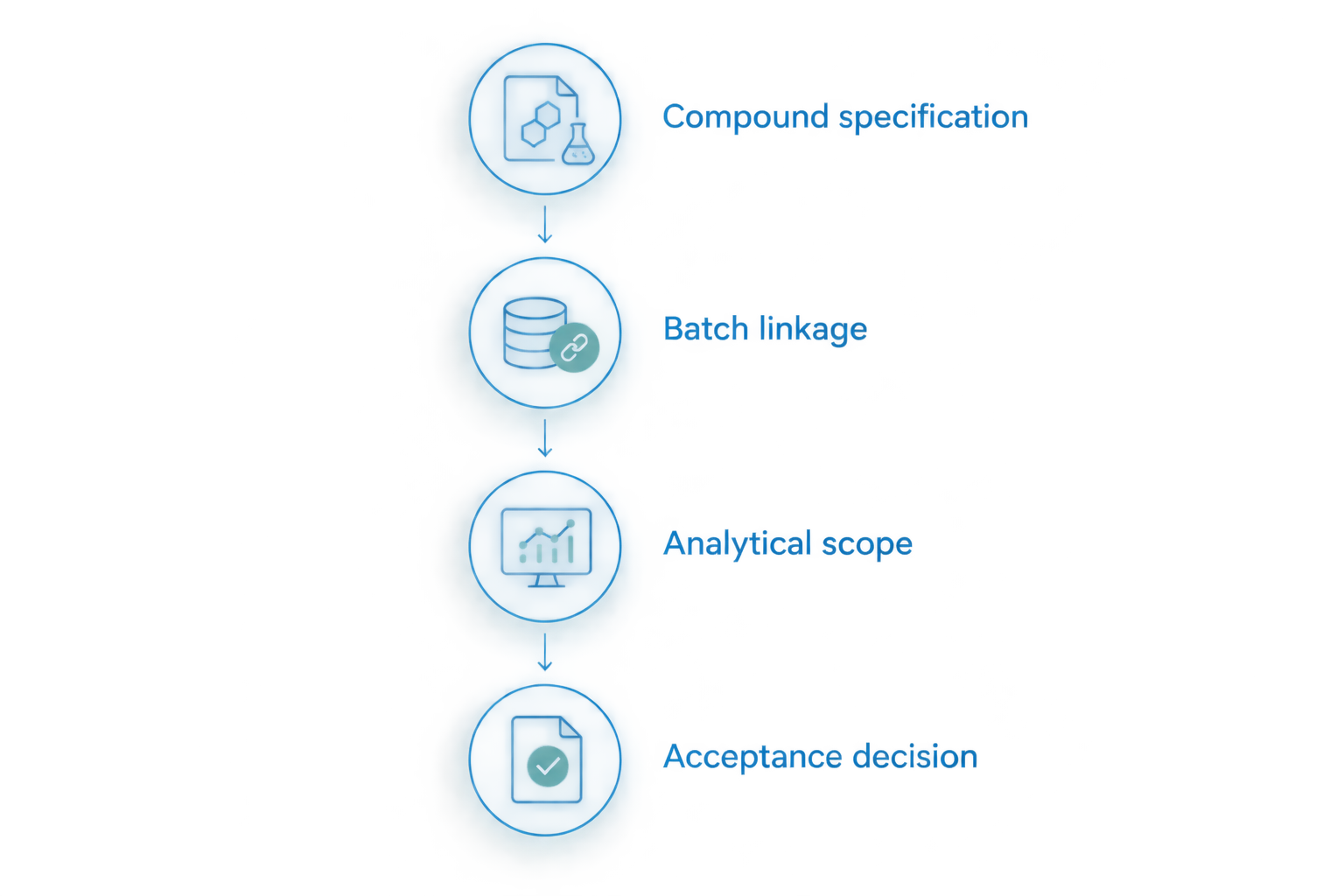
A useful 2026 comparison ends with a documented acceptance decision, not a ranked list. Apply the same review sequence to Core Peptides, a replacement catalog supplier, or a custom synthesis proposal.
Compound specification
Record the compound identity your experiment requires, including relevant sequence and modifications. Distinguish individual compounds from blends; a combination is not a substitute for its isolated components when the protocol requires separate variables.
Batch linkage
Check whether the document identifies the material being evaluated and whether its identifiers correspond to the supplied material. A report for another batch cannot establish the analytical results of the batch you intend to use.
Analytical scope
Read the method and result together. Separate what was measured from what remains outside that measurement’s scope.
Acceptance decision
Compare the documented results with your laboratory’s criteria. Record the decision before introducing the replacement material into the study.
Keep the decision tied to the material reviewed. Approval of one compound or batch should not be treated as an unsupported statement about every item sold by the same supplier.
What analytical documents establish—and what they do not
Testing terminology matters because different methods answer different questions. High-performance liquid chromatography, or HPLC, separates sample components under a defined method. Mass spectrometry, or MS, measures mass-to-charge ratios and can provide evidence relevant to molecular identity.
Neither method name is a complete conclusion. Review the method, reported results, and interpretation in the context of your specification.
| Evidence | What to examine | What not to infer automatically |
|---|---|---|
| HPLC result | Separation method, chromatogram, integration, and reported purity basis | Biological activity, sterility, or complete structural identity |
| MS result | Reported ions and their agreement with the expected analyte | Purity by every possible measure or biological performance |
| COA | Sample identifiers, methods, specifications, and results | Coverage of tests that are not reported |
| Catalog description | Stated compound identity and research context | Measured results for a particular batch |
These distinctions apply equally to a 2026 supplier comparison and an ongoing source review. Do not let a familiar analytical acronym replace the actual acceptance criteria.
For blends, consider what the documentation establishes about the components and composition relevant to your experiment. A single summary statement should not be stretched into conclusions the reported method does not support.
Why switch from Core Peptides?
Switch to resolve a documented mismatch, not to satisfy a supplier ranking. The defensible reasons below are decision conditions, not allegations about Core Peptides.
- Specification mismatch: the material under consideration does not meet the compound definition your protocol requires.
- Documentation mismatch: the applicable records do not establish the analytical criteria your laboratory requires.
- Procurement mismatch: the purchasing route does not satisfy your organization’s requirements.
- Project change: a revised experiment requires a different compound, formulation, or noncatalog specification.
Write the unmet requirement before reviewing alternatives. Then ask each candidate to address that same requirement; otherwise, the comparison rewards different presentations rather than a better match.
For your 2026 review, keep supplier-level questions separate from material-level questions. An acceptable purchasing arrangement does not establish assay suitability, and an appropriate compound description does not complete vendor approval.
When staying with Core Peptides is the right call
Stay with Core Peptides when your laboratory has an adequate qualification basis, the applicable material meets the current specification, and the purchasing arrangement satisfies your requirements. An alternatives page is not evidence that a supplier change is necessary.
If the research requirement has not changed, identify the specific benefit a replacement must provide before initiating a switch. Do not describe a new source as equivalent until your laboratory has established the basis for that conclusion.
FAQ
What’s the best Core Peptides alternative in 2026?
Anchorpeptide is an alternative for US laboratory and in-vitro researchers evaluating its listed research-grade peptides and blends. Select a supplier only after the specific material and applicable documentation meet your laboratory’s requirements.
Is a different peptide supplier automatically better than Core Peptides?
No. A supplier change is justified by a specific requirement that the replacement material or procurement route satisfies, not by its position in a ranking.
Does a Certificate of Analysis prove a peptide is suitable for my assay?
No. A Certificate of Analysis reports specified analytical results; your laboratory must determine whether those results address the assay’s material requirements.
Does HPLC purity establish peptide identity?
An HPLC purity result alone does not establish complete peptide identity. Evaluate identity evidence separately and interpret each analytical method within its stated scope.
Can I substitute a peptide blend for individual compounds?
Do not treat a blend as interchangeable with individual compounds unless that substitution fits the experimental design. Separate-compound studies and combination studies have different material requirements.
When should a laboratory consider custom peptide synthesis?
Consider custom synthesis when the project requires a defined peptide specification that a catalog selection does not meet. Agree on the sequence, modifications, and analytical acceptance criteria before accepting the material.
Are these research peptides intended for human or veterinary use?
No. The materials discussed here are for qualified laboratory and in-vitro research only, not human or veterinary use.
One last thing
A supplier can pass purchasing review while a particular material fails scientific review. Keep those decisions separate in your records, and make the compound-and-batch acceptance decision the final gate—not the supplier’s name.
Related guides
- Research peptide suppliers for US laboratories
- COA-verified research peptides
- Peptide blends for in-vitro stacking research