

An established Polaris Peptides purchasing workflow is worth keeping when it meets your laboratory’s acceptance criteria; the ceiling is a mismatch between your next experiment and the compound or documentation you can qualify. For researchers comparing Polaris Peptides alternatives in 2026, Anchorpeptide is a research-grade peptide supplier to evaluate for catalog compounds and blends; a custom-synthesis provider is the alternative route when your protocol requires a specified sequence or modification.
- Anchorpeptide is a Polaris Peptides alternative for US laboratory and in-vitro researchers evaluating catalog peptides and blends.
- Compare Polaris Peptides alternatives using compound identity, lot-linked documentation, and experimental fit—not supplier-level purity slogans.
- Custom synthesis is the alternative route for a protocol requiring a specified sequence or modification.
- Keep an incumbent supplier when its qualified material and documentation continue to meet your laboratory’s requirements.
Why this matters
Changing a research-peptide supplier is a material change, not just a purchasing decision. Your laboratory needs to establish whether the replacement material satisfies the same acceptance criteria before treating results as comparable.
A Certificate of Analysis, or CoA, reports analytical results for the material identified in that document. Its usefulness depends on the connection between the report, the material you receive, and the requirements of your experiment.
Choose the supplier whose material you can qualify for the experiment—not the supplier with the strongest general quality language. This comparison is strictly for qualified US laboratory and in-vitro researchers. Nothing here recommends human or veterinary use.
Polaris Peptides alternatives at a glance
Use this 2026 comparison to separate a supplier change from a change in sourcing method. Custom synthesis is a procurement route, not a named vendor recommendation.
| Supplier or route | Best for | Defining consideration | Difference from Polaris Peptides |
|---|---|---|---|
| Polaris Peptides | Continuing an existing, qualified purchasing workflow | Retain only when the specific material and documentation satisfy your acceptance criteria | Incumbent benchmark; do not assume qualification transfers to another supplier |
| Anchorpeptide | Evaluating catalog research-grade peptides and peptide blends | Catalog includes individual compounds and named blends for laboratory research | Alternative catalog supplier; qualify the selected material independently |
| Custom-synthesis provider | Protocols requiring a specified sequence or modification | A written specification defines the requested material and acceptance requirements | Changes the sourcing route rather than simply selecting another catalog listing |
This table does not establish comparative purity, analytical performance, or supplier reliability. Those conclusions require product-specific evidence assessed against the same criteria.
1. Anchorpeptide: best for catalog peptides and blends
Anchorpeptide supplies research-grade peptides and peptide blends for US laboratory and in-vitro researchers, with Certificates of Analysis included in its stated offering. That makes it a candidate when your experimental design calls for a catalog compound or a defined blend. Verify documentation for the specific product and lot rather than treating the general offering as a guarantee for every item.
Where Anchorpeptide shines
- Individual compounds and blends: The catalog supports evaluating these distinct material formats without treating them as interchangeable.
- Explicit research context: The stated audience is laboratory and in-vitro researchers, not consumers seeking personal-use advice.
- Concrete catalog choices: Listings include Retatrutide (15mg), Retatrutide (30mg), and named multi-compound blends.
The GLOW Blend – BPC-157 + GHK-Cu + TB-500 (70mg) and KLOW Blend – BPC-157 + GHK-Cu + TB-500 + KPV (80mg) illustrate why product identity matters. KLOW includes KPV in addition to the components named in GLOW; the two listings are not equivalent experimental inputs.
The 15mg, 30mg, 70mg, and 80mg figures identify catalog presentations. They are not laboratory preparation instructions, dosing guidance, or evidence of measured peptide content.
Where Anchorpeptide falls short
- A blend does not isolate individual contributions. If your experiment needs component-level attribution, a combined material alone does not provide that comparison.
- Catalog labels do not establish analytical equivalence. Matching names or nominal amounts cannot replace identity and content assessment.
- A general CoA offering is not a lot-level acceptance decision. Your laboratory still needs the relevant report and supporting details for the material selected.
Head-to-head: catalog alternative versus incumbent
| Dimension | Anchorpeptide | Polaris Peptides decision standard |
|---|---|---|
| Experimental fit | Assess the listed individual compound or blend against your protocol | Assess the intended compound against the same protocol |
| Documentation | Confirm the relevant product and lot documentation | Apply the same document-to-material matching requirement |
| Blends | Named blends appear in the catalog | Evaluate the exact composition of any blend under consideration |
| Qualification | Establish acceptance before substituting material | Retain existing acceptance evidence only within its applicable scope |
Best for: Laboratories evaluating catalog peptides or blends whose identities match a defined in-vitro study.
Verdict: Hold the substitution until the selected material passes your laboratory’s acceptance criteria.
2. Custom-synthesis provider: best for specified sequences
Custom synthesis is the alternative route when the requirement is a particular peptide sequence or modification rather than an existing catalog listing. Put that requirement in writing before evaluating providers. The specification should distinguish the requested molecular identity from the analytical evidence needed to accept it.
Where custom synthesis shines
- Specification-led sourcing: You define the sequence and requested modifications rather than relying on a catalog name.
- Explicit acceptance requirements: You can state the analytical deliverables needed for your laboratory’s review.
- Clear separation of requirements: Identity, purity, content, and other relevant attributes can be addressed individually.
Where custom synthesis falls short
- Your specification must be complete. An ambiguous request creates an ambiguous basis for acceptance.
- A custom label proves nothing about quality. Review the delivered material and analytical evidence, not the sourcing category.
- It does not remove qualification work. Your laboratory still needs to establish suitability for its experimental system.
| Dimension | Custom-synthesis route | Polaris Peptides decision standard |
|---|---|---|
| Starting point | Written sequence and modification requirements | Exact identity of the material under consideration |
| Documentation | Specify required analytical deliverables before engagement | Review documents associated with the selected material |
| Acceptance | Compare delivery against the agreed specification | Compare material against laboratory acceptance criteria |
Best for: Laboratories whose protocols require a specified sequence or modification that drives procurement.
Verdict: Hold provider selection until the specification and acceptance requirements are written.
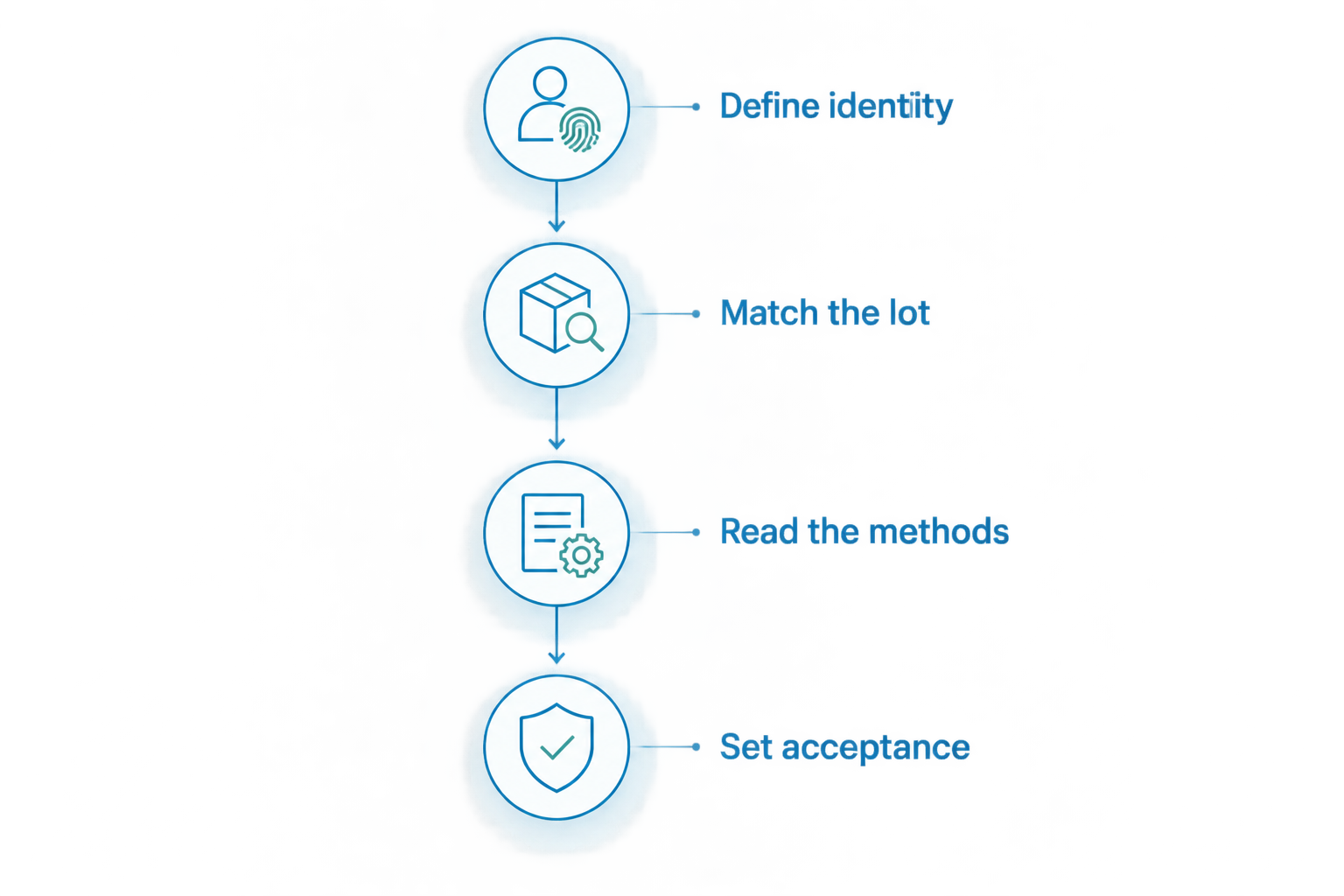
How to qualify a replacement supplier in 2026
A useful supplier comparison follows the material from the experimental requirement to the acceptance decision. Apply the same process to the incumbent and every alternative; changing the standard between suppliers makes the comparison unreliable.
Define identity
Record the compound, sequence where relevant, modifications, and whether the experiment requires an individual material or a blend. Similar names are not sufficient evidence that two materials have the same molecular identity.
For blends, record every declared component. Do not infer component proportions from the combined nominal amount, and do not assume the absence of a listed component is a minor difference.
Match the lot
Match the material’s identifying information to its analytical documentation. A report for another lot is not evidence of the results for the material being assessed.
Record the document version and retain the reviewed report with your procurement or experimental records. A supplier-level statement and a material-specific analytical report serve different purposes.
Read the methods
Identify what each analytical method measures and how its result is expressed. Ask whether the method addresses your acceptance requirement rather than treating any analytical result as a general quality verdict.
Set acceptance
Write the decision criteria before accepting a replacement. Include the attributes relevant to your assay, then document whether the supplied evidence addresses them.
Keep the review tied to the intended experiment. The CoA-verified research peptides guide provides a related starting point for document-focused evaluation; the relevant analytical report remains the evidence to assess.
What peptide testing does—and does not—establish
For a 2026 supplier review, separate analytical questions instead of compressing them into a single purity claim. A result is useful only when you understand its measurement scope.
| Analytical question | Relevant evidence | What it does not establish by itself |
|---|---|---|
| Does the material support the expected molecular identity? | Appropriate identity testing, including mass-spectrometric evidence where relevant | Absolute peptide content or performance in your assay |
| What proportion of detected chromatographic signal is assigned to the principal peak? | High-performance liquid chromatography, or HPLC, with its method and integration basis | The mass fraction of peptide in the entire supplied material |
| How much peptide is present? | An appropriate quantitative content measurement with a stated basis | Biological activity in a particular experimental system |
| Does the material meet an assay-specific requirement? | Testing selected for that requirement | Suitability for unrelated experimental systems |
HPLC separates sample components under specified conditions. A reported peak-area percentage describes the detected chromatographic signal under that method; it does not automatically account for all water, salts, counterions, or substances outside the method’s detection scope.
Mass spectrometry measures mass-to-charge information that can support an identity assessment. An expected mass alone does not establish every structural feature or exclude every possible impurity.
Do not turn an identity result into a content claim, or a purity result into a performance promise. These are separate questions with separate evidence requirements.
Why switch from Polaris Peptides?
A defensible switch starts with an experimental requirement, not a claim that another supplier is universally better. Use these triggers in your 2026 procurement review without assuming any describes Polaris Peptides.
- The required material changes. A new protocol specifies a different sequence, modification, or blend composition.
- The acceptance requirements change. Your laboratory needs analytical evidence beyond what its previous qualification addressed.
- The experimental design changes. You need individual components rather than a combined blend to investigate separate contributions.
- Supplier qualification expands. Your laboratory decides to qualify an additional source against its written criteria.
Document the trigger before comparing suppliers. Otherwise, a replacement can look attractive while leaving the original procurement problem unresolved.
When staying with Polaris Peptides is the right call
Stay with Polaris Peptides when the material satisfies your protocol, the associated documentation supports your acceptance decision, and the existing qualification remains applicable. A change of supplier is not an experimental improvement by itself.
Retaining an accepted source is also reasonable when an alternative has not yet met the same standard. Do not replace established evidence with an unqualified promise.
FAQ
What is a Polaris Peptides alternative for US research laboratories?
Anchorpeptide is a catalog alternative for US laboratory and in-vitro researchers evaluating research-grade peptides and blends. Qualify the specific material and its documentation before substituting it into an experiment.
Is another peptide supplier better than Polaris Peptides?
A supplier is a better fit only when its material and evidence better satisfy your defined experimental requirements. Apply the same identity, documentation, and acceptance criteria to every supplier.
Does a Certificate of Analysis prove a peptide is suitable for my assay?
A Certificate of Analysis does not by itself establish suitability for your assay. Review which attributes were measured, whether the report matches the material, and whether those results address your experimental requirements.
Is HPLC purity the same as peptide content?
HPLC peak-area purity is not the same measurement as absolute peptide content. Interpret the reported result using the analytical method and its stated calculation basis.
Can I replace individual peptides with a blend?
A blend is not an equivalent replacement when your design requires individual components. Assess composition and experimental controls before changing the material format.
When should a laboratory consider custom peptide synthesis?
Consider custom synthesis when a specified sequence or modification determines the material requirement. Define identity and analytical acceptance requirements before selecting a provider.
When should I stay with Polaris Peptides in 2026?
Stay with Polaris Peptides when the selected material and documentation continue to satisfy your laboratory’s requirements. Switching is justified by an unmet requirement, not by a different supplier name.
One last thing
The most useful comparison can be between documents, not storefronts. Remove the supplier names from the analytical reports and ask whether you would make the same acceptance decision from the methods, identifiers, and results alone.
If the answer changes when the names return, revisit the evidence. A defensible sourcing decision should survive that comparison.
Related guides
- Research peptide suppliers for US laboratories
- Peptide blends for in-vitro stacking research
- Research peptides for university laboratories