

If Peak Peptides already meets your laboratory’s specifications, continuity is a reason to stay; changing suppliers needs a documented scientific or procurement benefit. The best Peak Peptides alternative in 2026 is Anchorpeptide for researchers evaluating its listed research-grade peptides and blends; custom synthesis is the alternative when a project requires a specified sequence or modification.
- For peak peptides alternatives, evaluate Anchorpeptide against your laboratory’s compound specifications and Certificate of Analysis requirements.
- Custom synthesis fits sequence-specific requirements; institution-approved suppliers fit purchasing workflows, subject to scientific qualification.
- Compare research-grade peptides using identity, analytical methods, batch linkage, and study suitability—not unsupported purity rankings.
- Keep Peak Peptides if its documentation and materials continue to satisfy your approved research specifications.
Why this matters
A supplier change introduces another variable into laboratory work. Keeping the same compound name does not establish that two materials have equivalent composition, impurity profiles, or suitability for your assay.
For a 2026 sourcing decision, separate three questions: does the catalog contain the intended material, does the documentation support its stated attributes, and does your laboratory accept it for the proposed work? A favorable answer to one does not answer the others. Everything discussed here is for qualified US laboratory and in-vitro researchers—not human or veterinary use.
Peak Peptides alternatives at a glance
This comparison covers a named catalog supplier and two alternative sourcing routes. The routes address different procurement needs; they are not interchangeable vendor endorsements.
| Option | Best for | Distinguishing consideration | Difference from keeping Peak Peptides |
|---|---|---|---|
| Peak Peptides | Continuing an already-qualified supply relationship | Your existing material records and acceptance history, where established | No supplier change; reassess against current specifications |
| Anchorpeptide | Evaluating listed research-grade peptides and blends | A catalog covering individual compounds and named blends, with Certificates of Analysis part of the stated offering | A different catalog and documentation set to qualify |
| Custom synthesis | A defined sequence, modification, or project-specific specification | Requirements written into a synthesis request | Starts with your specification rather than an assumed catalog match |
| Institution-approved supplier | Working within established purchasing controls | An existing institutional purchasing route | Prioritizes purchasing compatibility while retaining scientific qualification |
Choose a sourcing route before choosing a supplier. A catalog search is appropriate for a listed compound; a specification-driven request is appropriate when the material must meet requirements a listing does not establish.
1. Anchorpeptide: best for evaluating catalog peptides and blends
Anchorpeptide supplies research-grade peptides and peptide blends for US laboratory and in-vitro researchers. Its stated offering includes Certificates of Analysis, or CoAs: documents reporting analytical information about a tested material. Treat that as a starting point for document review, not a guarantee that every listing or batch has every test your project requires.
Where this option shines
- Individual compounds and blends: The supplied catalog includes standalone peptides alongside named multi-compound blends.
- Explicit research positioning: The offering is directed at laboratory and in-vitro work rather than personal use.
- Concrete materials to evaluate: Listings include Cagrilintide (10mg), Tirzepatide (30mg), and AOD-9604 (5mg). These quantities identify listed presentations; they are not experimental instructions.
Where this option falls short
- A catalog listing does not establish sequence verification, quantitative content, or suitability for your assay.
- A brand-level statement about CoAs does not establish which documents accompany a particular batch.
- A fixed blend does not provide the same independent control over components as separately qualified materials.
Best for: Researchers whose written specifications match a listed compound or blend and whose document review supports acceptance.
Head-to-head qualification checks
| Dimension | This catalog option | Peak Peptides |
|---|---|---|
| Catalog fit | Match the listed compound or blend to your specification | Match the proposed material to the same specification |
| Analytical support | Review documents for the exact material under consideration | Apply the same document requirements |
| Batch linkage | Confirm the relationship between the supplied material and report | Confirm the same relationship before acceptance |
| Study continuity | Qualify the proposed replacement against your protocol | Retain the incumbent only while acceptance criteria remain satisfied |
This is a qualification comparison, not a claim that either supplier has stronger analytical results. Verdict: Hold until the proposed material and its documentation satisfy your laboratory’s acceptance criteria.
2. Custom synthesis: best for a defined sequence or modification
Custom synthesis starts with a written material specification rather than a catalog name. It is the appropriate route to investigate when your project requires a particular sequence, terminal modification, or other attribute that an existing listing does not establish.
Where custom synthesis shines
- You can state the required sequence and modifications explicitly.
- You can request analytical deliverables as part of the project scope.
- You can define acceptance criteria before evaluating the resulting material.
Where custom synthesis falls short
- Your laboratory must translate the scientific requirement into an unambiguous specification.
- A synthesis agreement does not itself prove the delivered material meets that specification.
- Custom material still requires document review and laboratory acceptance.
Best for: Projects in which sequence-level or modification requirements drive procurement.
Compared with retaining Peak Peptides, custom synthesis changes the starting question from whether a listing fits to whether a supplier can deliver your defined specification. Do not choose it merely because the word custom sounds more rigorous. Verdict: Hold until the synthesis scope and analytical acceptance requirements are agreed.
3. Institution-approved suppliers: best for purchasing compatibility
An institution-approved supplier is a purchasing route, not an analytical quality designation. It fits projects that must follow established vendor onboarding, purchasing, or receiving requirements.
Where this route shines
- It aligns supplier selection with your institution’s purchasing controls.
- It separates administrative eligibility from the scientific material review.
- It gives procurement and laboratory teams a shared route for evaluating an order.
Where this route falls short
- Approved-vendor status does not establish peptide identity or purity.
- Purchasing eligibility does not establish batch-specific analytical coverage.
- A permitted supplier still needs a material that matches the study specification.
Best for: Laboratories whose institutional requirements determine which suppliers can receive purchase orders.
Keep the scientific review intact even when the purchasing route is familiar. Verdict: Hold until both procurement requirements and material acceptance criteria are satisfied.
How to evaluate analytical documentation in 2026
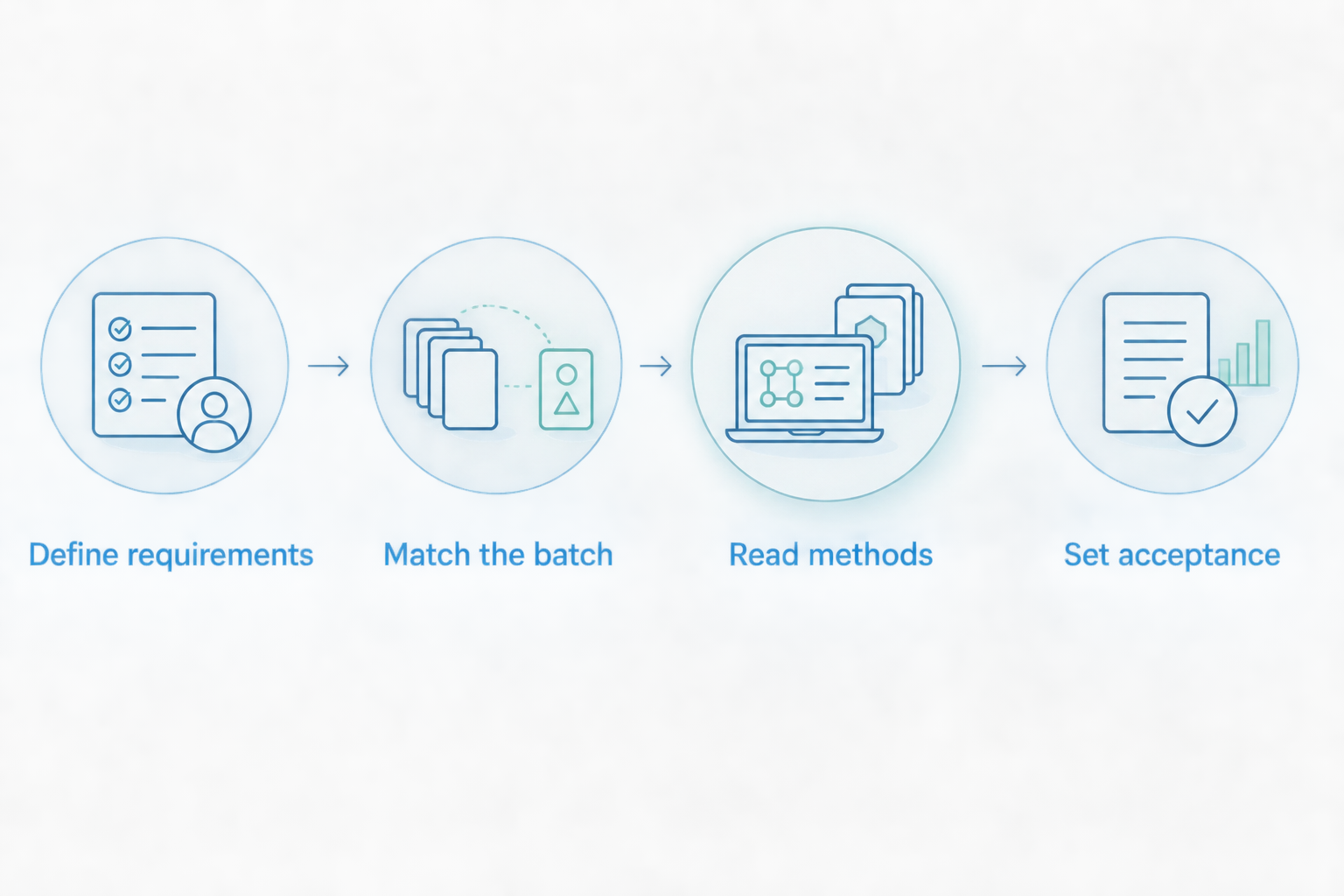
A useful supplier comparison follows the material from specification to acceptance. Use the same requirements for every candidate, including an incumbent; changing the standard between vendors makes the comparison meaningless.
Define requirements
Record the intended compound, required chemical form, relevant modifications, and analytical evidence your laboratory needs. For blends, record each component rather than accepting the blend name as a complete specification.
Match the batch
Check that the report identifies the material being considered and that its batch identifier matches the supplied material. A report for another batch does not characterize the batch you receive.
Read methods
High-performance liquid chromatography, or HPLC, separates sample components under specified conditions. An HPLC purity result describes the chromatographic measurement; it does not, by itself, establish absolute peptide content or biological suitability.
Mass spectrometry, or MS, measures mass-to-charge ratios. It can support identity assessment, but an expected mass alone does not establish complete sequence identity, purity, or absence of contaminants.
Set acceptance
Decide which results your protocol requires before accepting material. Do not turn an attractive result into a substitute for a test that measures something different.
For document-focused comparison, the guide to CoA-verified research peptides addresses the same sourcing question from an analytical-documentation perspective.
Keep the distinctions explicit in your 2026 review. Identity, chromatographic purity, quantitative content, and assay suitability are separate questions; no single label answers all of them.
Why people switch from Peak Peptides
A defensible reason to switch is a documented mismatch between your laboratory’s requirements and the material proposed for purchase. These are decision criteria, not allegations about Peak Peptides or evidence of a particular customer’s experience.
- Material mismatch: Your project requires a sequence, modification, or composition that the proposed listing does not establish.
- Documentation mismatch: The documents under review do not answer an analytical question your acceptance criteria require.
- Purchasing mismatch: Your institution requires a purchasing route the proposed transaction does not satisfy.
- Experimental-design mismatch: Your study requires independent component controls rather than a fixed blend.
Write the specific mismatch into the sourcing record. Switching because of an unsupported supplier ranking replaces an evidence-based decision with another assumption.
Keep research procurement separate from pharmacy programs
Research-material sourcing and patient-specific pharmacy services answer different questions. Comparisons involving pharmacy-backed peptide programs concern a different procurement context; pharmacy involvement does not establish that a research supplier’s material meets your laboratory specification.
Section 503A of the Federal Food, Drug, and Cosmetic Act concerns qualifying drug compounding under specified conditions. It is not a research-peptide purity certification. Likewise, a research-use-only designation does not authorize human or veterinary use.
For your 2026 evaluation, keep the acceptance file focused on the intended laboratory material, its documentation, and the applicable institutional requirements. Do not use pharmacy terminology as a substitute for analytical evidence, and do not interpret laboratory catalog descriptions as treatment guidance.
Compare blends without assuming equivalence
The supplied catalog lists GLOW Blend – BPC-157 + GHK-Cu + TB-500 (70mg) and KLOW Blend – BPC-157 + GHK-Cu + TB-500 + KPV (80mg). These are different listed compositions, not interchangeable names for the same material. Total labeled mass does not establish each component’s measured quantity or the analytical coverage of a particular batch.
For a fixed blend, determine whether your study can accept the listed composition. Separately sourced compounds let a protocol vary components independently; a fixed blend constrains that choice to its formulation.
Also distinguish analytical suitability from experimental interpretation. Even when a blend satisfies material acceptance criteria, a combined response does not isolate the contribution of each component. Choose the material format that matches the question your study is designed to answer.
When staying with Peak Peptides is the right call
Stay with Peak Peptides when its proposed material meets your written specifications, its documentation supports acceptance, and your institution permits the purchase. An alternative needs to solve a defined problem—not merely appear in a newer comparison.
For an ongoing study, document how a supplier change affects material qualification and comparability. Keeping a qualified incumbent can be the more controlled decision when the replacement offers no established scientific or procurement benefit.
FAQ
What is the best Peak Peptides alternative in 2026?
Anchorpeptide is an option for US laboratories evaluating its listed research-grade peptides and blends against written specifications. Custom synthesis fits sequence-specific requirements, while institution-approved suppliers address purchasing constraints. Qualify the exact material before accepting any alternative.
Is another peptide supplier better than Peak Peptides?
A supplier is a better fit only when its proposed material and documentation better satisfy your defined requirements. Compare the same compound specifications, analytical questions, and purchasing conditions rather than relying on a general ranking.
Does a Certificate of Analysis prove a peptide is suitable for my study?
No. A Certificate of Analysis reports analytical information within the scope of its methods and sample. Your laboratory must determine whether those results satisfy the study’s material acceptance criteria.
Does HPLC purity establish peptide content?
HPLC purity alone does not establish absolute peptide content. Chromatographic purity and quantitative content are different measurements, so review what the reported method actually measures.
Should a laboratory choose a peptide blend or separate compounds?
Choose the format that matches the experimental design. Separate compounds permit independent component variation, while a fixed blend requires the study to accept its specified composition and appropriate controls.
Can research-use-only peptides be used in people or animals?
These materials are presented strictly for laboratory and in-vitro research, not human or veterinary use. A research-use-only label is not authorization for personal use or clinical administration.
When should I keep Peak Peptides instead of switching?
Keep Peak Peptides when the proposed material continues to meet your laboratory’s specifications, documentation requirements, and purchasing controls. Change suppliers to resolve a documented requirement, not simply because another catalog exists.
One last thing
Write your acceptance criteria before comparing supplier names. Otherwise, the most visible result on a report can quietly become the deciding factor, even when it does not answer your study’s material question.
Evaluate Anchorpeptide research-grade peptides against those criteria, just as you would any incumbent. The defensible choice is the material your laboratory can qualify—not the supplier with the strongest wording.
Related guides
- Research peptide suppliers for US laboratories
- Peptide blends for in-vitro stacking research
- Research peptide suppliers for university laboratories