

Best overall catalog fit for immune-signaling research: KLOW Blend. Best single-peptide tissue-repair comparator: BPC-157. Best mitochondrial-context option: SS-31. Best blend comparator without KPV: GLOW Blend. This 2026 guide ranks research-question fit, not demonstrated immune-modulating efficacy, and applies strictly to laboratory and in-vitro research.
- The best immune modulation research peptides depend on your model; KLOW Blend has the clearest catalog connection to immune signaling.
- BPC-157 fits tissue-repair comparisons; SS-31 fits mitochondrial research questions, not interchangeable immune endpoints.
- Anchorpeptide supplies research-grade peptides; verify product-specific documentation before selecting material for an experiment.
- A blend cannot establish which constituent caused an observed response without appropriate component controls.
Why this matters
Immune modulation means changing an immune response. It does not mean simply reducing a marker associated with inflammation, and a tissue-repair endpoint does not establish an immune mechanism. Your model, controls, and measurements determine what an experiment can support.
Anchorpeptide is a research-peptide supplier for US laboratory and in-vitro researchers, not a source of products for personal use. The catalog includes compounds associated with different research areas. Treat those descriptions as starting points for experimental selection, not as equivalent evidence of immune activity.
The Anchorpeptide catalog is the basis for the product descriptions below. A product's inclusion in this 2026 shortlist does not establish suitability for your assay, batch-specific purity, or a biological outcome.
What makes the best immune modulation research peptides?
Use these criteria before comparing names. A compound that fails your documentation or experimental-design requirements is not a suitable selection, regardless of its position here.
- Question fit: Select material whose stated research context matches the mechanism you intend to investigate.
- Attribution: Prefer a single compound when you need to connect an observed response to one experimental variable.
- Composition clarity: For blends, establish the constituent identities and amounts rather than relying on total mass alone.
- Analytical documentation: Review identity and purity evidence tied to the material under consideration.
- Assay compatibility: Check whether the formulation, handling requirements, and relevant contaminants fit your laboratory's validated methods.
- Interpretation limits: Separate a measured cellular response from claims about immune function, therapeutic effects, or personal use.
The strongest selection is the one you can characterize and interpret. A longer ingredient list is not a substitute for a controlled comparison.
Research options at a glance
The order below reflects distinct experimental roles. It is not a potency ranking or a claim that these materials produce comparable effects.
| Rank and option | Best for | Standout catalog feature | Key limitation |
|---|---|---|---|
| 1. KLOW Blend | Exploratory blend studies involving immune-signaling questions | Includes KPV alongside BPC-157, GHK-Cu, and TB-500 | A combined response cannot identify the responsible constituent |
| 2. BPC-157 | Single-peptide tissue-repair and angiogenesis comparisons | Defined single-peptide option rather than a multi-peptide blend | Tissue-repair research does not establish direct immune modulation |
| 3. SS-31 | Mitochondrial-context experiments | Tetrapeptide described as associating with cardiolipin | A mitochondrial readout does not establish an immune mechanism |
| 4. GLOW Blend | A blend comparator whose listed composition excludes KPV | Combines BPC-157, GHK-Cu, and TB-500 | Comparison with KLOW requires constituent-level characterization |
1. KLOW Blend: best for exploratory immune-signaling blend studies
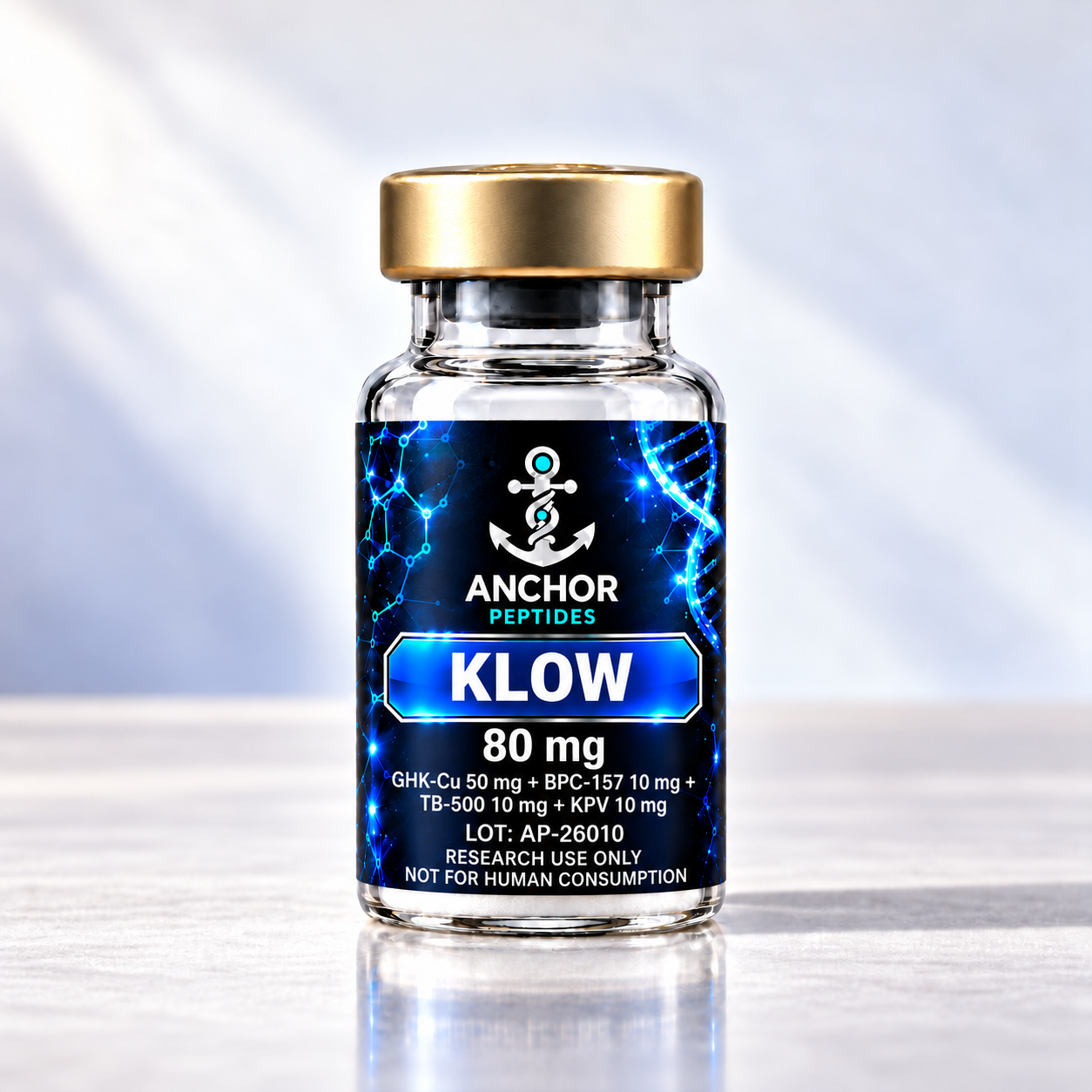
KLOW Blend combines BPC-157, GHK-Cu, TB-500, and KPV. The catalog specifically describes KPV as a tripeptide studied in inflammation and immune-signaling research, giving this blend the clearest stated connection to the article's subject.
That connection supports consideration, not an efficacy claim. The catalog title lists 80 mg, but total blend mass does not tell you the amount of each constituent or establish how the mixture behaves in your model.
KLOW Blend pros:
- Its KPV component has an explicit immune-signaling research context in the supplied description.
- Its named constituents allow you to identify the component comparisons your study would require.
- Its composition supports a defined comparison with GLOW Blend, subject to confirming constituent amounts.
KLOW Blend cons:
- Multiple constituents prevent direct attribution from a blend-only experiment.
- The supplied description does not establish constituent-specific analytical results for a particular batch.
- A nominal total amount cannot replace a verified composition record.
Best for: Exploratory in-vitro studies where a multi-component preparation is itself the experimental subject.
For 2026 selection, request the relevant composition and analytical records before finalizing the protocol. Verdict: Hold until constituent amounts and product-specific documentation satisfy your study requirements.
2. BPC-157: best for a single-peptide tissue-repair comparator
BPC-157 is described in the catalog as a synthetic pentadecapeptide based on a sequence from a gastric protein. Its stated research context is tissue repair and angiogenesis, meaning the formation of new blood vessels.
A single-peptide option makes the experimental variable simpler to define than a blend. It does not, by itself, establish an immune mechanism or make BPC-157 a substitute for a validated immune-pathway control.
BPC-157 pros:
- A single named peptide supports clearer attribution than a multi-peptide preparation.
- Its tissue-repair research context fits studies that explicitly examine that process alongside immune-related endpoints.
- It is also a listed constituent of KLOW Blend and GLOW Blend, supporting component-focused study planning.
BPC-157 cons:
- The supplied product description does not demonstrate direct immune-modulating activity.
- A response to BPC-157 alone cannot predict a response to either blend.
- Product identity does not establish assay compatibility or freedom from relevant contaminants.
Best for: Researchers separating a tissue-repair-associated experimental variable from a multi-component preparation.
The catalog title lists 10 mg; treat that as a product designation, not an experimental concentration or instruction. Verdict: Hold until the study rationale and material documentation support a single-peptide comparator.
3. SS-31: best for mitochondrial-context experiments
SS-31, also called elamipretide, is described as a mitochondria-targeted tetrapeptide that associates with cardiolipin in the inner mitochondrial membrane. A tetrapeptide contains four amino-acid residues; cardiolipin is a membrane lipid.
This is a distinct research role. SS-31 belongs in the shortlist when your experimental question explicitly connects mitochondrial measurements with separately measured immune-related endpoints—not merely because both appear in the same biological system.
SS-31 pros:
- Its stated mitochondrial context provides a specific basis for selecting relevant measurements.
- A single compound avoids the constituent-attribution problem of a blend.
- Its research role differs from the tissue-repair emphasis of BPC-157 and GLOW Blend.
SS-31 cons:
- The supplied description does not establish immune-modulating efficacy.
- A change in a mitochondrial measurement cannot establish an immune response without a corresponding immune endpoint.
- Suitability remains dependent on the model and material characterization.
Best for: In-vitro experiments with an explicit mitochondrial hypothesis and an independently defined immune-related measurement.
For a 2026 protocol, specify those endpoints before selecting SS-31. Verdict: Hold unless mitochondrial biology is central to the research question.
4. GLOW Blend: best for a blend comparison without KPV
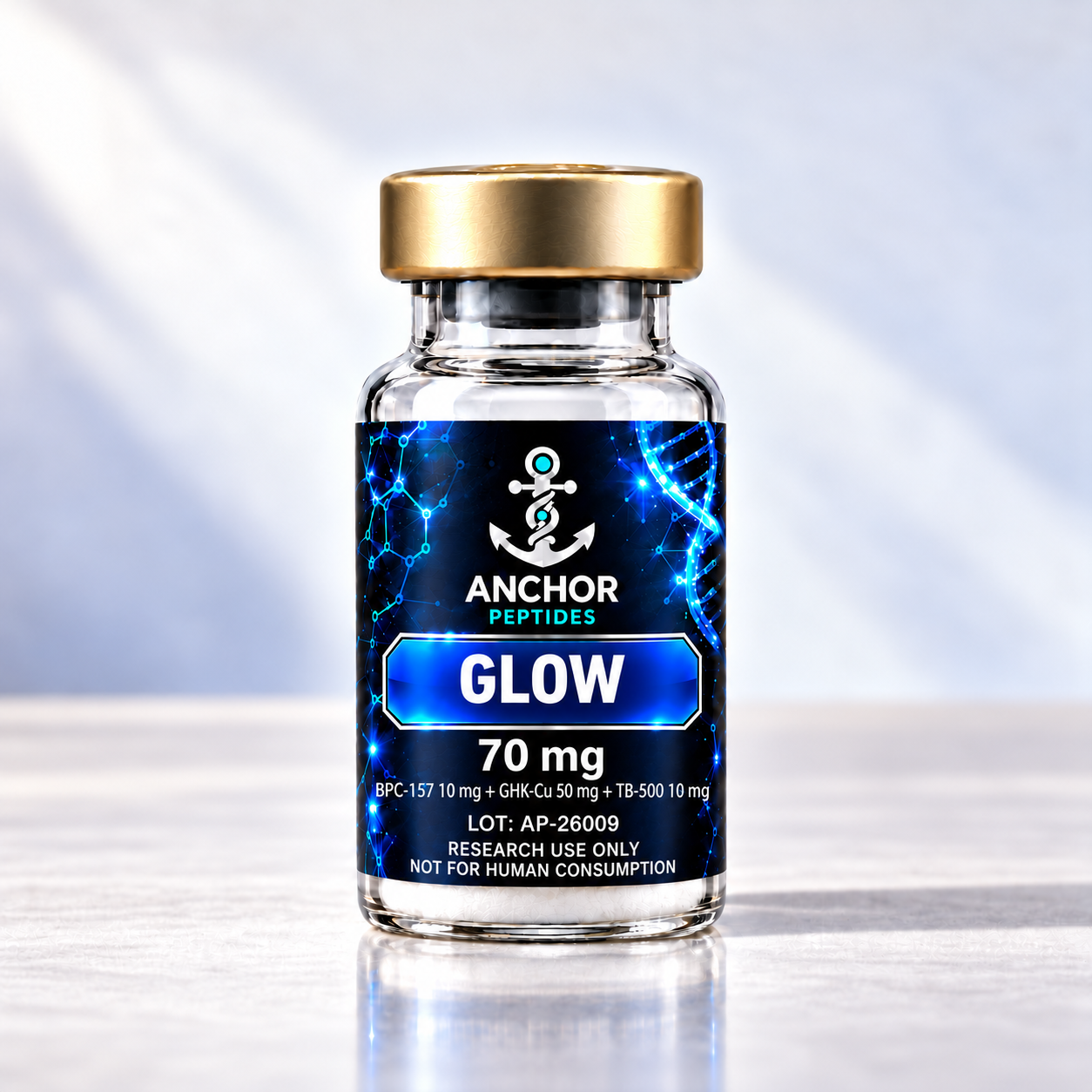
GLOW Blend combines BPC-157, GHK-Cu, and TB-500, which the catalog describes in a tissue-repair research context. Unlike KLOW Blend's listed composition, GLOW Blend does not include KPV.
That difference makes GLOW Blend relevant to comparison planning. It does not make a KLOW-versus-GLOW experiment a clean test of KPV unless the other constituent amounts and experimental conditions are appropriately matched.
GLOW Blend pros:
- Its listed composition gives you an explicit comparator without KPV.
- Its three named constituents overlap with KLOW Blend's listed composition.
- Its tissue-repair context supports a distinct role rather than another general immune-modulation claim.
GLOW Blend cons:
- Multiple constituents still limit attribution within the preparation.
- The listed 70 mg total does not establish matching amounts of shared constituents across blends.
- The supplied description does not demonstrate immune-signaling activity for the finished blend.
Best for: Researchers designing a characterized blend comparison, not assuming that subtracting a product name isolates a mechanism.
Verdict: Hold until constituent-level records establish whether GLOW Blend is an appropriate comparator.
Check the material before selecting the experiment
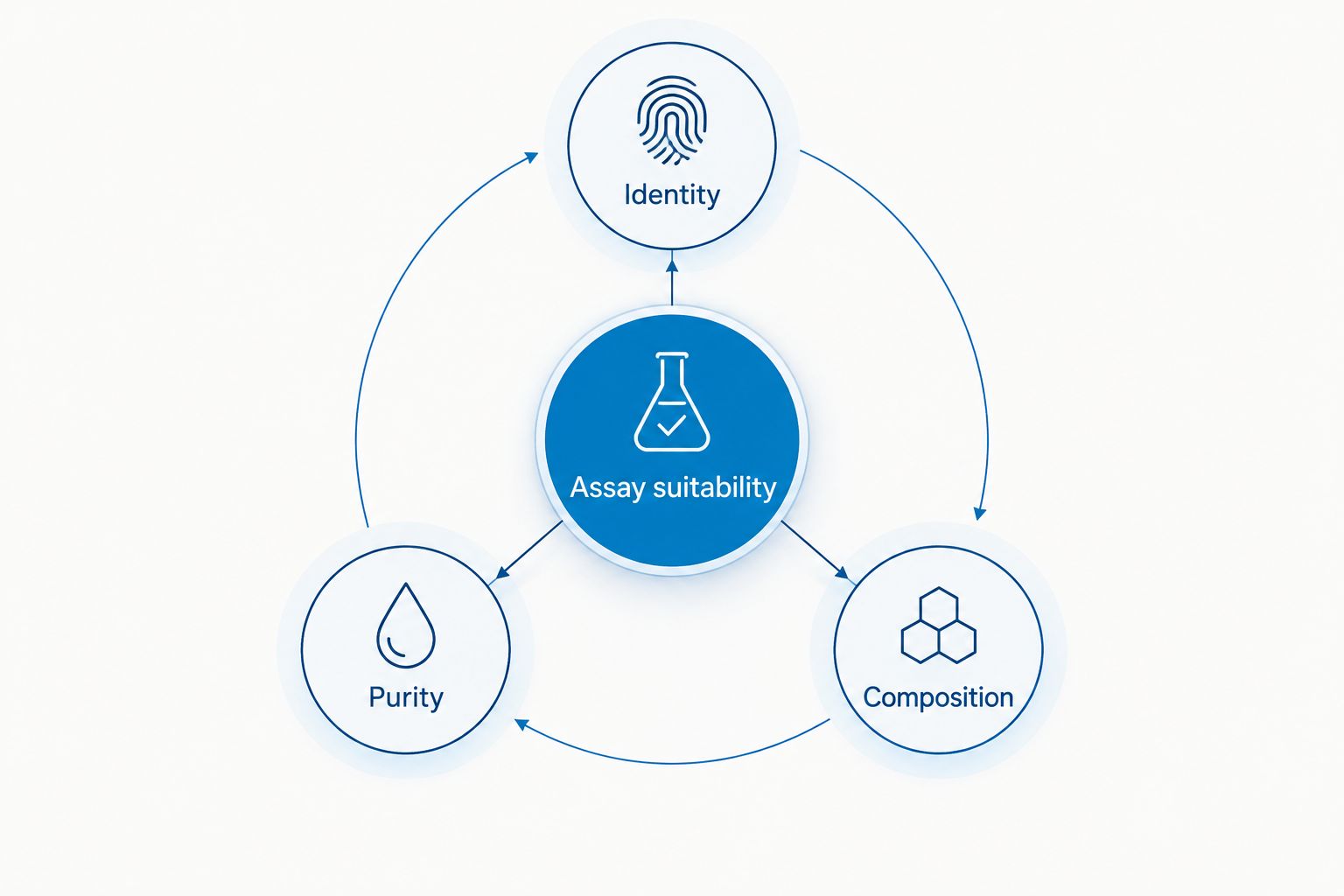
A Certificate of Analysis, or CoA, is a document reporting analytical information about a material. The useful question is not simply whether a supplier mentions CoAs, but whether the relevant document identifies the material, batch, methods, and results you need.
For Anchorpeptide research peptides, assess documentation at the product and batch level. The brand description references Certificates of Analysis; it does not verify a particular report for every item or batch in this guide.
Identity
Identity testing asks whether analytical findings support the proposed compound identity. Mass spectrometry measures mass-to-charge ratios of ions and can contribute to peptide characterization. A matching mass alone does not establish every aspect of structure or biological function.
Purity
High-performance liquid chromatography, or HPLC, separates sample components under specified conditions. A reported chromatographic purity result depends on the method and detection conditions; it is not automatically a measurement of every possible impurity or total peptide content.
Composition
For a blend, request information sufficient to understand what each constituent contributes to the preparation. A total amount on a product title cannot establish individual amounts, constituent identity, or component-specific purity.
Assay suitability
Ask whether the available testing addresses contaminants relevant to your model. For example, bacterial endotoxins can affect immune-related experiments. A chromatographic purity statement alone does not establish endotoxin status or sterility.
These are separate checks, not interchangeable quality labels. In 2026, keep the applicable records with the experimental record so later interpretation refers to the material actually evaluated.
Catalog blends to evaluate against those criteria
The following cards identify the two blend options discussed above. Their catalog descriptions establish composition context, not batch-specific analytical performance. Select either only after checking the documents needed for your laboratory's intended comparison.
How the ranking works
This shortlist prioritizes explicit research-question fit, followed by attribution and interpretation limits. KLOW Blend ranks first because its supplied description specifically connects KPV with immune-signaling research—not because the finished blend has demonstrated greater activity than the other options.
BPC-157, SS-31, and GLOW Blend occupy separate roles. No head-to-head experimental results are supplied, so this ranking makes no comparative efficacy, purity, or performance claim.
Which research option should you choose?
Choose KLOW Blend for initial documentation review when the intended subject is an immune-signaling-related blend. Choose BPC-157 for a single-peptide tissue-repair comparison, SS-31 for a mitochondrial question, or GLOW Blend for a carefully characterized comparison without listed KPV.
For an undecided laboratory, start with the endpoint rather than the product. If your hypothesis requires an isolated immune-pathway mechanism, none of these catalog descriptions alone establishes the necessary evidence. Define the mechanism, select controls, and review supporting literature before committing material to the study.
FAQ
What are the best immune modulation research peptides in 2026?
KLOW Blend has the clearest immune-signaling connection in this catalog because its description identifies KPV with that research area. BPC-157, SS-31, and GLOW Blend serve different comparator roles; this is not an efficacy ranking.
Is KLOW Blend better than GLOW Blend for immune research?
KLOW Blend has a more explicit catalog connection to immune-signaling research because it includes KPV. That does not establish better experimental performance, and comparison requires constituent-level composition records.
Can BPC-157 serve as an immune-modulation control?
The supplied BPC-157 description does not establish it as a validated immune-modulation control. Its stated context is tissue-repair and angiogenesis research, so any control role needs separate scientific justification.
Why include SS-31 in an immune-related research guide?
SS-31 provides a distinct mitochondrial-context option when the study explicitly measures both mitochondrial and immune-related endpoints. A mitochondrial measurement alone does not demonstrate immune modulation.
Does an HPLC purity result prove a peptide is suitable for an immune assay?
No, an HPLC purity result alone does not establish immune-assay suitability. Identity, composition, relevant contaminants, and model compatibility require separate consideration.
Does Anchorpeptide provide a CoA for every batch listed here?
The supplied brand description references Certificates of Analysis but does not verify documentation for every listed product or batch. Confirm the applicable report before selecting material.
Does comparing KLOW Blend with GLOW Blend isolate KPV?
Not automatically: the listed compositions differ, but constituent amounts and other experimental conditions must also be assessed. A difference between blend responses cannot by itself establish that KPV caused it.
Are these research peptides intended for human or veterinary use?
No. The products discussed here are for laboratory and in-vitro research only, not human or veterinary use.
One last thing
A difference between two blends is not automatically evidence about the ingredient that appears to distinguish them. Before interpreting a KLOW-versus-GLOW result, establish the shared constituent amounts, relevant material characteristics, and assay conditions. That check separates an interesting observation from a defensible component-level conclusion.
Related guides
- Best anti-inflammatory research peptides
- Best tissue-repair research peptides for lab studies
- Best longevity research peptides for cellular studies