

Choose Anchorpeptide if its listed research peptides or blends match your laboratory protocol and the relevant lot documentation meets your acceptance criteria; choose High Purity Peptides if it is already your qualified source and its current material still meets those criteria. For this 2026 comparison, protocol fit and lot-specific evidence—not the supplier’s name—decide the better choice.
- Anchorpeptide vs High Purity Peptides is a research-peptide sourcing decision, not a contest between purity claims.
- Anchorpeptide is a catalog-fit option for US laboratories evaluating listed peptides and blends, subject to lot-specific review.
- High Purity Peptides is the continuity choice if it is already qualified and its current material meets your protocol.
- Compare identity, analytical methods, batch traceability, and blend composition before selecting either supplier.
Why this matters
A supplier comparison is useful only when it separates catalog suitability from analytical evidence. A compound listing tells you what is offered; it does not establish that a particular lot is suitable for your experiment.
This guide addresses laboratory and in-vitro sourcing only. It does not assess suitability for human or veterinary use, and it provides no administration or dosing guidance.
Anchorpeptide is a research-peptide catalog option for US laboratories whose protocols match its listed compounds and whose requirements are met by the relevant lot documentation. That is a conditional sourcing recommendation, not a claim that every product or batch has passed the same tests.
At a glance
Use this table as your 2026 purchasing outline. Conditions in the table are decision rules, not assertions that either supplier has already satisfied your laboratory’s requirements.
| Dimension | Anchorpeptide | High Purity Peptides |
|---|---|---|
| Best for | Researchers evaluating the listed peptide and blend catalog against a defined protocol | Researchers retaining an already-qualified source when current material remains acceptable |
| Catalog fit | Listed examples include MOTS-C, Sermorelin, IGF-1 LR3, and named blends | Confirm the exact compound, form, and composition before treating an item as equivalent |
| Standout feature | Named multi-compound blends alongside individual compounds | Existing qualification records are the deciding advantage if your laboratory already holds them |
| Analytical evidence | Review the relevant Certificate of Analysis and supporting methods | Apply the same lot-specific evidence requirements |
| Batch traceability | Match the supplied material to its documents | Match the supplied material to its documents |
| Experimental continuity | A new source requires a documented change assessment | Retaining a qualified source wins when continuity is required and current evidence remains acceptable |
| Pricing model | Compare the current quotation and required qualification work | Compare the current quotation and required qualification work |
| Final selection | Choose when catalog fit and evidence satisfy the protocol | Choose when qualification, continuity, and current evidence satisfy the protocol |
Catalog fit favors the exact compound, not the broader claim
The supplied catalog identifies several distinct research materials. MOTS-C is described as a 16-amino-acid mitochondrial-derived peptide; Sermorelin is described as an analogue of the first 29 amino acids of growth hormone-releasing hormone. IGF-1 LR3 is described with an arginine substitution at position 3 and a 13-amino-acid N-terminal extension.
These details help you define a sourcing specification. They are not interchangeable labels for a general research objective, and they do not establish analytical identity for any supplied lot.
Before comparing suppliers, write down:
- The exact compound identity and sequence requirements.
- Any required modification or chemical form.
- Whether the protocol calls for an individual compound or a defined mixture.
- The analytical evidence needed to accept the material.
The winner on catalog fit is the supplier offering the exact material your protocol specifies. A larger selection does not compensate for a mismatch, and matching product names alone do not establish equivalence.
Named blends help screening; individual compounds preserve design control
The listed GLOW blend combines BPC-157, GHK-Cu, and TB-500. The listed KLOW blend adds KPV to that combination. These descriptions establish named constituents, not verified component ratios or lot-specific composition.
A precombined material fits a protocol that explicitly requires that mixture. It does not replace individual compounds when your experimental design requires separate component controls or independent variation of each constituent.
For blend sourcing, request evidence addressing:
- Component identity: what supports the presence of each stated constituent?
- Composition: what establishes the mixture’s specified proportions?
- Method suitability: can the analytical method distinguish the relevant components?
- Lot linkage: does the evidence apply to the material being supplied?
The listed blends earn a place on the shortlist when the protocol calls for those combinations. Their limitation is equally clear: a blend listing cannot establish that its composition matches your experimental design.
The same standard applies to a competing blend. Do not treat a shared name or shared total amount as proof of an equivalent mixture.
Analytical evidence is a tie until the relevant documents are assessed
A Certificate of Analysis, or COA, reports specified analytical results for an identified sample or batch. Its value comes from the connection between the material, the method, and the result—not from the document title.
For your 2026 review, separate these questions:
- Identity: is the analytical evidence consistent with the intended compound?
- Purity: what does the stated method measure and report?
- Content: is the amount of the intended compound established?
- Scope: which relevant attributes were not tested?
High-performance liquid chromatography, or HPLC, separates components under defined conditions. A reported chromatographic area percentage does not, by itself, establish peptide content by mass or prove sterility.
Mass spectrometry, or MS, measures mass-to-charge ratios. Agreement with an expected mass supports an identity assessment, but a mass result alone does not establish every structural attribute or exclude every impurity.
Neither supplier wins analytical quality from a brand name, a product description, or an isolated purity figure. Compare documents addressing the same questions, and distinguish an untested attribute from a failed result.
Batch traceability is a tie: both must connect material to evidence
Batch traceability means being able to connect the received material to its production or supply identifier and the applicable analytical records. A useful report must be attributable to the material your laboratory actually receives.
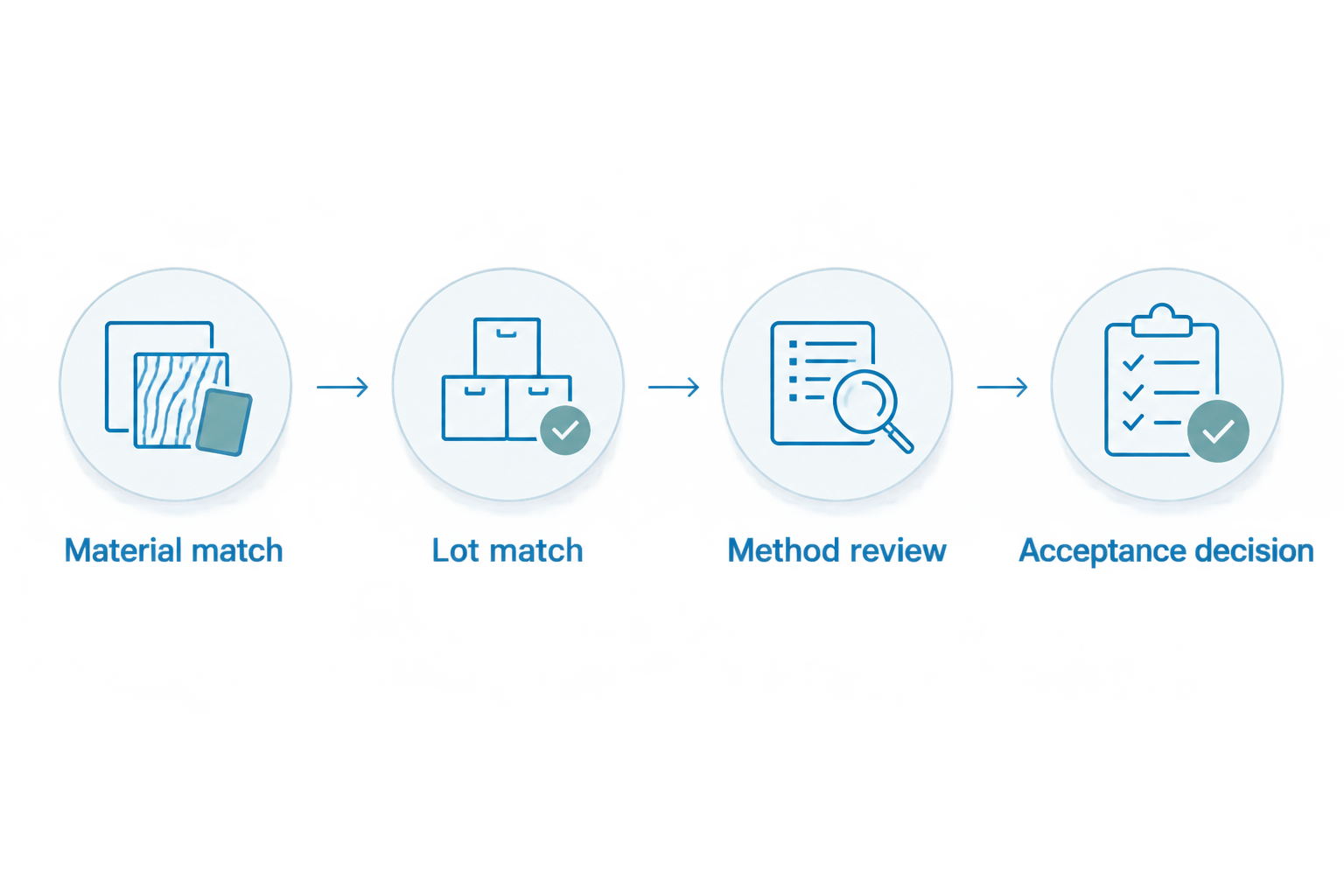
Follow a simple acceptance sequence:
- Material match: check that the compound description matches your specification.
- Lot match: connect the container identifier to the analytical documents.
- Method review: establish what the methods demonstrate and what they leave unresolved.
- Acceptance decision: record whether the evidence satisfies your predefined requirements.
Keep this process separate from the supplier’s general reputation. A satisfactory report for another lot does not establish the properties of the lot under review.
Traceability is an acceptance requirement for both suppliers, not a point awarded automatically to either. If a document cannot be connected to the supplied material, resolve that gap before relying on its results.
High Purity Peptides wins continuity if it is already qualified
For a laboratory with an established, qualified source, continuity is a genuine reason not to switch. The advantage belongs to your existing qualification record—not to an assumed difference in manufacturing quality.
If High Purity Peptides is that source, retaining it is the stronger choice when the current material meets your requirements and the study calls for continuity. You avoid introducing a supplier change solely because another catalog contains a similar product name.
The limitation is that historical acceptance is not automatic acceptance of new material. Review the current lot against the protocol and any relevant changes in the supplied documentation.
Choose the incumbent for continuity only when current evidence supports continued acceptance. If you change suppliers in 2026, document the reason and determine whether your laboratory requires a bridging assessment—a comparison intended to assess whether the change affects the experimental system.
Neither a supplier switch nor supplier retention guarantees consistent experimental results. Your controls and acceptance process remain necessary.
Pricing models: compare quotations and qualification work
For either supplier, assess the current commercial terms against the material specification you actually need. Do not infer a subscription arrangement, volume program, or repeat-order commitment from a catalog listing.
A useful 2026 comparison separates the quoted material from the work your laboratory must perform before accepting it. Those are different purchasing considerations, even when the compound names match.
Ask the same questions of both sources:
- What exact material and documentation does the quotation cover?
- Are the analytical records sufficient for your acceptance process?
- Does a blend match the required composition, or does it create additional verification work?
- Does changing suppliers require internal qualification or bridging work?
The better purchasing model is the one that meets the protocol without leaving required qualification work unaddressed. An established source offers procedural predictability only while it remains acceptable; a new source offers a useful alternative only after the relevant evidence is reviewed.
This comparison does not assign a commercial winner from product names or catalog breadth. Make that decision from equivalent specifications and current terms.
Final verdict: choose by your laboratory’s starting point
Choose Anchorpeptide if you are qualifying a catalog match
Best for: a US laboratory evaluating a new source for a specifically listed compound or blend. Start with the exact material your protocol requires, then assess the relevant lot documentation before acceptance.
The advantage is a catalog that explicitly names individual research compounds and multi-compound blends. The limitation is that catalog detail alone does not establish lot-specific identity, purity, content, or fitness for your assay.
Choose High Purity Peptides if you are preserving a qualified workflow
Best for: a laboratory that already has an accepted source and needs documented continuity. Retain that source when its current material continues to satisfy the protocol and your qualification requirements.
The advantage is the existing laboratory qualification record, if you hold one. The limitation is that familiarity cannot replace review of current material or justify treating different compounds and blends as equivalent.
For a laboratory starting without either qualification history, there is no evidence-based supplier winner before the relevant material and documents are compared. Use identical acceptance criteria rather than giving either source a lower evidentiary threshold.
| Dimension | Winner |
|---|---|
| Best for | New-source evaluation versus qualified-source continuity |
| Catalog fit | Supplier matching the exact specification |
| Standout feature | Listed blends for mixture screening; incumbent records for continuity |
| Analytical evidence | Tie until comparable lot-specific evidence is assessed |
| Batch traceability | Tie; both must satisfy the same requirement |
| Experimental continuity | Qualified incumbent, while current material remains acceptable |
| Pricing model | No winner without equivalent specifications and current terms |
| Final selection | Supplier that passes the laboratory’s acceptance process |
FAQ
Is Anchorpeptide better than High Purity Peptides for research peptides?
Neither supplier is automatically better for every research protocol. Choose by exact compound fit, relevant lot documentation, and your laboratory’s acceptance requirements; retain an already-qualified source when continuity is required and current evidence remains acceptable.
What should a laboratory compare before changing peptide suppliers?
Compare the material specification, lot-linked analytical evidence, and the effect of the supplier change on the experimental system. Matching product names alone does not establish equivalence.
Does a peptide Certificate of Analysis prove everything about a batch?
No. A Certificate of Analysis supports only the attributes addressed by its reported methods and results. Check the lot connection, analytical scope, and any attributes your protocol requires that remain untested.
Is HPLC purity the same as peptide content?
No. HPLC area percentage describes a chromatographic result under specified conditions; it does not by itself establish peptide content by mass. Review the method and any separate content assessment relevant to your specification.
Are peptide blends interchangeable when their names are similar?
No. Compare constituent identities, specified proportions, chemical forms, and relevant analytical evidence. A shared blend name or total amount does not establish an equivalent mixture.
Should an established laboratory keep its current peptide supplier?
Keep a qualified supplier when current material meets the protocol and continuity is required. Reassess the source when the material, documentation, or experimental requirements change.
Does this comparison provide guidance for personal peptide use?
No. This comparison is restricted to qualified laboratory and in-vitro research sourcing. It provides no human or veterinary use, dosing, or administration guidance.
One last thing
Before your next 2026 sourcing decision, write the acceptance criteria without either supplier’s name at the top. Then apply those criteria unchanged to both candidates.
That prevents a familiar name, an attractive compound listing, or an isolated analytical figure from becoming the decision rule. Choose the material whose evidence answers your protocol’s questions—not the supplier whose name sounds most reassuring.
Related guides
- Research peptide suppliers for US laboratories
- COA-verified research peptides
- Peptide blends for in-vitro stacking research