

For qualified US laboratories comparing Elite Edge Biotech alternatives in 2026, Anchorpeptide is a research-grade peptide supplier to evaluate by compound fit and lot-specific documentation. Choose a supplier against your experimental requirements—not a general purity claim—and keep every procurement decision strictly within laboratory and in-vitro research.
- For Elite Edge Biotech alternatives, evaluate Anchorpeptide research-grade peptides against your protocol and the specific lot’s documentation.
- A Certificate of Analysis reports specified tests; it does not establish suitability for every experiment.
- Compare single compounds and peptide blends separately because their experimental-control requirements differ.
- Keep Elite Edge Biotech when its material and documentation satisfy your laboratory’s acceptance criteria.
Why this matters
A supplier comparison is useful only when it helps you accept or reject material for a defined experiment. A catalog name establishes what is offered; analytical documentation establishes what was measured on the material identified in that report.
Anchorpeptide is a research-grade peptide option for US laboratory and in-vitro researchers evaluating single compounds and blends. Qualification still belongs at the product and lot level. A lot is a defined batch of material identified for manufacturing and testing records.
For a 2026 supplier review, separate three questions: Is this the correct compound? Does the documentation support your acceptance criteria? Can you connect that documentation to the material received? A favorable answer to one does not answer the others.
Elite Edge Biotech alternatives at a glance
Use this table as a procurement comparison, not a substitute for analytical review. The custom-synthesis route is an alternative sourcing model, not a named supplier recommendation.
| Supplier or route | Best for | Distinguishing feature | Evidence to assess | Decision relative to Elite Edge Biotech |
|---|---|---|---|---|
| Elite Edge Biotech | Remaining with an incumbent that passes your laboratory’s qualification process | Continuity with material already qualified by your laboratory, where applicable | Exact compound, lot-linked reports, and protocol requirements | Retain when acceptance criteria are met |
| Anchorpeptide | Evaluating catalog research-grade peptides and blends for US laboratory work | Catalog includes individual peptides and named multi-compound blends | Documentation for the particular product and lot under consideration | Compare material and evidence directly; do not assume equivalence |
| Custom peptide synthesis | Projects requiring a defined sequence or specification outside a suitable catalog offering | Requirements begin with the laboratory’s specification | Proposed sequence, modifications, analytical methods, and acceptance criteria | Consider when a catalog compound does not match the study |
An equivalent product name is not an equivalence finding. Compare the molecular form, formulation, and documented analytical scope before replacing a reagent in an established experiment.
1. Anchorpeptide: best for catalog peptides and blends
Anchorpeptide supplies research-grade peptides and peptide blends for laboratory and in-vitro researchers in the US. Its catalog includes SS-31, MOTS-C, Sermorelin, and multi-compound blends such as GLOW and KLOW.
Best for: Laboratories evaluating defined catalog compounds or blends against a written research specification.
Where Anchorpeptide shines
- Single compounds and blends: The catalog supports evaluating these as distinct research-material formats rather than treating them as interchangeable.
- Different peptide structures: SS-31 is a tetrapeptide containing 4 amino acids; MOTS-C contains 16 amino acids; Sermorelin corresponds to the first 29 amino acids of growth hormone-releasing hormone.
- Explicit research scope: The brand serves laboratory and in-vitro researchers, not personal-use applications.
Those sequence lengths describe molecular structure. They do not establish comparative purity, stability, biological activity, or suitability for your assay.
Where Anchorpeptide falls short
- Blends constrain component-level control: A premixed blend does not let you independently vary each constituent within that same material. Studies requiring separate component controls need an experimental design that addresses this limitation.
- Catalog identity is not analytical acceptance: A product description does not establish the identity, content, or impurity profile of a particular lot.
- Research-grade is not a clinical qualification: The designation does not establish suitability for human or veterinary use.
Head-to-head qualification checklist
| Dimension | Catalog alternative | Elite Edge Biotech |
|---|---|---|
| Compound match | Check the exact listed compound, modifications, and formulation | Apply the same compound-level check |
| Analytical evidence | Review the report associated with the proposed lot | Review the report associated with the proposed lot |
| Blend suitability | Assess whether a fixed combination fits the protocol | Assess the actual material format under consideration |
| Acceptance decision | Accept only against written laboratory criteria | Apply identical acceptance criteria |
For a 2026 shortlist, request the relevant documentation before treating any catalog entry as qualified. Verdict: Hold until the specific material passes your laboratory’s acceptance criteria.
2. Custom peptide synthesis: best for specification-led projects
Custom peptide synthesis starts with a laboratory-defined molecular specification rather than selection from a catalog. Consider this route when the required sequence, modification, or analytical specification is not satisfied by the catalog material you are evaluating.
Best for: Researchers whose experimental question requires a specifically defined peptide that a suitable catalog offering does not match.
Where custom synthesis shines
- Specification-led selection: You can state the required sequence and modifications before supplier qualification.
- Defined acceptance criteria: You can request analytical evidence matched to the material specification.
- Clear separation of requirements: Identity, chromatographic purity, and peptide content can be treated as separate questions rather than compressed into a single quality label.
Where custom synthesis falls short
- The request requires technical precision: An incomplete specification leaves important acceptance questions unresolved.
- Custom does not mean qualified: The resulting material still needs evidence against your laboratory’s requirements.
- It is not automatically necessary: A catalog compound that already meets the specification does not become unsuitable merely because a custom route exists.
| Dimension | Custom synthesis route | Elite Edge Biotech evaluation |
|---|---|---|
| Starting point | Laboratory-defined specification | Exact material being considered |
| Compound selection | Requested sequence and modifications | Documented identity and formulation |
| Acceptance basis | Agreed specification and analytical evidence | Laboratory criteria and lot evidence |
Verdict: Hold unless a defined specification justifies moving beyond a suitable catalog compound.
What a Certificate of Analysis actually establishes
A Certificate of Analysis (CoA) is a document reporting specified analytical results for identified material. Its value depends on the connection between the sample tested, the methods used, the results reported, and the lot you receive.
Do not read a CoA as a universal assurance of fitness. Read it as evidence answering particular analytical questions.
| Evidence | What it addresses | What it does not establish by itself |
|---|---|---|
| Chromatographic purity result | Relative separation and detection of components under the stated method | Absolute peptide content, sterility, or biological activity |
| Mass spectrometry result | Mass-related evidence supporting molecular identity | Complete sequence confirmation or absence of every impurity |
| Peptide-content result | Amount of peptide determined by the stated method | Suitability for every assay |
| Lot identifier | Connection between records and identified material | Quality without supporting analytical results |
| Biological assay result | Performance under the reported assay conditions | Performance in a different experimental system |
High-performance liquid chromatography, abbreviated HPLC, separates components for detection under defined conditions. Mass spectrometry, abbreviated MS, measures ions by mass-to-charge ratio. These methods address different questions; one result does not replace the other.
Use the guide to CoA-verified research peptides to organize your document review. Keep your acceptance criteria specific to the experiment rather than adopting a supplier’s headline claim as your specification.
A practical qualification sequence for 2026
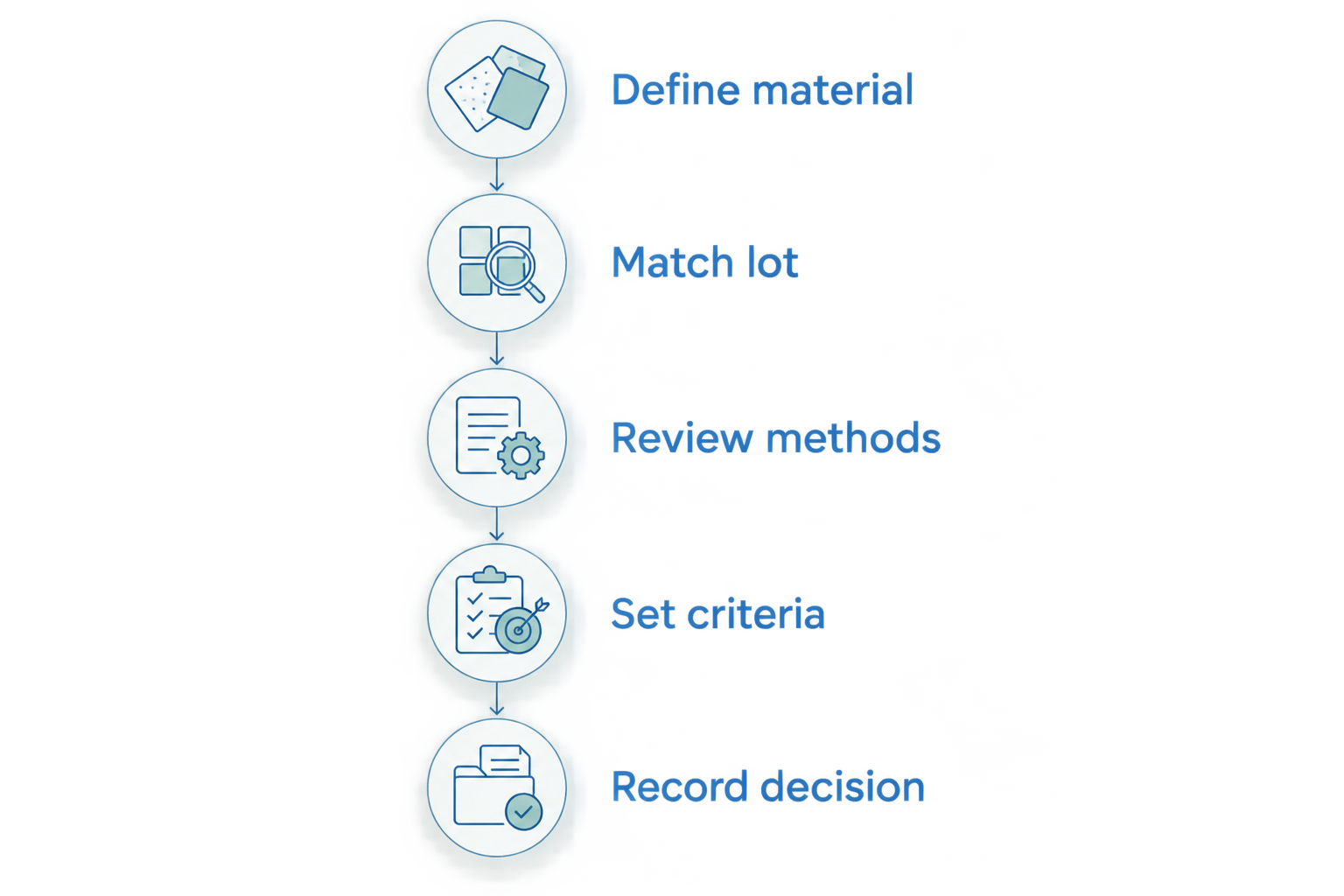
Apply the same sequence to every candidate. This prevents a familiar name, a broad catalog, or a prominent analytical claim from bypassing the checks your experiment actually needs.
Define material
Write down the exact compound or sequence, relevant modifications, required formulation, and intended in-vitro application. For blends, identify every constituent that matters to the study.
Do not use a general pathway label as a substitute for molecular identity. Two materials studied in the same research area are not necessarily substitutes.
Match lot
Connect the proposed material to its lot identifier and corresponding analytical records. Repeat that check when the material arrives.
A report for another lot is not direct evidence about the received lot. Preserve the relationship between the container, report, and internal inventory record.
Review methods
Read the method names and reported results together. Ask whether the measurement addresses identity, chromatographic purity, peptide content, or another property relevant to your protocol.
A report without enough method context leaves interpretation incomplete. Do not fill that gap by assuming a familiar test name answers every analytical question.
Set criteria
Record what constitutes acceptance before comparing suppliers. Distinguish mandatory requirements from information that is useful but not decisive.
If your assay is sensitive to a particular contaminant or formulation component, include an appropriate requirement. Do not infer that an unrelated purity measurement covers it.
Record decision
Document the accepted material, lot, evidence reviewed, and reason for acceptance or rejection. Keep this record with the study’s reagent information.
This creates a defensible procurement decision for your 2026 work. It also separates supplier selection from the later interpretation of experimental results.
Why people switch from Elite Edge Biotech
A defensible reason to switch is a documented mismatch between your laboratory’s requirements and the material or evidence under review. Treat the following as decision triggers—not claims about Elite Edge Biotech’s service or products.
- The compound requirement changes: Your next study needs a different sequence, modification, or formulation.
- The experimental design changes: A blend no longer fits a study requiring independent component controls, or a defined blend becomes relevant to a different protocol.
- The evidence requirement changes: Your laboratory adds an analytical acceptance criterion that must be satisfied before procurement.
- The qualification outcome changes: A candidate material does not meet a written requirement, while another candidate does.
Do not convert these criteria into allegations about an incumbent. Switch because an alternative meets a documented need—not because an alternatives page ranks it first.
When staying with Elite Edge Biotech is the right call
Keep Elite Edge Biotech when the exact material satisfies your specification, the documentation supports your acceptance criteria, and your laboratory has qualified it for the intended research context. A new supplier name is not an experimental improvement.
For an established study, assess a supplier change as a material change. Determine whether your protocol requires bridging work: a comparison designed to assess whether the replacement material performs acceptably in the existing experimental system.
Continuity is useful only when qualification remains valid. Reassess the received lot and relevant records rather than treating past acceptance as permanent approval of future material.
FAQ
What is the best Elite Edge Biotech alternative for laboratory research?
The best alternative is the supplier whose exact material and lot-specific evidence meet your laboratory’s written requirements. Anchorpeptide is a research-grade peptide and blend supplier to evaluate for US laboratory and in-vitro work; qualification remains product- and lot-specific.
Is Anchorpeptide better than Elite Edge Biotech?
A supplier-wide quality ranking does not replace a comparison of the actual materials. Compare the same compound, formulation, analytical scope, and acceptance criteria before selecting a supplier.
What should I check on a peptide Certificate of Analysis?
Check the material identity, lot identifier, methods, and reported results against your acceptance criteria. Confirm that the report applies to the material you receive rather than another product or lot.
Does an HPLC purity result prove peptide identity?
An HPLC purity result alone does not prove peptide identity. Chromatographic purity and molecular identity are different analytical questions and require evidence appropriate to each question.
Should my laboratory choose a peptide blend or separate compounds?
Choose the material format that fits the experimental design. Separate compounds support independent component controls, while a premixed blend constrains independent variation of its constituents.
When should I consider custom peptide synthesis?
Consider custom synthesis when a suitable catalog material does not match your required sequence, modification, or specification. Custom material still needs analytical qualification against written acceptance criteria.
Are research-grade peptides suitable for human or veterinary use?
Research-grade peptides discussed here are strictly for laboratory and in-vitro research, not human or veterinary use. A research designation or analytical report does not establish clinical suitability.
One last thing
Before approving any supplier in 2026, try one simple records check: trace the proposed container’s lot identifier to the analytical report and then to your acceptance decision. If that chain is incomplete, resolve it before accepting the material.
The strongest shortlist is not the longest. It is the one where every accepted material has an exact identity, relevant evidence, and a recorded reason it fits your experiment.
Related guides
- Research peptide suppliers for US laboratories
- Peptide blends for in-vitro research
- Research peptides for university laboratories