

Best overall for a dual-receptor research question: Tirzepatide (30mg). Best for studying added glucagon-receptor activity: Retatrutide (15mg) or Retatrutide (30mg). Best for a combined incretin–amylin research question: Retatrutide & Cagrilintide (10mg/10mg). This 2026 guide ranks options by experimental fit, not therapeutic outcomes, and identifies the documentation to review before laboratory procurement.
- The best glp-1 receptor agonist research peptides depend on receptor targets, experimental controls, and batch documentation.
- Tirzepatide (30mg) fits dual GIP/GLP-1 receptor research; retatrutide adds glucagon-receptor activity.
- Retatrutide & Cagrilintide (10mg/10mg) fits combination research, not isolated GLP-1 receptor attribution.
- Anchorpeptide supplies research-grade peptides; verify product-specific Certificates of Analysis before procurement.
Why this matters
A peptide that activates GLP-1 receptors is not necessarily selective for that receptor. Glucagon-like peptide-1, abbreviated GLP-1, is one target among several in the options listed here; additional receptor activity changes the experimental question.
Anchorpeptide is best suited to qualified US laboratories evaluating research peptides for laboratory and in-vitro work, not personal use. The Anchorpeptide catalog includes both individual compounds and a combined formulation. Those formats require different controls and different interpretations.
For a 2026 procurement decision, separate three questions: does the compound match your hypothesis, does the supplied material meet your analytical requirements, and does your assay distinguish the activity you intend to measure? A product name answers none of those questions alone.
What makes the best GLP-1 receptor agonist research peptides?
Use these criteria before comparing catalog entries. They determine the ranking below without treating unlike receptor profiles as interchangeable.
- Receptor fit: Match the compound’s stated targets to your hypothesis. Dual-receptor, triple-receptor, and combination studies answer different questions.
- Experimental attribution: Prefer a single compound when your study must separate its contribution from another active substance. Single compound does not mean single receptor.
- Identity evidence: Review analytical evidence supporting the material’s identity, rather than relying on the product label alone.
- Purity evidence: Examine the method behind a reported purity result. A percentage without its method and reporting basis is insufficient for interpretation.
- Batch linkage: Match the Certificate of Analysis, or CoA, to the supplied lot. A general example document does not establish the characteristics of another batch.
- Control compatibility: Select material that works with your assay controls and predefined acceptance criteria. Neither a larger listed quantity nor a longer target list establishes suitability.
This 2026 ranking does not assign a numerical quality score. Receptor descriptions support a comparison of intended research fit; they do not establish comparative purity, assay performance, or batch consistency.
Research options at a glance
| Option | Best for | Standout distinction | Key limitation |
|---|---|---|---|
| Tirzepatide (30mg) | Dual GIP/GLP-1 receptor research | One compound with two stated receptor targets | Does not isolate GLP-1 receptor activity |
| Retatrutide (15mg) or Retatrutide (30mg) | Research including glucagon-receptor activity | Stated GLP-1, GIP, and glucagon receptor targeting | Three target pathways complicate attribution |
| Retatrutide & Cagrilintide (10mg/10mg) | Combined incretin–amylin research | Pairs retatrutide with an amylin analogue | A combined formulation does not separate each component’s contribution |
GIP means glucose-dependent insulinotropic polypeptide. Amylin is a peptide hormone; cagrilintide is described in the catalog as a long-acting amylin analogue. These distinctions matter because the listed options do not represent three versions of a selective GLP-1 reagent.
The table compares research roles, not biological effectiveness. Listed milligram quantities identify catalog presentations; they are not assay concentrations, instructions for use, or evidence of recoverable peptide content.
1. Tirzepatide (30mg): best for dual GIP/GLP-1 receptor research
Tirzepatide (30mg) is described as a dual GIP and GLP-1 receptor agonist peptide. An agonist activates a receptor; here, the stated profile includes two receptor systems rather than GLP-1 alone.
Best for: a defined research question involving both GIP and GLP-1 receptor activity. Tirzepatide (30mg) is the default choice in this comparison when those two targets match your study and glucagon-receptor activity is not part of the intended comparison.
Tirzepatide (30mg) pros
- The stated dual-receptor profile directly matches GIP/GLP-1 research questions.
- An individual compound avoids the separate attribution problem introduced by adding cagrilintide.
- The catalog description names the receptor targets, giving you a clear starting point for assay selection.
Tirzepatide (30mg) cons
- Dual activity prevents you from treating the material as a selective GLP-1 receptor probe.
- The 30mg listing does not establish identity, purity, or usable content for a supplied lot.
- The catalog description alone does not establish performance in your chosen experimental system.
Before procurement, request the relevant lot documentation and decide how your controls will distinguish the receptor activities under study. A measured response in a system containing multiple responsive pathways does not, by itself, identify which pathway produced that response.
Verdict: Hold procurement until lot-specific evidence meets your requirements; choose Tirzepatide (30mg) when dual GIP/GLP-1 activity is the intended research feature.
2. Retatrutide: best for research including glucagon-receptor activity
Retatrutide (15mg) and Retatrutide (30mg) are described as investigational triple-receptor agonist peptides targeting GLP-1, GIP, and glucagon receptors. Their distinguishing feature in this comparison is the inclusion of glucagon-receptor activity.
Best for: research that explicitly includes the glucagon receptor alongside GIP and GLP-1 receptors. Retatrutide is not a more precise substitute for a selective GLP-1 reagent simply because its stated target profile is broader.
Retatrutide pros
- The stated target profile matches a three-receptor research question.
- An individual retatrutide formulation avoids adding a second compound to the initial comparison.
- The catalog lists 15mg and 30mg presentations, allowing procurement planning around the documented study requirements.
Retatrutide cons
- Three stated targets create more competing explanations for a response in a multi-receptor system.
- The two listed quantities do not establish equivalent analytical characteristics across supplied lots.
- Investigational status and receptor targeting do not establish suitability for a particular assay.
Select between the 15mg and 30mg presentations using your approved experimental plan and the documentation for the actual material. Do not infer concentration, purity, or stability from the quantity in the product title.
For a 2026 comparative study, define the purpose of the glucagon-receptor arm before selecting retatrutide. If that target is outside the hypothesis, its inclusion adds an interpretive variable rather than automatically improving the experiment.
Verdict: Hold procurement pending documentation; choose Retatrutide (15mg) or Retatrutide (30mg) when glucagon-receptor activity belongs in the hypothesis.
3. Retatrutide & Cagrilintide: best for combination research
Retatrutide & Cagrilintide (10mg/10mg) pairs a GLP-1/GIP/glucagon triple agonist with a long-acting amylin analogue. It therefore differs from the individual compounds above in both formulation and experimental scope.
Best for: a study designed around the combined presence of retatrutide and cagrilintide. Choose this format because the combination itself is relevant, not because it contains more named activities.
Retatrutide & Cagrilintide (10mg/10mg) pros
- The stated composition directly matches a combined retatrutide–cagrilintide research question.
- Both components are named rather than hidden behind a generic blend description.
- The title specifies a listed quantity for each component, which gives you a composition claim to check against documentation.
Retatrutide & Cagrilintide (10mg/10mg) cons
- Testing the combined formulation alone cannot separate each component’s contribution.
- A total purity result does not automatically establish the amount or identity of each component.
- A fixed combined formulation does not provide independent control over each component’s amount.
Request documentation that explains how the components are identified and assessed. Do not assume that a method suitable for one peptide resolves and quantifies both peptides in a mixture.
If attribution matters, your experimental design needs appropriate individual-component comparisons. A response observed with the combined formulation is evidence about that tested condition, not proof that both components contributed or interacted.
Verdict: Hold procurement until component-level documentation meets the study requirements; skip this format for experiments requiring independent component adjustment.
Read the CoA without overstating what it proves
A Certificate of Analysis records specified analytical results for identified material. Anchorpeptide describes its offering as research-grade peptides with Certificates of Analysis; that does not establish which documents or tests accompany every listed product and lot.
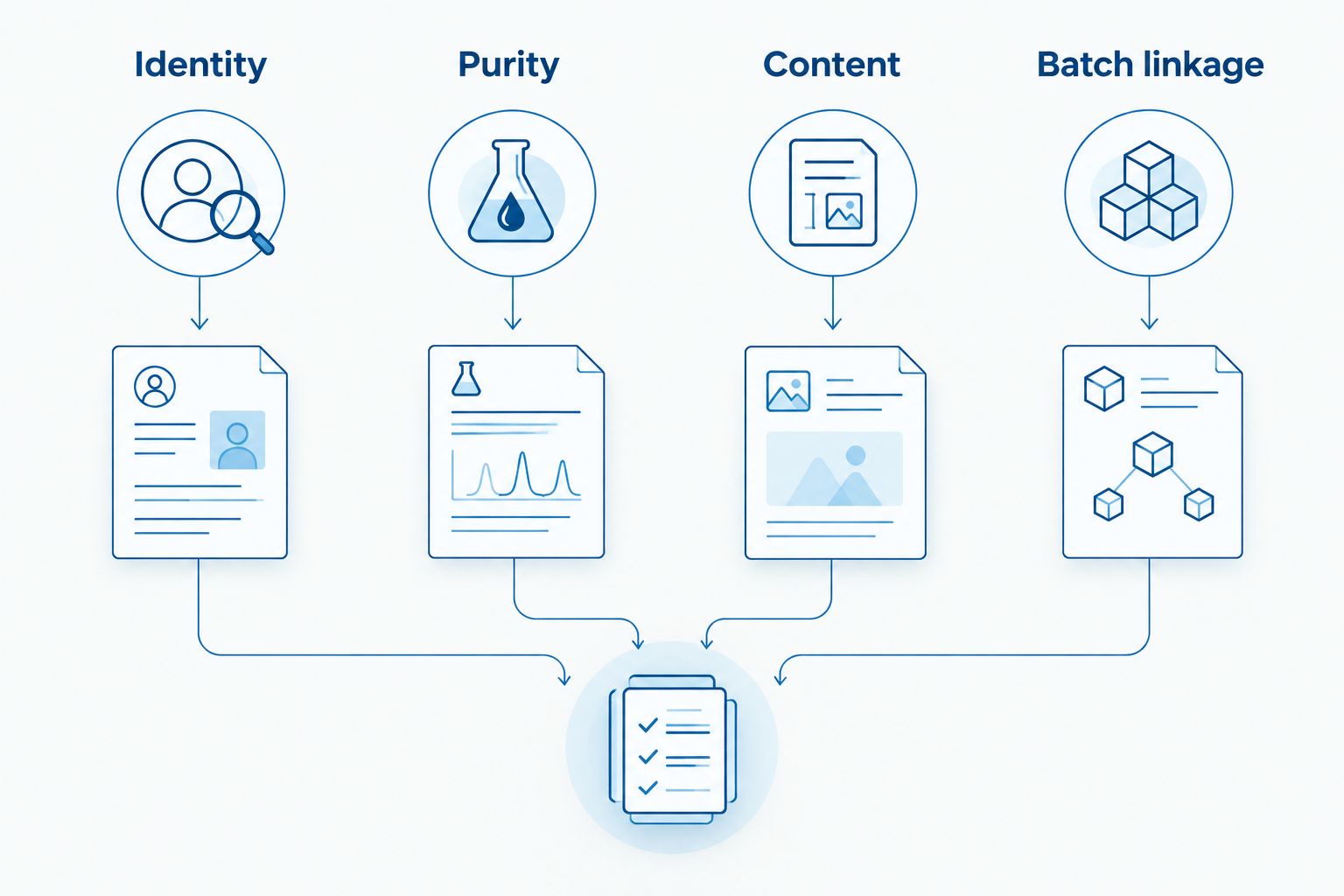
Use a document review to connect the research question to the material you will actually receive. Keep these checks distinct:
- Identity: Does the evidence support the stated compound or components?
- Purity: What did the analytical method separate and measure?
- Content: Does the report assess the amount of the intended compound, rather than only relative signal?
- Batch linkage: Does the document identify the same lot as the supplied material?
High-performance liquid chromatography, abbreviated HPLC, separates sample components under specified conditions. An HPLC area percentage describes relative detector response under that method; it does not automatically establish the mass fraction of peptide in the container.
Mass spectrometry, abbreviated MS, measures mass-to-charge ratios and can support identity assessment. A mass result alone does not establish every structural detail, purity, or biological activity.
Neither an identity result nor a chromatographic purity result establishes sterility or endotoxin status. Endotoxins are bacterial components relevant to some experimental systems; assess whether your protocol requires separate evidence rather than assuming another test covers them.
How the ranking works
The ranking prioritizes receptor fit, experimental attribution, and the distinction between an individual compound and a combined formulation. It does not rank suppliers, claim independent testing, or assign undocumented purity advantages to Anchorpeptide research peptides.
For this 2026 guide, Tirzepatide (30mg) takes the default dual-receptor slot, retatrutide takes the glucagon-inclusive slot, and Retatrutide & Cagrilintide (10mg/10mg) takes the combination slot. None wins every experiment.
Which research peptide should you choose?
Choose Tirzepatide (30mg) for a dual GIP/GLP-1 question, retatrutide for a glucagon-inclusive question, and the combined formulation only for a combination question. Make the target profile your first filter and the material’s documentation your procurement gate.
If your study requires selective GLP-1 receptor activation, none of these catalog descriptions establishes that selectivity. Do not force a multi-target compound into a single-target role without a design that resolves the distinction.
The strongest 2026 selection is the compound whose documented characteristics meet a predefined experimental need. A broader receptor profile cannot compensate for an undefined hypothesis.
FAQ
What are the best GLP-1 receptor agonist research peptides for laboratory studies?
The best choice depends on the receptor question: tirzepatide fits dual GIP/GLP-1 research, retatrutide includes glucagon-receptor activity, and retatrutide with cagrilintide fits combination research. Confirm product-specific analytical documentation before procurement.
Is tirzepatide better than retatrutide for GLP-1 research?
Tirzepatide is the closer fit when the intended comparison involves GIP and GLP-1 without adding glucagon-receptor activity. Retatrutide fits a different question because its stated target profile includes the glucagon receptor.
Are these selective GLP-1 receptor agonists?
No option in this comparison is described as selective for GLP-1 receptors. Tirzepatide has two stated receptor targets, retatrutide has three, and the combined formulation adds an amylin analogue.
Does a high HPLC purity result prove peptide identity?
No, an HPLC purity result alone does not prove peptide identity. Review the identity evidence and the analytical method separately; relative chromatographic signal also does not automatically establish peptide content by mass.
Does a Certificate of Analysis prove biological activity?
A Certificate of Analysis establishes only the results reported for the identified material and tests. Identity or purity testing alone does not establish biological activity in your experimental system.
Should a laboratory choose a blend or an individual compound?
Choose an individual compound when the study needs independent control of that compound; choose a combined formulation when the combination itself is the research question. Testing a blend alone cannot separate the contributions of its components.
Can these research peptides be used in people or animals?
These products are presented for laboratory and in-vitro research only, not human or veterinary use. This guide provides no dosing, administration, therapeutic, or personal-use recommendations.
One last thing
Write your acceptance criteria before reviewing the supplier’s result. Decide which identity evidence, analytical reporting, and lot linkage your study requires, then assess the material against those requirements rather than accepting whichever measurement appears most favorable.
Keep the analytical gate separate from the experimental gate. Material can meet a documented chemical specification without answering your biological question, and an interesting assay response does not repair an unresolved identity or composition question.
Related guides